Results by title
162 books match the query 'Comparative Politics' and 6 start with f

Famous but Misunderstood
Three Essays on Maurice Duverger’s Political ScienceMiroslav Novák
Karolinum Press, 2026
A major reassessment of the work of the canonical political theorist Maurice Duverger.
Widely cited but increasingly seldom read, Maurice Duverger (1917–2014) exemplifies the fate of many canonical thinkers in political science. Famous but Misunderstood revisits his legacy through a comprehensive analysis of three interconnected pillars of his work: the formulation of Duverger’s laws concerning the relationship between electoral systems and party systems; his typology of pluralist party systems; and his empirical theories of democracy. Duverger’s ideas are examined in close comparison with the later and highly influential contributions of Giovanni Sartori (1924–2017) and Arend Lijphart (*1936), highlighting both continuities and divergences.
Authored by political scientist Miroslav Novák, recipient of the 2024 Czech Political Science Association Award for his contribution to the development of Czech political science, the book persuasively argues that contemporary scholarship has significantly misunderstood Duverger’s work. In doing so, it calls for a reassessment not only of Duverger’s theories but also of prevailing narratives about the evolution of political science in the second half of the twentieth century.
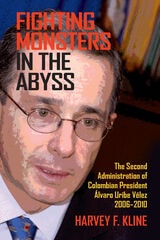
Fighting Monsters in the Abyss
The Second Administration of Colombian President Álvaro Uribe Vélez, 2006–2010Harvey F. Kline
University of Alabama Press, 2015
Studies the complex constraints and trade-offs the second administration of Colombian President Uribe (2006–2010) encountered as it attempted to resolve that nation’s violent Marxist insurrection and to have a more efficient judicial system
Fighting Monsters in the Abyss offers a deeply insightful analysis of the efforts by the second administration of Colombian President Álvaro Uribe Vélez (2006–2010) to resolve a decades-long Marxist insurgency in one of Latin America’s most important nations. Continuing work from his prior books about earlier Colombian presidents and yet written as a stand-alone study, Colombia expert Harvey F. Kline illuminates the surprising successes and setbacks in Uribe’s response to this existential threat.
In State Building and Conflict Resolution in Colombia, 1986–1994, Kline documented and explained the limited successes of Presidents Virgilio Barco and César Gaviria in putting down the revolutionaries while also confronting challenges from drug dealers and paramilitary groups. The following president Andrés Pastrana then boldly changed course and attempted resolution through negotiations, an effort whose failure Kline examines in Chronicle of a Failure Foretold. In his third book, Showing Teeth to the Dragons, Kline shows how in his first term President Álvaro Uribe Vélez more successfully quelled the insurrection through a combination of negotiated demobilization of paramilitary groups and using US backing to mount more effective military campaigns.
Kline opens Fighting Monsters in the Abyss with a recap of Colombia’s complex political history, the development of Marxist rebels and paramilitary groups and their respective relationships to the narcotics trade, and the attempts of successive Colombian presidents to resolve the crisis. Kline next examines the ability of the Colombian government to reimpose rule in rebel-controlled territories as well as the challenges of administering justice. He recounts the difficulties in the enforcement of the landmark Law of Justice and Peace as well as two significant government scandals, that of the “false positives” (“falsos positivos”) in which innocent civilians were killed by the military to inflate the body counts of dead insurgents and a second scandal related to illegal wiretapping.
In tracing Uribe’s choices, strategies, successes, and failures, Kline also uses the example of Colombia to explore a dimension quite unique in the literature about state building: what happens when some members of a government resort to breaking rules or betraying their societies’ values in well-intentioned efforts to build a stronger state?

Financing Local Government in Indonesia
Mis Sea#84Nick Devas
Ohio University Press, 1989
Not surprisingly in view of the country's great size, vast regional differences, and cultural diversity, local government in Indonesia is on a massive scale. The task of managing and financing a system of local government is a troublesome one; the development needs of different regions are vast and the tasks facing local government are generally far beyond their limited resources. It is the purpose of this book not only to describe the existing system of local government but also to analyze it, identify weaknesses and problems with the present arrangement, and to propose realistic lines of reform. This collection of essays will provide a useful and constructive contribution to the discussion of issues central to the system of local government in Indonesia.
Flying Against the Arrow
An Intellectual in Ceausescu's RomaniaHoria-Roman Patapievici
Central European University Press, 2003
The ‘unbearable 80s’, as the last decade of the Ceauşescu era has been called in Romania, are in the focus of this quasi-autobiographical work. The book vividly portrays the difficulties encountered by a young intellectual trying to shape himself under the oppressive regime and provides a stark depiction of a man’s intellectual suffocation under hard-line socialist rule.
Fragile Dreams
Tales of Liberalism and Power in Central EuropeJohn A. Gould
University of Michigan Press, 2021
In Fragile Dreams, John A. Gould examines Central European communism, why it failed, and what has come since. Moving loosely chronologically from 1989 to the present, each chapter focuses on topics of importance to the fields of comparative politics, sociology, and feminist and gender studies. He draws heavily from his own research and experience as well as case studies of the former Czechoslovakia, Western Balkans, and Hungary—but much of the analysis has general applicability to the broader postcommunist region.
Broad in its coverage, this academically rigorous book is ideal for students, travelers, and general readers. Gould writes in the first person and seamlessly blends theory with stories both from the existing literature and from 30 years of regional personal experience with family and friends. Throughout, Gould introduces key concepts, players, and events with precise definitions. Wherever possible, he emphasizes marginalized narratives, centering theory and stories that are often overlooked in standard comparative political science literature.

From East Germans to Germans?
The New Postcommunist ElitesJennifer A. Yoder
Duke University Press, 1999
Although the quick transplant of a ready-made democratic system supported by West German financial backing and expertise provided benefits, problems arose for the development of postcommunist political leadership and for the growth of mass support for the democratic system. Jennifer A. Yoder analyzes the implications of the transition process for democratic legitimation and integration. Based on field research in East Germany that included interviews with parliamentarians, her study addresses issues such as culture, identity, and the lack of continuity between the old and new political elites. Although the availability of West German role models, together with pressure to conform, allowed the process of decommunization to occur much faster than elsewhere in Eastern Europe, the cultural differences between east and west are more extensive and complex than previously assumed. Unification has also been followed by a reinvigoration of regional interests. Yoder shows how some political elites have adopted western German patterns, while others openly criticize many of the practices and policies originating in Bonn and present themselves as democratic alternatives and advocates for East German interests in the new Germany. Indeed, for many East Germans, these new regional elites are regarded as the only representatives of their interests in the western-dominated political system.
Providing insight into elite-building at a time of transition and a valuable alternative to the “institutions versus culture” debate found in traditional analyses of political change, this book will interest political scientists and students and scholars of European politics and German studies.