Results by title
77 books match the query 'Congress' and 3 start with f
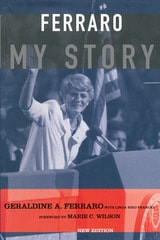
Ferraro
My StoryGeraldine Ferraro with Linda Bird Francke and with a foreword by Marie Wilson
Northwestern University Press, 2004
In this memoir, Geraldine A. Ferraro reflects on her experience as the first and only woman nominated by a major party to run on the presidential ticket. This book reveals the process that led to her nomination as the 1984 Democratic Vice-Presidential candidate and gives a revealing behind-the-scenes look at campaign politics, especially the ruthless criticism directed at her and her family. Ferraro brings to life the dynamics of the women in Congress and how the different life experiences that they bring to the table affect the policy making process. She also gives a real understanding of the pioneering women, including Bella Abzug, Gloria Steinem, Millie Jeffrey and many others who worked together to make sure that a women was on the Democratic ticket in 1984.
Ferraro's run for vice-president was an important moment in American history. The time is right for telling a new generation this story of women's collective political power and the difference women office holders can and do make to public policy.
Ferraro's run for vice-president was an important moment in American history. The time is right for telling a new generation this story of women's collective political power and the difference women office holders can and do make to public policy.
[more]
Foreign Policy and Congress
An International Relations PerspectiveMarie T. Henehan
University of Michigan Press, 2000
In the traditional view of foreign policy making in the United States, the President is considered the primary authority and Congress is seen as playing a subsidiary role. Marie T. Henehan looks at the effects of events in the international system on both the content of foreign policy and what actions Congress takes on foreign policy. Henehan argues that the only way to understand the way congressional behavior varies over time is by looking at the rise and resolution of critical issues in foreign policy, which in turn have their origin in the international system. When a critical foreign policy issue arises, congressional activity and attempts to influence foreign policy increase. Once the debate is resolved and one side wins, a consensus emerges and Congress settles into a more passive role. Using a data set consisting of all roll call votes on foreign policy issues taken by the Senate from 1897 to 1984 to generate indicators of Congressional behavior, together with the rise and fall of critical issues in international relations, Henehan is able to develop a more nuanced understanding of Congress's role in foreign policy making over time.
In recent years political scientists have begun to consider the impact of the international system on domestic policy. Part of the difficulty of some of this work, as well as work on Congress's role in foreign policy, is that it has been limited in terms of time and the number of events the analysis considered, depending on case studies. This book offers a systematic consideration of the effects of international events on domestic politics, crossing many different kinds of international activity, and provides a unique longitudinal view of Congressional action on foreign policy.
This book will be of interest to scholars of international relations, American foreign policy making, and Congress.
Marie T. Henehan is Assistant Professor of Political Science, Vanderbilt University.
[more]
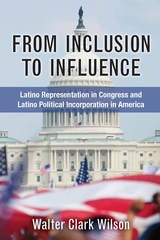
From Inclusion to Influence
Latino Representation in Congress and Latino Political Incorporation in AmericaWalter Clark Wilson
University of Michigan Press, 2017
In From Inclusion to Influence, Walter Wilson addresses urgent questions regarding the political incorporation of Latinos in America. First, he demonstrates that Latino representatives in the U.S. Congress do, in fact, represent Latino interests more effectively than do other representatives, both by serving as conduits connecting fellow Latinos to the government and by introducing their concerns into the legislative process. Then, moving beyond the debate about descriptive and substantive representation, Wilson identifies the ways in which the efforts of Latinos in Congress enable the meaningful inclusion of Latinos in politics, foster the ability of Latinos to shape public policy, and ultimately promote democracy in an increasingly diverse nation.
[more]