365 books match the query 'Correspondence' and 8 start with f
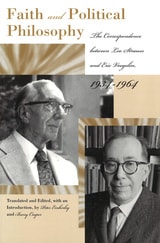
cover of Faith and Political Philosophy: The Correspondence Between Leo Strauss and Eric Voegelin, 1934-1964

Faith and Political Philosophy

The Correspondence Between Leo Strauss and Eric Voegelin, 1934-1964

Edited & Intro by Peter Emberley & Barry Cooper

University of Missouri Press, 2004

Faith and Political Philosophy consists of fifty-three letters between Leo Strauss and Eric Voegelin, two of the most important political theorists of the twentieth century. In this correspondence, Strauss and Voegelin explore the nature of their similarities and differences, offering insightful observations about one another's work, about the state of the discipline, and about the influences working on them. The letters shed light on many assumptions made in their published writings, often with an openness that removes all vestiges of uncertainty.
[more]
cover of Festal Letters 1-12

Festal Letters 1-12

St. Cyril of Alexandria

Catholic University of America Press, 2013
No description available
[more]
cover of Festal Letters 13-30

Festal Letters 13-30

St. Cyril of Alexandria

Catholic University of America Press, 2013

Twenty-nine in all, these letters cover all but three of Cyril's years as a bishop. The first twelve were published in 2009 (Fathers of the Church 118). The present volume completes the set. Festal letters were used in Alexandria primarily to announce the beginning of Lent and the date of Easter. They also served a catechetical purpose, however, allowing the Patriarch an annual opportunity to write pastorally not just about issues facing the entire see, but also about the theological issues of the day.
[more]
cover of Flying for the Air Service: The Hughes Brothers in World War I

Flying for the Air Service

The Hughes Brothers in World War I

David K. Vaughan

University of Wisconsin Press, 1998
Flying for the Air Service provides a realistic picture of the typical flying experiences of the pilots who flew for the fledgling American Air Service during World War I. The narrative describes two brothers from Boston, George and Gerard Hughes, as they progress from apprentice pilots to flight instructors and combat pilots. After completing their pilot training program together, both were assigned as instructors. Then George was sent to France with the 12th Aero Squadrom, where he flew two-place observation aircraft over the front lines. Gerard, meanwhile, remained in America, instructing students in Texas. Eventually Gerard joined his brother's squadron in France as the war ended. Through the detailed letters and narrative comments of these two pilots, we can see clearly the hazards and challenges that were faced by those who flew in the early years of American aviation.
[more]
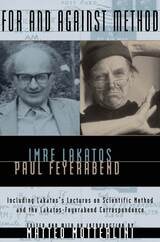
cover of For and Against Method: Including Lakatos's Lectures on Scientific Method and the Lakatos-Feyerabend Correspondence

For and Against Method

Including Lakatos's Lectures on Scientific Method and the Lakatos-Feyerabend Correspondence

Imre Lakatos and Paul Feyerabend

University of Chicago Press, 1999

The work that helped to determine Paul Feyerabend's fame and notoriety, Against Method, stemmed from Imre Lakatos's challenge: "In 1970 Imre cornered me at a party. 'Paul,' he said, 'you have such strange ideas. Why don't you write them down? I shall write a reply, we publish the whole thing and I promise you—we shall have a lot of fun.' " Although Lakatos died before he could write his reply, For and Against Method reconstructs his original counter-arguments from lectures and correspondence previously unpublished in English, allowing us to enjoy the "fun" two of this century's most eminent philosophers had, matching their wits and ideas on the subject of the scientific method.

For and Against Method opens with an imaginary dialogue between Lakatos and Feyerabend, which Matteo Motterlini has constructed, based on their published works, to synthesize their positions and arguments. Part one presents the transcripts of the last lectures on method that Lakatos delivered. Part two, Feyerabend's response, consists of a previously published essay on anarchism, which began the attack on Lakatos's position that Feyerabend later continued in Against Method. The third and longest section consists of the correspondence Lakatos and Feyerabend exchanged on method and many other issues and ideas, as well as the events of their daily lives, between 1968 and Lakatos's death in 1974.

The delight Lakatos and Feyerabend took in philosophical debate, and the relish with which they sparred, come to life again in For and Against Method, making it essential and lively reading for anyone interested in these two fascinating and controversial thinkers and their immense contributions to philosophy of science.

"The writings in this volume are of considerable intellectual importance, and will be of great interest to anyone concerned with the development of the philosophical views of Lakatos and Feyerabend, or indeed with the development of philosophy of science in general during this crucial period."—Donald Gillies, British Journal for the Philosophy of Science (on the Italian edition)

"A stimulating exchange of letters between two philosophical entertainers."—Tariq Ali, The Independent

Imre Lakatos (1922-1974) was professor of logic at the London School of Economics. He was the author of Proofs and Refutations and the two-volume Philosophical Papers. Paul Feyerabend (1924-1994) was educated in Europe and held numerous teaching posts throughout his career. Among his books are Against Method; Science in a Free Society; Farewell to Reason; and Killing Time: The Autobiography of Paul Feyerabend, the last published by the University of Chicago Press.
[more]
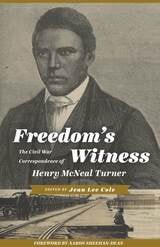
cover of Freedom's Witness: The Civil War Correspondence of Henry McNeal Turner

Freedom's Witness

The Civil War Correspondence of Henry McNeal Turner

Jean Lee Cole

West Virginia University Press, 2013
In a series of columns published in the African American newspaper The Christian Recorder, the young, charismatic preacher Henry McNeal Turner described his experience of the Civil War, first from the perspective of a civilian observer in Washington, D.C., and later, as one of the Union army’s first black chaplains.
 
In the halls of Congress, Turner witnessed the debates surrounding emancipation and black enlistment. As army chaplain, Turner dodged “grape” and cannon, comforted the sick and wounded, and settled disputes between white southerners and their former slaves. He was dismayed by the destruction left by Sherman’s army in the Carolinas, but buoyed by the bravery displayed by black soldiers in battle. After the war ended, he helped establish churches and schools for the freedmen, who previously had been prohibited from attending either.
 
Throughout his columns, Turner evinces his firm belief in the absolute equality of blacks with whites, and insists on civil rights for all black citizens. In vivid, detailed prose, laced with a combination of trenchant commentary and self-deprecating humor, Turner established himself as more than an observer: he became a distinctive and authoritative voice for the black community, and a leader in the African Methodist Episcopal church. After Reconstruction failed, Turner became disillusioned with the American dream and became a vocal advocate of black emigration to Africa, prefiguring black nationalists such as Marcus Garvey and Malcolm X. Here, however, we see Turner’s youthful exuberance and optimism, and his open-eyed wonder at the momentous changes taking place in American society.
 
Well-known in his day, Turner has been relegated to the fringes of African American history, in large part because neither his views nor the forms in which he expressed them were recognized by either the black or white elite. With an introduction by Jean Lee Cole and a foreword by Aaron Sheehan-Dean, Freedom’s Witness: The Civil War Correspondence of Henry McNeal Turner restores this important figure to the historical and literary record.

[more]
cover of Frenchman, Chaplain, Rebel: The Civil War Letters of Pere Louis-Hippoltye Gache, 10th Louisiana Infantry

Frenchman, Chaplain, Rebel

The Civil War Letters of Pere Louis-Hippoltye Gache, 10th Louisiana Infantry

Pere Louis-Hippolyte Gache, S.J.

University of Alabama Press, 2007

The American Civil War through the eyes of a French Jesuit chaplain.

"This book has a tantalizing quality, and it certainly is fresh literature for those who have watched the story of the Civil War unfold. . . . One cannot help but marvel at the research undertaken by Fr. Buckley. These letters of Fr. Gache cover such subjects as the duties of a chaplain, the lack of stimulating conversation in camp, whiskey as medication for diarrhea, the chaplain’s uniform, the oversupply of Catholic chaplains, descriptions of battles—Chancellorsville, Fredericksburg—chaplains as prisoners of war, the possibility of General Lee being chosen as the second president of the Confederacy, making candles for the alter and bleaching wax, procuring sacramental wine, conflicts with Protestant preachers, and the surrender of Richmond. Such subjects allow the personality and character of Hippolyte to stand out. . . . [The book] is interesting reading for all who love and admire the Jesuits. Its wealth of information makes it a must for others whose concern is the Confederate soldier and his God."

—Journal of Southern History
[more]
cover of From Vermont to Michigan: Correspondence of James Burrill Angell: 1869-1871

From Vermont to Michigan

Correspondence of James Burrill Angell: 1869-1871

Edited by Wilfred B. Shaw

University of Michigan Press, 1936

From Vermont to Michigan: Correspondence of James Burrill Angell 1869-1871 is a collection of letters edited by Wilfred B. Shaw and published by the University of Michigan Press in 1936. The book provides a detailed account of James Burrill Angell's decision-making process before accepting the presidency of the University of Michigan. It includes correspondence with various individuals, including insights from his son James Rowland Angell in a foreword, capturing Angell's qualities, the consideration of educational standards, and the influence of the New England perspective on the Western frontier. The letters reveal the intricate process and diverse opinions surrounding Angell's eventual acceptance, as well as the initial hesitations and the search for the right candidate. Illustrated and meticulously edited, this compilation serves as a significant historical document, shedding light on the educational landscape of the time and Angell's pivotal role in shaping the future of the University of Michigan.
[more]