Results by title
123 books match the query 'Courts' and 4 start with f
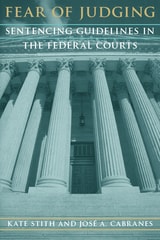
Fear of Judging
Sentencing Guidelines in the Federal CourtsKate Stith and José A. Cabranes
University of Chicago Press, 1998
For two centuries, federal judges exercised wide discretion in criminal sentencing. This changed in 1987, when a hopelessly complex bureaucratic apparatus was imposed on the federal courts. Though termed Sentencing "Guidelines," the new sentencing rules are mandatory. Reformers hoped that the Sentencing Guidelines would address inequities in sentencing. The Guidelines have failed to achieve this goal, according to Kate Stith and José Cabranes, and they have sacrificed comprehensibility and common sense.
Fear of Judging is the first full-scale history, analysis, and critique of the new sentencing regime. The authors show that the present system has burdened the courts, dehumanized the sentencing process, and, by repressing judicial discretion, eroded the constitutional balance of powers. Eschewing ideological or politically oriented critiques of the Guidelines and offering alternatives to the current system, Stith and Cabranes defend a vision of justice that requires judges to perform what has traditionally been considered their central task—exercising judgment.
Fear of Judging is the first full-scale history, analysis, and critique of the new sentencing regime. The authors show that the present system has burdened the courts, dehumanized the sentencing process, and, by repressing judicial discretion, eroded the constitutional balance of powers. Eschewing ideological or politically oriented critiques of the Guidelines and offering alternatives to the current system, Stith and Cabranes defend a vision of justice that requires judges to perform what has traditionally been considered their central task—exercising judgment.
[more]

Federal Courts in the International Human Rights Paradigm
Kenneth C. Randall
Duke University Press, 1990
[more]
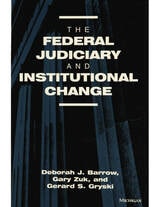
Federal Judiciary and Institutional Change
Deborah J. Barrow, Gary Zuk, and Gerard S. Gryski
University of Michigan Press, 1996
This work focuses on the staffing of the federal district and appellate courts from 1869-1992. Using a large data set that includes information on appointments and voluntary departures, the importance of government control (unified versus divided) to institutional change is showcased.The analysis is divided into three eras (1869-1932, 1933-68, and 1969-92), each of which was dominated by one of the two parties. The nature of partisan transformation of the judiciary in each era is examined, and comparisons across eras are made. The authors scrutinize the approaches of individual presidents to judicial staffing and describe the politics of bench expansion. In addition, they present an intriguing analysis of how judges contribute to change in the partisan complexion of the bench by timing retirements to favor their parties. The Federal Judiciary and Institutional Change is written in the theoretical tradition of neoinstitutionalism. The authors find that the nature of partisan transformation of the Third Branch is very much a function of changes in the institutional environment. This work will be of interest to judicial scholars, especially in political science, as well as legal historians and specialists in American politics drawn to the theme of the importance of unified government.
[more]
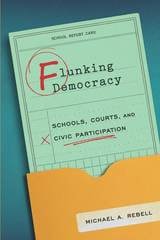
Flunking Democracy
Schools, Courts, and Civic ParticipationMichael A. Rebell
University of Chicago Press, 2018
The 2016 presidential election campaign and its aftermath have underscored worrisome trends in the present state of our democracy: the extreme polarization of the electorate, the dismissal of people with opposing views, and the widespread acceptance and circulation of one-sided and factually erroneous information. Only a small proportion of those who are eligible actually vote, and a declining number of citizens actively participate in local community activities.
In Flunking Democracy, Michael A. Rebell makes the case that this is not a recent problem, but rather that for generations now, America’s schools have systematically failed to prepare students to be capable citizens. Rebell analyzes the causes of this failure, provides a detailed analysis of what we know about how to prepare students for productive citizenship, and considers examples of best practices. Rebell further argues that this civic decline is also a legal failure—a gross violation of both federal and state constitutions that can only be addressed by the courts. Flunking Democracy concludes with specific recommendations for how the courts can and should address this deficiency, and is essential reading for anyone interested in education, the law, and democratic society.
In Flunking Democracy, Michael A. Rebell makes the case that this is not a recent problem, but rather that for generations now, America’s schools have systematically failed to prepare students to be capable citizens. Rebell analyzes the causes of this failure, provides a detailed analysis of what we know about how to prepare students for productive citizenship, and considers examples of best practices. Rebell further argues that this civic decline is also a legal failure—a gross violation of both federal and state constitutions that can only be addressed by the courts. Flunking Democracy concludes with specific recommendations for how the courts can and should address this deficiency, and is essential reading for anyone interested in education, the law, and democratic society.
[more]