Results by title
115 books match the query 'Criminal Law' and 3 start with f
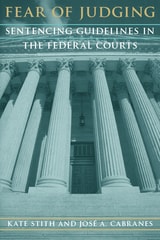
Fear of Judging
Sentencing Guidelines in the Federal CourtsKate Stith and José A. Cabranes
University of Chicago Press, 1998
For two centuries, federal judges exercised wide discretion in criminal sentencing. This changed in 1987, when a hopelessly complex bureaucratic apparatus was imposed on the federal courts. Though termed Sentencing "Guidelines," the new sentencing rules are mandatory. Reformers hoped that the Sentencing Guidelines would address inequities in sentencing. The Guidelines have failed to achieve this goal, according to Kate Stith and José Cabranes, and they have sacrificed comprehensibility and common sense.
Fear of Judging is the first full-scale history, analysis, and critique of the new sentencing regime. The authors show that the present system has burdened the courts, dehumanized the sentencing process, and, by repressing judicial discretion, eroded the constitutional balance of powers. Eschewing ideological or politically oriented critiques of the Guidelines and offering alternatives to the current system, Stith and Cabranes defend a vision of justice that requires judges to perform what has traditionally been considered their central task—exercising judgment.
Fear of Judging is the first full-scale history, analysis, and critique of the new sentencing regime. The authors show that the present system has burdened the courts, dehumanized the sentencing process, and, by repressing judicial discretion, eroded the constitutional balance of powers. Eschewing ideological or politically oriented critiques of the Guidelines and offering alternatives to the current system, Stith and Cabranes defend a vision of justice that requires judges to perform what has traditionally been considered their central task—exercising judgment.
[more]
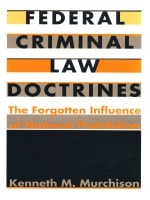
Federal Criminal Law Doctrines
The Forgotten Influence of National ProhibitionKenneth M. Murchison
Duke University Press, 1994
This book offers a close look at the development of legal thought during the era of prohibition and documents the impact of prohibition on law as an intellectual discipline. Kenneth M. Murchison examines changes in federal criminal law doctrines from 1918 to 1933 in light of recent historical scholarship on prohibition and its impact on American society. He identifies these federal doctrinal developments as an important but ignored legacy of prohibition and describes how these changes continue to effect contemporary law.
In this detailed examination, Murchison considers a portion of the Supreme Court’s work prior to the New Deal crisis, a period insufficiently considered until now. Among the developments he discusses are those relating to the defense of entrapment, the Fourth Amendment’s protection against unreasonable search and seizure, the Fifth Amendment’s prohibition against double jeopardy, property forfeitures, and the jury trial guarantees for criminal proceedings. His analysis reveals a court less rigid, less consistently divided along modern ideological lines, and more tolerant of governmental authority than traditional wisdom would suggest. Thus, Murchison offers a framework for a revisionist view of the Supreme Court’s activities during this period.
Exploring an important connection between the Eighteenth Amendment, the Volstead Act, and the development of federal criminal law, this book documents what was arguably the nation’s first criminal law revolution at the federal level. Explaining the modern origins of doctrines that still inform federal criminal law, Murchison also provides a case study of how legal doctrine responds to changing social conditions. Federal Criminal Law Doctrines will add immeasurably to the work of historians and legal scholars alike.
[more]
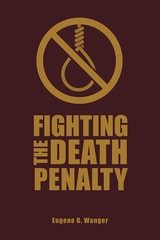
Fighting the Death Penalty
A Fifty-Year Journey of Argument and PersuasionEugene G. Wanger
Michigan State University Press, 2019
Michigan is the only state in the country that has a death penalty prohibition in its constitution—Eugene G. Wanger’s compelling arguments against capital punishment is a large reason it is there. The forty pieces in this volume are writings created or used by the author, who penned the prohibition clause, during his fifty years as a death penalty abolitionist. His extraordinary background in forensics, law, and political activity as constitutional convention delegate and co-chairman of the Michigan Committee Against Capital Punishment has produced a remarkable collection. It is not only a fifty-year history of the anti–death penalty argument in America, it also is a detailed and challenging example of how the argument against capital punishment may be successfully made.
[more]