Results by title
161 books match the query 'Cuba' and 7 start with f
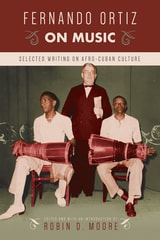
Fernando Ortiz on Music
Selected Writing on Afro-Cuban CultureRobin D. Moore
Temple University Press, 2018
Fernando Ortiz (1881–1969) is recognized as one of the most influential Latin American authors of the twentieth century. Although he helped establish the field of Afro-diasporic studies, his writings are still relatively unknown to the English-speaking world. In Fernando Ortiz on Music, accomplished ethnomusicologist Robin Moore has collected and translated an essential selection of Ortiz’s publications. These essays on Afro-Cuban expressive culture, music and dance are now available for the first time in English.
Ortiz’s writings are accompanied by an extended introduction that contextualizes the author’s life, intellectual influences, and collaborators as well as his fieldwork and interviews. Fernando Ortiz on Music also charts the writer’s changing views of black heritage through the years. This comprehensive anthology, which includes examples of his early scholarship as well as publications from the 1940s and ’50s, extends the life and legacy of this important and under-known scholar of Latin American and Caribbean music.
Contributors include: David Garcia, Sarah Lahasky, Cary Peñate, Susan Thomas, and the editor
Fidel between the Lines
Paranoia and Ambivalence in Late Socialist Cuban CinemaLaura-Zoë Humphreys
Duke University Press, 2019

Fidel's Ethics of Violence
The Moral Dimension of the Political Thought of Fidel CastroDayan Jayatilleka
Pluto Press, 2007
This book makes a timely intervention into the question of Castro's historical role and contribution. The author argues that Castro's doctrine of armed struggle is the logical development of his idea of the ethical liberation fighter. At its core is an unremitting emphasis on the ethical use of violence.
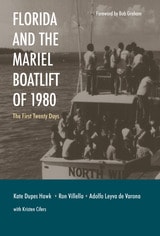
Florida and the Mariel Boatlift of 1980
The First Twenty DaysKate Dupes Hawk, Ron Villella, and Adolfo Leyva de Varona, with Kristen Cifers
University of Alabama Press, 2014
The 1980 Mariel Boatlift was a profound episode in twentieth-century American history, impacting not just Florida, but the entire country. During the first twenty days of the boatlift, with little support from the federal government, the state of Florida coordinated and responded to the sudden arrival in Key West of more than thirty thousand Cuban refugees, the first wave of immigrants who became known as “Marielitos.”
Kathleen Dupes Hawk, Ron Villella, Adolfo Leyva de Varona, and Kristen Cifers combine the insights of expert observers with the experiences of actual participants. The authors organize and present a wealth of primary sources, first-hand accounts, archival research, government records, and interviews with policy-makers, volunteers, and refugees that bring into focus the many far-reaching human, political, and cultural outcomes of the Mariel Boatlift that continue to influence Florida, the United States, and Cuba today.
Emerging from these key records and accounts is a grand narrative of high human drama. Castro’s haphazard and temporary opening of Cuba spurred many thousands of Cubans to depart in calamitously rushed, unprepared, and dangerous conditions. The book tells the stories of these Cuban citizens, most legitimately seeking political asylum but also including subversive agents, convicted criminals, and the mentally ill, who began arriving in the US beginning in April 1980. It also recounts how local and state agencies and private volunteers with few directives or resources were left to improvise ways to provide the Marielitos food, shelter, and security as well as transportation away from Key West.
The book provides a definitive account of the political, legal, and administrative twists on the local, state, and federal levels in response to the crisis as well as of the often-dysfunctional attempts at collaboration between governmental and private institutions. Vivid and readable, Florida and the Mariel Boatlift of 1980 presents the significant details that illuminate and humanize this complex humanitarian, political, and logistical crisis.
From Cuba, Volume 29
John Beverley, ed.
Duke University Press, 0
Featuring essays, poetry, art, performance texts, song lyrics, and writing from members of the generation of the Revolution to younger writers and artists of the nineties, this collection explores themes such as the crisis of the project of the Revolution in an era of the decline of socialism, the Cuban literary diaspora, resistance and freedom, and Cuban identity in the nineties. From Cuba expands upon and challenges the traditional ways in which scholars think about Cuba’s political past and future prospects.
Contributors. Carlos Aguilera, Haroldo Dilla Alfonso, Miguel Barnet, Tania Bruguera, Michael Chanan, Antonio Fernandez, Ambrosio Fornet, Tomas Gutierrez Alea, Fernando Martínez Heredia, Rafael Hernandez, Fina Garcia Marruz, Nancy Morejón, Geraredo Mosquera, Magaly Muguericia, Desiderio Navarro, Margarita Mateo Palmer, Omar Perez, Antonio José Ponte, Raúl Rivero, Reina Maria Rodriguez, José Prats Sariol, Cintio Vitier
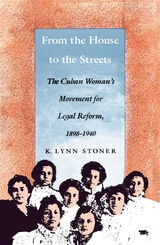
From the House to the Streets
The Cuban Woman's Movement for Legal Reform, 1898-1940K. Lynn Stoner
Duke University Press, 1991
Stoner draws on rich primary sources—texts, personal letters, journal essays, radio broadcasts, memoirs from women’s congresses—which allow these women to speak in their own voices. In reconstructing the mentalité of Cuban feminists, who came primarily from a privileged social status, Stoner shows how feminism drew from traditional notions of femininity and a rejection of gender equality to advance a cause that assumed women’s expanded roles were necessary for social progress. She also examines the values of the progressive male politicians who supported feminists and worked to change Cuban laws.
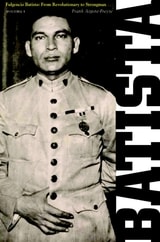
Fulgencio Batista
The Making of a DictatorArgote-Freyre, Frank
Rutgers University Press, 2000
Pawn of the U.S. government. Right-hand man to the mob. Iron-fisted dictator. For decades, public understanding of the pre-Revolutionary Cuban dictator Fulgencio Batista has been limited to these stereotypes. While on some level they all contain an element of truth, these superficial characterizations barely scratch the surface of the complex and compelling career of this important political figure.
Second only to Fidel Castro, Batista is the most controversial leader in modern Cuban history. And yet, until now, there has been no objective biography written about him. Existing biographical literature is predominantly polemical and either borders on hero worship or launches a series of attacks aimed at denigrating his entire legacy.
In this book, the first of two volumes, Frank Argote-Freyre provides a full and balanced portrait of this historically shadowed figure. He describes Batista's rise to power as part of a revolutionary movement and the intrigues and dangers that surrounded him. Drawing on an extensive review of Cuban newspapers, government records, memos, oral history interviews, and a selection of Batista's personal documents, Argote-Freyre moves beyond simplistic caricatures to uncover the real man-one with strengths and weaknesses and with a career marked by accomplishments as well as failures.
This volume focuses on Batista's role as a revolutionary leader from 1933 to 1934 and his image as a "strongman" in the years between 1934 and 1939. Argote-Freyre also uses Batista as an interpretive prism to review an entire era that is usually ignored by scholars-the Republican period of Cuban history. Bringing together global and local events, he considers the significance and relationship of the worldwide economic depression, the beginnings of World War II, and in Cuba, the Revolution of 1933, the expansion of the middle class, and the gradual development of democratic institutions.
Fulgencio Batista and most of Cuba's past prior to the Revolution of 1959 has been lost in the historical mists. Cuba had a rich and fascinating history before the Marxist Revolution and the reign of Fidel Castro. This captivating and long-overdue book uncovers it.