Results by title
176 books match the query 'Deaf' and 6 start with f
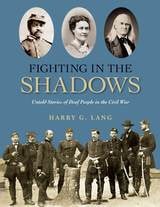
Fighting in the Shadows
Untold Stories of Deaf People in the Civil WarHarry G. Lang
Gallaudet University Press, 2017
Lang pieces together hundreds of stories, accompanied by numerous historical images, to reveal a powerful new perspective on the Civil War. These soldiers and civilians were not “disabled” by their deafness. On the contrary, despite the marginalization and paternalism they experienced in society, they were able to apply their skills and knowledge to support the causes in which they ardently believed.
Fighting in the Shadows is a story of how deaf civilians and soldiers put aside personal concerns about deafness, in spite of the discrimination they faced daily, in order to pursue a cause larger than themselves. Yet their stories have remained in the shadows, leaving most Americans, hearing and deaf, largely unaware of the deaf people who made significant contributions to the events that changed the course of our nation’s history. This book provides new insights into Deaf history as well as into mainstream interpretations of the Civil War.

Forbidden Signs
American Culture and the Campaign against Sign LanguageDouglas C. Baynton
University of Chicago Press, 1996
The ensuing debate over sign language invoked such fundamental questions as what distinguished Americans from non-Americans, civilized people from "savages," humans from animals, men from women, the natural from the unnatural, and the normal from the abnormal. An advocate of the return to sign language, Baynton found that although the grounds of the debate have shifted, educators still base decisions on many of the same metaphors and images that led to the misguided efforts to eradicate sign language.
"Baynton's brilliant and detailed history, Forbidden Signs, reminds us that debates over the use of dialects or languages are really the linguistic tip of a mostly submerged argument about power, social control, nationalism, who has the right to speak and who has the right to control modes of speech."—Lennard J. Davis, The Nation
"Forbidden Signs is replete with good things."—Hugh Kenner, New York Times Book Review

Forging Deaf Education in Nineteenth-Century France
Biographical Sketches of Bébian, Sicard, Massieu, and ClercFerdinand Berthier
Gallaudet University Press, 2009
In 1811, deaf student Ferdinand Berthier commenced his education at the National Institute for the Deaf in Paris under its director Abbé Sicard and his teachers Auguste Bébian, Jean Massieu, and Laurent Clerc. Their tutelage eventually led Berthier to join the faculty at the Institute and become a life-long proponent of sign language and Deaf culture. Berthier earned fame for instituting the famous silent banquets in Paris in 1834. He also learned to advance his agenda by writing biographies of important figures who advocated sign over oralism to educate deaf French students. Forging Deaf Education in Nineteenth-Century France offers the first translation of Berthier’s biographical sketches of the four men above who influenced him most.
Berthier wrote first about Bébian in 1839, timed to advocate sign language for teaching deaf students after the death of the pro-oralism Institute Director Désiré Ordinaire. Berthier extolled Bébian’s linguistic acumen and his educational philosophy. In later sketches, however, he described Sicard and Massieu in positive terms, but also criticized them for supporting “methodical” signing that conformed to spoken language conventions. In contrast, he lauded Clerc in his portrayal for using “natural” signing to teach deaf students. The clarity of these translations will introduce a brand new audience to Berthier’s biographies shaped by his unswerving beliefs about Deaf French education.

Four Days in Michigan
A NovelPhilip Zazove
Gallaudet University Press, 2012
As a young, deaf Jewish woman living in a small town in Michigan in 1942, Sandra Horowitz felt deeply frustrated by her limited prospects. Even though she had just graduated from junior college, she knew that she had two strikes against her in fulfilling her dream to become a veterinarian. Better to marry Jacob Winter, her parents urged her, a deaf Jewish man who made a good living. Then, Sandra met Rudy Townsend, a hearing soldier on leave before shipping out to the war in Europe.
In just four days, both Sandra and Rudy’s worlds were turned upside down. Sandra’s parents feared him for being hearing and a Gentile, while Rudy’s parents expressed openly their bias against her ethnic background and her deafness. Even so, Sandra and Rudy soon realized that they had fallen in love, deeply and passionately. As they shared the brief time they had together, they learned about each other’s dreams for the future — Sandra’s desire to be a vet and Rudy’s determination to serve in Congress. Then, Rudy had to leave for the war.
Philip Zazove’s novel Four Days in Michigan captures perfectly the power of irrepressible love between two individuals from opposite backgrounds. The struggles they encounter in an era when such differences were never more sharply drawn also reveal great detail about deaf and hearing life. Despite all, their triumph comes ultimately because of their long-lasting individual respect and love.
From Gesture to Language in Hearing and Deaf Children
Virginia Volterra
Gallaudet University Press, 1994
Renowned scholars contributing to this volume include Ursula Bellugi, Judy Snitzer Reilly, Susan Goldwin-Meadow, Andrew Lock, M. Chiara Levorato, and many others.
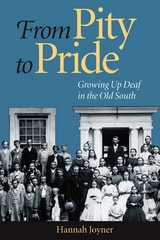
From Pity to Pride
Growing Up Deaf in the Old SouthHannah Joyner
Gallaudet University Press, 2004
The antebellum South’s economic dependence on slavery engendered a rigid social order in which a small number of privileged white men dominated African Americans, poor whites, women, and many people with disabilities. From Pity to Pride examines the experiences of a group of wealthy young men raised in the old South who also would have ruled over this closely regimented world had they not been deaf. Instead, the promise of status was gone, replaced by pity, as described by one deaf scion, “I sometimes fancy some people to treat me as they would a child to whom they were kind.”
In this unique and fascinating history, Hannah Joyner depicts in striking detail the circumstances of these so-called victims of a terrible “misfortune.” Joyner makes clear that Deaf people in the North also endured prejudice. She also explains how the cultural rhetoric of paternalism and dependency in the South codified a stringent system of oppression and hierarchy that left little room for self-determination for Deaf southerners. From Pity to Pride reveals how some of these elite Deaf people rejected their family’s and society’s belief that being deaf was a permanent liability. Rather, they viewed themselves as competent and complete. As they came to adulthood, they joined together with other Deaf Americans, both southern and northern, to form communities of understanding, self-worth, and independence.