114 books match the query 'Decision Making' and 3 start with f
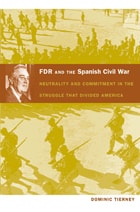
cover of FDR and the Spanish Civil War: Neutrality and Commitment in the Struggle that Divided America

FDR and the Spanish Civil War

Neutrality and Commitment in the Struggle that Divided America

Dominic Tierney

Duke University Press, 2007

What was the relationship between President Franklin D. Roosevelt, architect of America’s rise to global power, and the 1936–39 Spanish Civil War, which inspired passion and sacrifice, and shaped the road to world war? While many historians have portrayed the Spanish Civil War as one of Roosevelt’s most isolationist episodes, Dominic Tierney argues that it marked the president’s first attempt to challenge fascist aggression in Europe. Drawing on newly discovered archival documents, Tierney describes the evolution of Roosevelt’s thinking about the Spanish Civil War in relation to America’s broader geopolitical interests, as well as the fierce controversy in the United States over Spanish policy.

Between 1936 and 1939, Roosevelt’s perceptions of the Spanish Civil War were transformed. Initially indifferent toward which side won, FDR became an increasingly committed supporter of the leftist government. He believed that German and Italian intervention in Spain was part of a broader program of fascist aggression, and he worried that the Spanish Civil War would inspire fascist revolutions in Latin America. In response, Roosevelt tried to send food to Spain as well as illegal covert aid to the Spanish government, and to mediate a compromise solution to the civil war. However unsuccessful these initiatives proved in the end, they represented an important stage in Roosevelt’s emerging strategy to aid democracy in Europe.
[more]
cover of For the Sake of the Children: The Social Organization of Responsibility in the Hospital and the Home

For the Sake of the Children

The Social Organization of Responsibility in the Hospital and the Home

Carol A. Heimer and Lisa R. Staffen

University of Chicago Press, 1998

For the Sake of the Children examines the social organization of responsibility by asking who takes responsibility for critically ill newborns. Drawing on medical records and interviews with parents and medical staff, the authors take us into two neonatal intensive care units, showing us the traumas of extreme medical measures and the sufferings of infants. The accounts are by turns heroic and disturbing as we see people trying to take charge of these infants' care, thinking about long-term plans, redefining their roles as adults and parents, and coping with sometimes awful contingencies.

Rather than treating responsibility as an ethical issue, the authors focus on how responsibility is socially produced and sustained. The authors ask: How do staff members encourage parents to take responsibility, but keep them from interfering in medical matters, and how do parents encourage staff vigilance when they are novices attempting to supervise the experts?

The authors conclude that it is not sufficient simply to be responsible individuals. Instead, we must learn how to be responsible in an organizational world, and organizations must learn how to support responsible individuals.
[more]
cover of Foreign Policy and Congress: An International Relations Perspective

Foreign Policy and Congress

An International Relations Perspective

Marie T. Henehan

University of Michigan Press, 2000

In the traditional view of foreign policy making in the United States, the President is considered the primary authority and Congress is seen as playing a subsidiary role. Marie T. Henehan looks at the effects of events in the international system on both the content of foreign policy and what actions Congress takes on foreign policy. Henehan argues that the only way to understand the way congressional behavior varies over time is by looking at the rise and resolution of critical issues in foreign policy, which in turn have their origin in the international system. When a critical foreign policy issue arises, congressional activity and attempts to influence foreign policy increase. Once the debate is resolved and one side wins, a consensus emerges and Congress settles into a more passive role. Using a data set consisting of all roll call votes on foreign policy issues taken by the Senate from 1897 to 1984 to generate indicators of Congressional behavior, together with the rise and fall of critical issues in international relations, Henehan is able to develop a more nuanced understanding of Congress's role in foreign policy making over time.
In recent years political scientists have begun to consider the impact of the international system on domestic policy. Part of the difficulty of some of this work, as well as work on Congress's role in foreign policy, is that it has been limited in terms of time and the number of events the analysis considered, depending on case studies. This book offers a systematic consideration of the effects of international events on domestic politics, crossing many different kinds of international activity, and provides a unique longitudinal view of Congressional action on foreign policy.
This book will be of interest to scholars of international relations, American foreign policy making, and Congress.
Marie T. Henehan is Assistant Professor of Political Science, Vanderbilt University.
[more]