Results by title
281 books match the query 'Disease & Health Issues' and 15 start with f
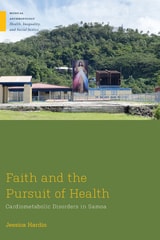
Faith and the Pursuit of Health
Cardiometabolic Disorders in SamoaHardin, Jessica
Rutgers University Press, 2019

Father Mathew's Crusade
Temperance in Nineteenth-Century Ireland and Irish AmericaJohn F. Quinn
University of Massachusetts Press, 2002
For centuries, the Irish have been famed, and often derided, for their attachment to alcohol. Yet in the 1830s and 1840s, Ireland became a temperance stronghold. The man almost singlehandedly responsible for this surprising transformation was Father Theobald Mathew (1790–1856), a popular Franciscan friar. Over a ten-year period, five million Irish men, women, and children took the pledge at his hands, while hundreds of public houses were forced to shut their doors or switch to selling coffee and tea.
By the end of the 1840s, however, Mathew's “miracle” was already coming undone. The Great Famine was ravaging Ireland and Mathew's years of nonstop campaigning had left him sick, exhausted, and bankrupt. Undeterred, he traveled to the United States in 1849 to generate support and administer the pledge to as many new immigrants as he could find. Failing health forced him to return to Ireland where he died in 1856, leaving behind a weak and fragmented movement.
In the late nineteenth century, several Irish priests revived Mathew's crusade. In the United States, Irish American bishops supported the Catholic Total Abstinence Union (CTAU) and joined hands with the Women's Christian Temperance Union in their war against liquor. In Ireland, Father James Cullen formed the Pioneers, a total abstinence association for devout Catholics. While the CTAU languished after the United States Congress passed the Prohibition Amendment in 1919, the Pioneers continued to thrive in Ireland into the 1960s. Although the group's membership has declined in recent years, there are still today a large number of Irish teetotalers.
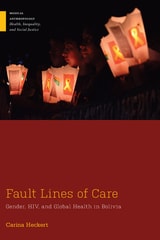
Fault Lines of Care
Gender, HIV, and Global Health in BoliviaHeckert, Carina
Rutgers University Press, 2018
The HIV epidemic in Bolivia has received little attention on a global scale in light of the country’s low HIV prevalence rate. However, by profiling the largest city in this land-locked Latin American country, Carina Heckert shows how global health-funded HIV care programs at times clash with local realities, which can have catastrophic effects for people living with HIV who must rely on global health resources to survive. These ethnographic insights, as a result, can be applied to AIDS programs across the globe.
In Fault Lines of Care, Heckert provides a detailed examination of the effects of global health and governmental policy decisions on the everyday lives of people living with HIV in Santa Cruz. She focuses on the gendered dynamics that play a role in the development and implementation of HIV care programs and shows how decisions made from above impact what happens on the ground.
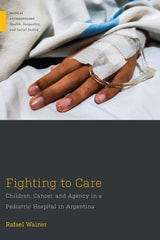
Fighting to Care
Children, Cancer, and Agency in a Pediatric Hospital in ArgentinaRafael E. Wainer
Rutgers University Press, 2027
Fighting to Care explores the lived experiences of children with pediatric blood cancer in Argentina, centering the struggles to care from the moment a child is labelled as experiencing "strangeness in the blood.” The book focuses on the notion of "permeable bodies" to understand children’s corporeal and subjective dynamic experience of cancer treatment and interpersonal care. Despite their vulnerability, throughout the course of demanding treatment, children display significant agency, actively navigating their medical journeys through various forms of communication and action. Fighting to Care also highlights the collective forms of care and the personal and interpersonal pain experienced by children, their families, and healthcare professionals in contexts of urgency and against health bureaucracies. In Argentina, caregiving, that is, fighting to care, is deeply intertwined with fighting for health rights within a public healthcare system that, while historically universal and free, is complex and impacted by recurring economic crises and social inequalities.
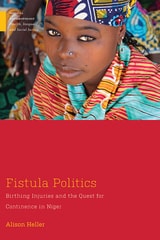
Fistula Politics
Birthing Injuries and the Quest for Continence in NigerHeller, Alison
Rutgers University Press, 2019
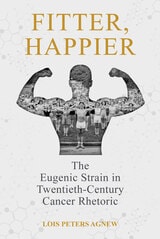
Fitter, Happier
The Eugenic Strain in Twentieth-Century Cancer RhetoricLois Peters Agnew
University of Alabama Press, 0
A critical investigation into how eugenic logics quietly animated twentieth‑century cancer rhetoric, reshaping cultural narratives of health, risk, and human worth.
Fitter, Happier: The Eugenic Strain in Twentieth-Century Cancer Rhetoric is a thought-provoking exploration of the relationship between cancer rhetoric, American ideals, and eugenic influences in the twentieth century. This groundbreaking work delves into the paradoxical interplay between acknowledging the genuine threat of cancer and the ingrained American ethos of confidence and control.
Agnew’s meticulous research traces the topic’s historical context, unveiling how cancer discourses evolved from a hushed personal concern to a public issue thanks to the rise of cancer research centers and advocacy organizations. However, she unearths a troubling dimension to these discussions—subtle yet persistent eugenic ideologies that taint cancer arguments and advocacy groups. By dissecting prevailing cancer narratives, Agnew brings into focus how ideals rooted in eliminating imperfections and embracing progress converge with concerns for safeguarding societal fitness.
Fitter, Happier scrutinizes the military origins and metaphors that permeate government policies and medical research, the transformation of cancer’s association with melancholy into a rallying cry for a positive outlook, and the nuanced implications of prevention-focused dialogues. Reflecting on the varied experiences of actual cancer patients, Agnew resists the neat assimilation of these stories into a eugenic framework. Agnew’s insights prompt readers to contemplate the societal meanings of disease and disability as well as how language constructs our shared reality.

Food for Thought
Understanding Older Food InsecurityColleen M. Heflin
Russell Sage Foundation, 2025
Through analysis of national data sets and interviews with lower income older adults, Heflin and Harrington Meyer describe why many older adults do not have enough money to afford food and other essentials. As a result of chronic economic disadvantage, food insecure older adults are often forced to make budget trade-offs between food and other expenses. In these trade-offs, food typically ranks below housing and energy costs and competes with other household bills, such as medical costs, transportation, and phone and internet coverage. While finances play a large role, nonfinancial factors, such as poor physical, cognitive, and mental health, access to healthy food, and transportation challenges, also contribute to food insecurity in old age. In the face of these difficulties, food insecure older adults may go hungry, skip meals, or eat unhealthy foods to help make ends meet.
While SNAP and community-based programs, such as food pantries and home delivered meals, are intended to help address the issue of food insecurity, they are typically inadequate to address the needs of food insecure older adults. SNAP has enrollment and maintenance procedures that are particularly difficult for older adults to navigate, pays out an insufficient amount of money to cover food costs, and varies greatly by state. Availability of community programs varies by municipality, often lacks nutritious foods that are complementary to health conditions common among older adults, and can be difficult to access due to a lack of reliable transportation, disability, or cost. Heflin and Harrington Meyer advocate for addressing all the issues that increase older adults’ risk of food insecurity, not just financial barriers. They suggest updating food insecurity screening tools to include these factors, increasing SNAP benefits and income support for older adults, and other policies to help combat food insecurity in older adults.
Food for Thought highlights the increasingly important issue of food insecurity in old age and lays bare the overlooked challenges faced by food insecure older adults.

For Love or Money
Care Provision in the United StatesNancy Folbre
Russell Sage Foundation, 2013
For the Public Good
Women, Health, and Equity in Rural IndiaPatricia Antoniello
Vanderbilt University Press, 2020
In one generation, village health workers have progressed from child brides and sequestered wives to knowledgeable health practitioners, valued teachers, and community leaders. Through collective efforts, CRHP has reduced infant and maternal mortality, eliminated some endemic health problems, and advanced economic well-being in villages with women's cooperative lending groups.
This book describes how the recognition and elimination of embedded inequalities—in this case caste discrimination, gender subordination, and class injustice—promote health and well-being and collaboratively establish the public good.

Forget Burial
HIV Kinship, Disability, and Queer/Trans Narratives of CareMarty Fink
Rutgers University Press, 2021
Queers and trans people in the 1980s and early ‘90s were dying of AIDS and the government failed to care. Lovers, strangers, artists, and community activists came together take care of each other in the face of state violence. In revisiting these histories alongside ongoing queer and trans movements, this book uncovers how early HIV care-giving narratives actually shape how we continue to understand our genders and our disabilities. The queer and trans care-giving kinships that formed in response to HIV continue to inspire how we have sex and build chosen families in the present. In unearthing HIV community newsletters, media, zines, porn, literature, and even vampires, Forget Burial bridges early HIV care-giving activisms with contemporary disability movements. In refusing to bury the legacies of long-term survivors and of those we have lost, this book brings early HIV kinships together with ongoing movements for queer and trans body self-determination.
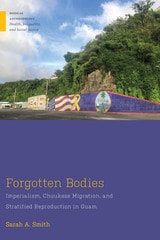
Forgotten Bodies
Imperialism, Chuukese Migration, and Stratified Reproduction in GuamSarah A. Smith
Rutgers University Press, 2024
Framing Disease
Studies in Cultural HistoryRosenberg, Charles E
Rutgers University Press, 1992
"In some ways disease does not exist until we have agreed that it does, by perceiving, naming, and responding to it, " writes Charles E. Rosenberg in his introduction to this stimulating set of essays. Disease is both a biological event and a social phenomenon. Patient, doctor, family, and social institutions—including employers, government, and insurance companies—all find ways to frame the biological event in terms that make sense to them and serve their own ends.
Many diseases discussed here—endstage renal disease, rheumatic fever, parasitic infectious diseases, coronary thrombosis—came to be defined, redefined, and renamed over the course of several centuries. As these essays show, the concept of disease has also been used to frame culturally resonant behaviors: suicide, homosexuality, anorexia nervosa, chronic fatigue syndrome. Disease is also framed by public policy, as the cases of industrial disability and of forensic psychiatry demonstrate. Medical institutions, as managers of people with disease, come to have vested interests in diagnoses, as the histories of facilities to treat tuberculosis or epilepsy reveal. Ultimately, the existence and conquest of disease serves to frame a society's sense of its own "healthiness" and to give direction to social reforms.
The contributors include Steven J. Peitzman, Peter C. English, John Farley, Christopher Lawrence, Michael MacDonald, Bert Hansen, Joan Jacobs Brumberg, Robert A. Aronowitz, Gerald Markowitz, David Rosner, Janet A. Tighe, Barbara Bates, Ellen Dwyer, John M. Eyler, and Elizabeth Fee. For any student of disease and society, this book is essential, compelling reading.
From Crisis to Catastrophe
Care, COVID, and Pathways to ChangeMignon Duffy
Rutgers University Press, 2023
From Residency to Retirement
Physicians' Careers over a Professional LifetimeTerry Mizrahi
Rutgers University Press, 2021
Mizrahi observed and interviewed these physicians in six timeframes ending in 2016. Beginning with medical school in the mid-1970s, these physicians reveal the myriad fluctuations and uncertainties in their professional practice, working conditions, collegial relationships, and patient interactions. In their own words, they provide a “view from the front lines” both in academic and community settings. They disclose the satisfactions and strains in coping with macro policies enacted by government and insurance companies over their career trajectory.
They describe their residency in internal medicine in a large southern urban medical center as a “siege mentality” which lessened as they began their careers, in Getting Rid of Patients, the title of Mizrahi’s first book (1986). As these doctors moved on in their professional lives more of their experiences were discussed in terms of dissatisfaction with financial remuneration, emotional gratification, and intellectual fulfillment. Such moments of career frustration, however, were also interspersed with moments of satisfaction at different stages of their medical careers. Particularly revealing was whether they were optimistic about the future at each stage of their career and whether they would recommend a medical career to their children. Mizrahi's subjects also divulge their private feelings of disillusionment and fear of failure given the malpractice epidemic and lawsuits threatened or actually brought against so many doctors. Mizrahi’s work, covering almost fifty years, provides rarely viewed insights into the lives of physicians over a professional life span.

From Skepticism to Competence
How American Psychiatrists Learn PsychotherapyMariana Craciun
University of Chicago Press, 2024
While many medical professionals can physically examine the body to identify and understand its troubles—a cardiologist can take a scan of the heart, an endocrinologist can measure hormone levels, an oncologist can locate a tumor—psychiatrists have a much harder time unlocking the inner workings of the brain or its metaphysical counterpart, the mind.
In From Skepticism to Competence, sociologist Mariana Craciun delves into the radical uncertainty of psychiatric work by following medical residents in the field as they learn about psychotherapeutic methods. Most are skeptical at the start. While they are well equipped to treat brain diseases through prescription drugs, they must set their expectations aside and learn how to navigate their patients’ minds. Their instructors, experienced psychotherapists, help the budding psychiatrists navigate this new professional terrain by revealing the inner workings of talk and behavioral interventions and stressing their utility in a world dominated by pharmaceutical treatments. In the process, the residents examine their own doctoring assumptions and develop new competencies in psychotherapy. Exploring the world of contemporary psychiatric training, Craciun illuminates novice physicians’ struggles to understand the nature and meaning of mental illness and, with it, their own growing medical expertise.