Results by title
2728 books match the query 'Education' and 80 start with f
Facing the Center
Toward an Identity Politics of One-to-One MentoringHarry C. Denny
Utah State University Press, 2010
The face of the writing center, be it mainstream or marginal, majority or miority, orthodox or subversive, always has implications for teaching and learning. Facing the Center will extend current research in writing center theory to bring it in touch with theories now common in cultural studies curricula. Denny takes up issues of power, agency, language, and meaning, and pushes his readers to ask how they themselves, or the centers in which they work, might be perpetuating cultures that undermine inclusive, progressive education.
Faculties
A Dialogue on Inciting Constructive Change in Destructive TimesCathy N. Davidson and Jody Greene
Duke University Press, 2026
Faculty as Global Learners
Off-Campus Study at Liberal Arts CollegesJoan Gillespie
Lever Press, 2020
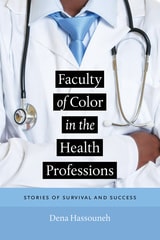
Faculty of Color in the Health Professions
Stories of Survival and SuccessDena Hassouneh
Dartmouth College Press, 2017
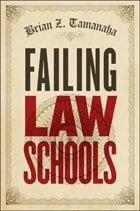
Failing Law Schools
Brian Z. Tamanaha
University of Chicago Press, 2012
On the surface, law schools today are thriving. Enrollments are on the rise, and their resources are often the envy of every other university department. Law professors are among the highest paid and play key roles as public intellectuals, advisers, and government officials. Yet behind the flourishing facade, law schools are failing abjectly. Recent front-page stories have detailed widespread dubious practices, including false reporting of LSAT and GPA scores, misleading placement reports, and the fundamental failure to prepare graduates to enter the profession.
Addressing all these problems and more in a ringing critique is renowned legal scholar Brian Z. Tamanaha. Piece by piece, Tamanaha lays out the how and why of the crisis and the likely consequences if the current trend continues. The out-of-pocket cost of obtaining a law degree at many schools now approaches $200,000. The average law school graduate’s debt is around $100,000—the highest it has ever been—while the legal job market is the worst in decades, with the scarce jobs offering starting salaries well below what is needed to handle such a debt load. At the heart of the problem, Tamanaha argues, are the economic demands and competitive pressures on law schools—driven by competition over U.S. News and World Report ranking. When paired with a lack of regulatory oversight, the work environment of professors, the limited information available to prospective students, and loan-based tuition financing, the result is a system that is fundamentally unsustainable.
Growing concern with the crisis in legal education has led to high-profile coverage in the Wall Street Journal and the New York Times, and many observers expect it soon will be the focus of congressional scrutiny. Bringing to the table his years of experience from within the legal academy, Tamanaha has provided the perfect resource for assessing what’s wrong with law schools and figuring out how to fix them.
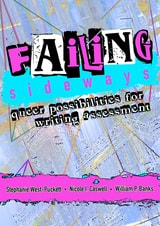
Failing Sideways
Queer Possibilities for Writing AssessmentStephanie West-Puckett
Utah State University Press, 2023
A failure-oriented assessment model unsettles some of the most common practices, like rubrics and portfolios, and challenges many deeply held assumptions about validity and reliability in order to ask what could happen if assessment was oriented toward possibility and potential. Working to engage a more capacious writing construct, the authors propose queer validity inquiry (QVI) as a model for assessment that values failure, affect, identity, and materiality. These overlapping lenses help teachers honor parts of writing and learning that writing studies faculty have struggled to hold onto in a world overly focused on quickness and efficiency in schools.
Through programmatic and classroom examples, Failing Sideways privileges what is valued in the classroom but traditionally ignored in assessments. Reimagining what matters in the teaching and learning of writing and using assessment data differently, this book demonstrates what writing can be and could do in a more diverse and just world.
Failing the Future
A Dean Looks at Higher Education in the Twenty-first CenturyAnnette Kolodny
Duke University Press, 1998
In this volume Kolodny explains the reasons for the financial crisis in higher education today and boldly addresses the challenges that remain ignored, including rising birthrates, changing demographics both on campus and across the country, the accelerating globalization of higher education and advanced research, and the necessity for greater interdisciplinarity in undergraduate education. Moreover, while sensitive to the complex burdens placed on faculty today, Kolodny nonetheless reveals how the professoriate has allowed itself to become vulnerable to public misperceptions and to lampooning by the media.
Not simply a book about current problems and future challenges, Failing the Future is rich with practical solutions and workable programs for change. Among her many insights, Kolodny offers a thorough defense of the role of tenure and outlines a new set of procedures to ensure its effective implementation; she proposes a structure for an “Antifeminist Intellectual Harassment Policy”; and she provides a checklist of family-sensitive policies universities can offer their staff, faculty, and administrators. Kolodny calls on union leaders, campus communities, policymakers, and the general public to work together in unprecedented partnerships. Her goal, as she states in a closing coda, is to initiate a revitalized conversation about public education.
This book should be required reading for all those concerned with the future of higher education in this country—from college trustees to graduate students entering the professoriate, from faculty to university administrators, from officers of campus-based unions to education policymakers.
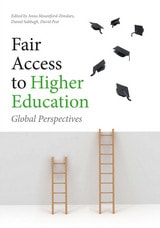
Fair Access to Higher Education
Global PerspectivesEdited by Anna Mountford-Zimdars, Daniel Sabbagh, and David Post
University of Chicago Press, 2014
Fair Access to Higher Education addresses this challenge from a broad, transnational perspective. The chapters in this volume contribute to our thinking and reflection on policy developments and also offer new empirical findings about patterns of advantage and disadvantage in higher education access. Bringing together insights drawn from a variety of fields, including philosophy, linguistics, social psychology, sociology, and public policy, the book sheds light on how “fairness” in university admissions has been articulated worldwide.
Faith and the Historian
CATHOLIC PERSPECTIVESEdited by Nick Salvatore
University of Illinois Press, 2006
Faith and the Historian collects essays from eight experienced historians discussing the impact of being "touched" by Catholicism on their vision of history. That first graduate seminar, these essays suggest, did not mark the inception of one's historical sensibilities; rather, that process had deeper, and earlier, roots. The authors--ranging from "cradle to the grave" Catholics to those who haven’t practiced for forty years, and everywhere in between--explicitly investigate the interplay between their personal lives and beliefs and the sources of their professional work. A variety of heartfelt, illuminating, and sometimes humorous experiences emerge from these stories of intelligent people coming to terms with their Catholic backgrounds as they mature and enter the academy. Contributors include: Philip Gleason, David Emmons, Maureen Fitzgerald, Joseph A. McCartin, Mario T. Garcia, Nick Salvatore, James R. Barrett, and Anne M. Butler.
Faithful Efforts
Education, Formation and the ChurchBram de Muynck,
Central European University Press, 2026

Faithful Efforts
Education, Formation and the ChurchBram de Muynck,
Central European University Press, 2026
Families for Mobility
Elite Korean Students Abroad and Their Parents' Reproduction of PrivilegeJuyeon Park
Rutgers University Press, 2025
Family Life and School Achievement
Why Poor Black Children Succeed or FailReginald M. Clark
University of Chicago Press, 1984
To support his contentions, Clark offers ten intimate portraits of Black families in Chicago. Visiting the homes of poor one- and two-parent families of high and low achievers, Clark made detailed observations on the quality of home life, noting how family habits and interactions affect school success and what characteristics of family life provide children with "school survival skills," a complex of behaviors, attitudes, and knowledge that are the essential elements in academic success.
Clark's conclusions lead to exciting implications for educational policy. If school achievement is not dependent on family structure or income, parents can learn to inculcate school survival skills in their children. Clark offers specific suggestions and strategies for use by teachers, parents, school administrators, and social service policy makers, but his work will also find an audience in urban anthropology, family studies, and Black studies.
Fandom as Classroom Practice
A Teaching GuideKatherine Anderson Howell
University of Iowa Press, 2018
Providing ways to engage students through their popular culture interests, this collection brings together several essays, across disciplines, to show how fan practices such as writing fan fiction, creating vids, communicating via Tumblr, and participating in film tourism can invite students to invest more of themselves into their education.
Both scholarship and fandom encourage passionate engagement with texts—rather than passive consumption in isolation— and editor Katherine Anderson Howell and her contributors find that when students are encouraged to partake in a remix classroom that encourages their fan interests, they participate more in their education, are more critical of experts and authorities, and actively shape the discourse themselves. Creating this remix classroom requires thoughtfulness on the instructor’s part, and so the chapters in this volume come from teachers who have carefully constructed such courses, including several invaluable appendices that provide examples of methodologies, course assignments, teaching practices, and classroom setup. Each chapter also includes student responses that offer a sense of what students gained from each course.
The result is an exciting and entertaining new way to motivate students and teachers alike, and it is sure to be a popular reference guide for instructors teaching classes from high school to graduate levels.
Fantastic Antone Succeeds
Experiences in Educating Children with Fetal Alcohol SyndromeJudith Kleinfeld
University of Alaska Press, 1993
The book consists of separate chapters written in a popular and accessible style by psychologists, teachers, and birth and adoptive parents of alcohol-affected children. Many chapters are personal stories with emotional power. A birth mother, for example, tells of her anguish when she realizes that she has recovered from her own alcoholism but her daughter cannot. This mother describes how she dealt with her grief, how she told her daughter the truth, her daughter's relief at finally understanding what was wrong, and how they both developed ways of overcoming her daughter's learning problems.
Other chapters describe how experienced teachers have learned to organize classrooms where alcohol-affected children can thrive and how therapists have learned to work with parents. One chapter summarizes medical knowledge of FAS/FAE and offers information useful for understanding a child's learning and behavioral problems and devising educational approaches. The book includes lists of important resources, organizations to contact, and descriptions of effective classroom practices for teachers.
Without minimizing the seriousness of FAS/FAE and the first priority prevention, Fantastic Antone Succeeds provides practical tools and strategies that can help alcohol-affected individuals and their families lead happier, more productive lives.

Far Away from the Tigers
A Year in the Classroom with Internationally Adopted ChildrenJane Katch
University of Chicago Press, 2011
Over the past three decades, more than a quarter of a million children have become citizens of the United States through international adoption. Kindergarten teacher Jane Katch recently found herself with three such children in her class: Katya, born in Russia, Jasper, from Cambodia, and Caleb, from Romania. Each child had spent early years in an orphanage, and each had unique educational and emotional needs. How Katch came to recognize and respond to those needs makes up the journey of discovery in this moving and insightful book.
Interspersing vignettes from the classroom and conversations with the children’s parents, Far Away from the Tigers first explores Katch’s misunderstandings and mistakes as she struggles to help the children adjust to school. As Katch learns more about each child’s preadoption past, she gradually realizes that they were deprived of some basic learning experiences and she needs to find ways to fill those gaps. Before Caleb can learn to read or write, he must improve his verbal skills by learning nursery rhymes, stories, and songs. Katya, who came from an overcrowded orphanage, now needs to be the center of attention; before learning how to form real friendships, she first must gain control over more basic functions such as eating and sleeping. And the youngest, Jasper, needs steady encouragement to play with classmates instead of sitting alone practicing his handwriting.
Slowly, through trial and error and by drawing on the deep understanding and intense commitment of the children’s parents, Katch discovers the importance—and joy—of allowing each child time to develop in his or her own way. Beautifully told, wise, and candid, Far Away from the Tigers is a gift for parents, teachers, and anyone who cares for children growing up in a new home.

Fear Of Math
How to Get Over It and Get on With Your Life!Zaslavsky, Claudia
Rutgers University Press, 1994
Claudia Zaslavsky has helped thousands of men and women understand why math made them miserable. Let her introduce you to real people who, like you, fled from anything to do with math. All of them--White, African American, Asian American, Latino, artist, homemaker, manager, teacher, teenager, or grandparent--came to see that their math troubles were not their fault. Social stereotypes, poor schools, and well-meaning parents had convinced them that they couldnÕt, or shouldnÕt, do math.
Claudia Zaslavsky shows you how the school math you dreaded is a far cry from the math you really need in life (and probably know better than you ever suspected)! She gives a host of reassuring methods, drawn from many cultures, for tackling real-world math problems. She explodes the myth that women and minorities are not good at math. With Claudia Zaslavsky’s help, you can see why math matters and how to get over the math barrier that has been holding you back from your goals in life.

Feeding the Future
School Lunch Programs as Global Social PolicyRutledge, Jennifer Geist
Rutgers University Press, 2016
Feltness
Research-Creation, Socially Engaged Art, and Affective PedagogiesStephanie Springgay
Duke University Press, 2022
Feminist Digital Humanities
Intersections in PracticeEdited by Lisa Marie Rhody and Susan Schreibman
University of Illinois Press, 2025
The editors divide the works into three categories. In the first section, contributors offer readings that demonstrate how feminist thought can be put into operation through digital practice or via analytical approaches, methodologies, and interpretations. A second section structured around infrastructure considers how technologies of knowledge creation, publication, access, and sharing can be formed or reformed through feminist values. The final section focuses on pedagogies and proposes feminist strategies for preparing students to become critical and confident readers with and against technologies.
Aimed at readers in and out of the classroom, Feminist Digital Humanities reveals the many ways scholars have pushed beyond critique to practice digital humanities in new ways.
Contributors: Daniela Agostinho, Monika Barget, Jenny Bergenmar, Susan Brown, Tanya E Clement, Katrine Dirckinck-Holmfeld, Jaime Lee Kirtz, Cecilia Lindhé, Laura Mandell, Lisa Marie Rhody, Mark Sample, Susan Schreibman, Andie Silva, Nikki L. Stevens, Ravynn K. Stringfield, Dhanashree Thorat, Nanna Bonde Thylstrup, Kristin Veel, Astrid von Rosen, and Jacqueline Wernimont
Feminist Rhetorical Practices
New Horizons for Rhetoric, Composition, and Literacy StudiesJacqueline Jones Royster and Gesa E. Kirsch
Southern Illinois University Press, 2012
To contextualize a new and changed landscape for narratives in the history of rhetoric, Royster and Kirsch present four critical terms of engagement—critical imagination, strategic contemplation, social circulation, and globalization—as the foundation for a new analytical model for understanding, interpreting, and evaluating feminist rhetorical inquiry and the study and teaching of rhetoric in general. This model draws directly on the wealth of knowledge and understanding gained from feminist rhetorical practices, especially sensitivity toward meaningfully and respectfully rendering the work, lives, cultures, and traditions of historical and contemporary women in rhetorical scholarship.
Proposing ambitious new standards for viewing and valuing excellence in feminist rhetorical practice, Royster and Kirsch advocate an ethos of respect and humility in the analysis of communities and specific rhetorical performances neglected in rhetorical history, recasting rhetorical studies as a global phenomenon rather than a western one. They also reflect on their own personal and professional development as researchers as they highlight innovative feminist research over the past thirty years to articulate how feminist work is changing the field and pointing to the active participation of women in various discourse arenas and to the practices and genres they use.
Valuable to new and established scholars of rhetoric, Feminist Rhetorical Practice: New Horizons for Rhetoric, Composition, and Literacy Studies is essential for understanding the theoretical, methodological, and ethical impacts of feminist rhetorical studies on the wider field.
Winner, 2014 Winifred Bryan Horner Outstanding Book Award

Ferment in Education
A Look AbroadEdited by John J. Lane
University of Chicago Press, 1995
The contributors chronicle the substantial growth and changing focus of comparative education, offer criticism of this type of research, and describe recent developments in education worldwide. Topics include a profile of the International Association for the Evaluation of Educational Achievement and a summary of the organization’s key findings; the impact of international agencies like the World Bank on the reconstruction of schooling in Africa; the effects of social upheaval on education in Russia; the expansion of secondary education and independent schools in the new Czech Republic; the removal of vestiges of Communism from civic education in Romania; new forms of teacher training in Israel and China; and reforms in the entrance examination process in Japan.
The contributors are scholars at universities in Australia, China, Europe, Israel, and the United States, a Romanian school inspector, and a research pyschologist from the United States.
Field Seasons
Reflections on Career Paths and Research in American ArchaeologyAnna Marie Prentiss
University of Utah Press, 2012
In Field Seasons, Anna Marie Prentiss chronicles her experiences as an archaeologist, providing an insider’s look at the diverse cultures, personal agendas, and career pathways associated with American archaeology since the late twentieth century. As the narrative moves from her academic training to employment in government and private consulting to her eventual professorship at a state university, several themes emerge.
This book is about career paths. Its discussion of the diverse jobs within the archaeological profession makes it valuable to students seeking guidance about their career options. It also provides insight into the cultures of American archaeology, a discipline with many schools of thought and unique subcultures. The world of archaeological field technicians is quite different from that of government bureaucrats or academics. Prentiss also explores the elements of cultural change within archaeology while she reflects on her personal evolution throughout her thirty years within the discipline.
The book’s unique personal assessment of the state of American archaeology will appeal to a broad swath of students and professionals. Students will find it an entertaining road map to possible careers while professionals will find plenty of scholarly material concerning ethics, archaeological theory, and interpretations of the archaeological record.

Fifty-Eight Lonely Men
Southern Federal Judges and School DesegregationJ. W. Peltason
University of Illinois Press, 1971
Fight the Tower
Asian American Women Scholars’ Resistance and Renewal in the AcademyKieu Linh Caroline Valverde
Rutgers University Press, 2020
However, change is in the air. Fight the Tower is a continuation of the Fight the Tower movement, which supports women standing up for their rights to claim their earned place in academia and to work for positive change for all within academic institutions. The essays provide powerful portraits, reflections, and analyses of a population often rendered invisible by the lies that sustain intersectional injustices in order to operate an oppressive system.
Financing Institutions of Higher Education
Edited by John Y. Campbell and Kaye Husbands Fealing
University of Chicago Press, 2026
An insightful, wide-ranging analysis of the economic hurdles facing America’s higher education system.
The US higher education sector faces numerous economic challenges, including the stagnating number of college-age domestic students, geographic mismatch between population growth and the location of colleges and universities, financial pressures, including cutbacks in government support, growing student debt burdens, sticker prices that deter prospective applicants, and the risk of low capital market returns on endowment portfolios. This volume analyzes the responses of students, families, and the financial managers of higher education institutions to these challenges. It presents new insights into the substantial disparities in the financial structure of, and the financial challenges facing, different types of institutions. The volume draws together contributions from financial economics, public finance, and industrial organization, as well as the economics of education.
Finding the Lost Year
What Happened When Little Rock Closed Its Public SchoolsSondra Gordy
University of Arkansas Press, 2009
Much has been written about the Little Rock School Crisis of 1957, but very little has been devoted to the following year—the Lost Year, 1958–59—when Little Rock schools were closed to all students, both black and white. Finding the Lost Year is the first book to look at the unresolved elements of the school desegregation crisis and how it turned into a community crisis, when policymakers thwarted desegregation and challenged the creation of a racially integrated community and when competing groups staked out agendas that set Arkansas’s capital on a path that has played out for the past fifty years.
In Little Rock in 1958, 3,665 students were locked out of a free public education. Teachers’ lives were disrupted, but students’ lives were even more confused. Some were able to attend schools outside the city, some left the state, some joined the military, some took correspondence courses, but fully 50 percent of the black students went without any schooling. Drawing on personal interviews with over sixty former teachers and students, black and white, Gordy details the long-term consequences for students affected by events and circumstances over which they had little control.
“Fifty years ago segregationists trying to keep black students out of Little Rock Central High inadvertently broke up one of the country’s greatest football dynasties. . . . Wait a minute. . . . Who said you can’t have a high school football team just because you don’t have a high school? Canceling football, Faubus decreed, would be ‘a cruel and unnecessary blow to the children.’ O.K. then, everyone agreed. Play ball!”
—“Blinded by History,” Sports Illustrated
First Day to Final Grade, Third Edition
A Graduate Student's Guide to TeachingAnne Curzan and Lisa Damour
University of Michigan Press, 2011
This new edition incorporates newer teaching and learning pedagogy. The book has been updated to reflect the role of technology both inside and outside the classroom. In addition, a new chapter has been added that discusses successfully transitioning from being a teaching assistant to being hired as a full-time instructor.

First Day to Final Grade
A Graduate Student's Guide to Teaching, Fourth EditionAnne Curzan, Lisa Damour, and Whitney Peoples
University of Michigan Press, 2027
Every year, tens of thousands of graduate students walk into a college classroom for the first time with deep subject-matter expertise but little or no formal preparation for teaching. First Day to Final Grade has guided those instructors through three successful editions, offering clear, honest, and immediately usable advice for every stage of a course—from writing a syllabus and preparing a first lecture to running discussions, grading fairly, and handling difficult moments in the classroom. This fourth edition brings that trusted guidance fully up to date with new material on creating classrooms where all students can succeed and teaching with today’s technology. Whether read cover to cover before a first assignment or consulted in the middle of a challenging semester, this book is the practical companion new college teachers need.
In this new edition of First Day to Final Grade, readers will find:
- Equity-focused and inclusive pedagogy woven throughout the text;
- New material on transparency as a core inclusive and equity-focused practice, including explicit attention to surfacing the “hidden curriculum” for first-generation students;
- Advice on AI and generative tools, including designing writing assignments that account for AI, and a section on academic integrity, plagiarism, and inappropriate use of generative AI;
- New syllabus guidance on contemporary classroom management issues, including students requesting to record class sessions;
- Updated and consolidated recommended readings that address AI in teaching, equity-based pedagogy, student belonging, student mental health, teaching writing, and teaching when English is not one’s first language;
- Prescriptive guidance that explains the reasoning behind specific recommendations to help readers understand how particular practices benefit the learning environment and the instructor-student relationship.
First Light
Encountering Edward Said and the Late-Style Jewish Prophetic in the New DiasporaMarc H. Ellis
Bridwell Press, 2023
Encountering Edward Said on Yom Kippur: Reflections on the Late-Style Jewish Prophetic is a fascinating and controversial collection of journals and meditations on the plight and possibility of the prophetic witness in the modern world. In these pages, the Jewish theologian, Marc H. Ellis, explores the prophetic through his encounters with the late Palestinian intellectual, Edward Said, as a way of thinking through the stakes of contemporary Jewish history. His unexpected encounter with Said on Yom Kippur provides a fascinating window to explore the dangers and possibilities of present-day Jewish life and its future. Ellis applies Said’s idea of late-style to the Jewish prophetic – what Ellis names the Late-Style Jewish Prophetic – to mean the reappearance and coming home of the Jewish prophetic as it undergoes its own deconstruction and re-emergence. At turns deeply personal and creatively theoretical, Ellis doesn’t shy away from the forbidden terrains of self questioning and progressive posturing, even with people and movements he identifies with. The result is a sensitive and provocative exploration filled with questions and responses rather than definitive answers.
First Person Squared
A Study of Co-Authoring in the AcademyKami Day & Michele Eodice
Utah State University Press, 2001
In (First Person)2, Day and Eodice offer one of the few book-length studies of co-authoring in academic fields since Lunsford and Ede published theirs over a decade ago. The central research here involves in-depth interviews with ten successful academic collaborators from a range of disciplines and settings. The interviews explore the narratives of these informants' experience—what brought them to collaborate, what cognitive and logistical processes were involved as they worked together, what is the status of collaborated work in their field, and so on—and situate these informants within the broader discussion of collaboration theory and research as it has been articulated over the last ten years.
As the study develops, Day and Eodice become most interested in the affective domain of co-authorship, and they find the most promising explorations of that domain in the work of feminist theorists in composition.
First Strike
Educational Enclosures in Black Los AngelesDamien M. Sojoyner
University of Minnesota Press, 2016
California is a state of immense contradictions. Home to colossal wealth and long portrayed as a bastion of opportunity, it also has one of the largest prison populations in the United States and consistently ranks on the bottom of education indexes. Taking a unique, multifaceted insider’s perspective, First Strike delves into the root causes of its ever-expansive prison system and disastrous educational policy.
Recentering analysis of Black masculinity beyond public rhetoric, First Strike critiques the trope of the “school-to-prison pipeline” and instead explores the realm of public school as a form of “enclosure” that has influenced the schooling (and denial of schooling) and imprisonment of Black people in California. Through a fascinating ethnography of a public school in Los Angeles County, and a “day in the life tour” of the effect of prisons on the education of Black youth, Damien M. Sojoyner looks at the contestation over education in the Black community from Reconstruction to the civil rights and Black liberation movements of the past three decades.
Policy makers, school districts, and local governments have long known that there is a relationship between high incarceration rates and school failure. First Strike is the first book that demonstrates why that connection exists and shows how school districts, cities and states have been complicit and can reverse a disturbing and needless trend. Rather than rely upon state-sponsored ideological or policy-driven models that do nothing more than to maintain structures of hierarchal domination, it allows us to resituate our framework of understanding and begin looking for solutions in spaces that are readily available and are immersed in radically democratic social visions of the future.

First Time Up
An Insider'S Guide For New Composition TeachersBrock Dethier
Utah State University Press, 2005
"First time up?"—an insider’s friendly question from 1960s counter-culture—perfectly captures the spirit of this book. A short, supportive, practical guide for the first-time college composition instructor, the book is upbeat, wise but friendly, casual but knowledgeable (like the voice that may have introduced you to certain other firsts). With an experiential focus rather than a theoretical one, First Time Up will be a strong addition to the newcomer’s professional library, and a great candidate for the TA practicum reading list.
Dethier, author of The Composition Instructor’s Survival Guide and From Dylan to Donne, directly addresses the common headaches, nightmares, and epiphanies of composition teaching—especially the ones that face the new teacher. And since legions of new college composition teachers are either graduate instructors (TAs) or adjuncts without a formal background in composition studies, he assumes these folks as his primary audience.
Dethier’s voice is casual, but it conveys concern, humor, experience, and reassurance to the first-timer. He addresses all major areas that graduate instructors or new adjuncts in a writing program are sure to face, from career anxiety to thoughts on grading and keeping good classroom records. Dethier’s own eclecticism is well-represented here, but he reviews with considerable deftness the value of contemporary scholarship to first-time writing instructors—many of whom will be impatient with high theory. Throughout the work, he affirms a humane, confident approach to teaching, along with a true affection for college students and for teachers just learning to deal with them.
First-Generation Faculty of Color
Reflections on Research, Teaching, and ServiceTracy Lachica Buenavista
Rutgers University Press, 2023
Firsts Abroad
First-Generation Students' Journeys Outward and UpwardJeremy Townley
Rutgers University Press, 2026
Across the country, flagship universities and liberal arts colleges, regional state campuses and Ivy League institutions continue to adapt to a globalized economy. One key internationalization strategy is study abroad. But who gets to have an overseas experience? In Firsts Abroad, Jeremy Townley explores the stories of first-generation college students who participated in study abroad. Because of their multicultural, multilingual backgrounds, nontraditional paths to and through college, and hard-won life experiences, first-generation students possess knowledge, skills, and savvy developed in their families that help them take advantage of their time overseas. While abroad, these students also experience significant gains in social networks and cultural knowledge, as well as important transformations in worldview, that allow for the possibility of upward social mobility. This powerfully argued book reveals that study abroad, so important in a globalized world, may be most essential for students historically underserved by higher education.
Flipping the Classroom
What Every ESL Teacher Should KnowRobyn Brinks Lockwood
University of Michigan Press, 2018
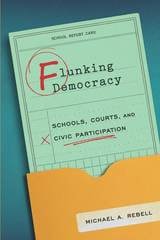
Flunking Democracy
Schools, Courts, and Civic ParticipationMichael A. Rebell
University of Chicago Press, 2018
In Flunking Democracy, Michael A. Rebell makes the case that this is not a recent problem, but rather that for generations now, America’s schools have systematically failed to prepare students to be capable citizens. Rebell analyzes the causes of this failure, provides a detailed analysis of what we know about how to prepare students for productive citizenship, and considers examples of best practices. Rebell further argues that this civic decline is also a legal failure—a gross violation of both federal and state constitutions that can only be addressed by the courts. Flunking Democracy concludes with specific recommendations for how the courts can and should address this deficiency, and is essential reading for anyone interested in education, the law, and democratic society.
Focus on Teaching
Edited by Walter Doyle and Thomas L. Good
University of Chicago Press, 1982
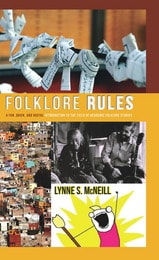
Folklore Rules
A Fun, Quick, and Useful Introduction to the Field of Academic Folklore StudiesS.
Utah State University Press, 2013
- What Is Folklore?
- What Do Folklorists Do
- Types of Folklore
- Types of Folk Groups;
- What Do I Do Now?
These chapters guide students toward a working understanding of the field, learn basic terms and techniques, and learn to perceive the knowledge base and discourse frame for materials used in folklore courses. Folklore Rules has become a classic text, serving instructors and students for a variety of courses, including introductory folklore and comparative studies as well as literature, anthropology, and composition classes that include a folklore component.
Following the Elephant
Ethnomusicologists Contemplate Their DisciplineEdited by Bruno Nettl: A collection of articles from Ethnomusicology
University of Illinois Press, 2017
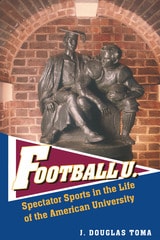
Football U.
Spectator Sports in the Life of the American UniversityJ. Douglas Toma
University of Michigan Press, 2003
The Big Ten . . . the SEC . . . the Final Four . . . sometimes it seems that American higher education is more about sports than studies. Not so, says this well-researched, evenhanded study of athletics in university life. Sports--particularly football--play a key role in defining institutions that might otherwise be indistinguishable and are an indispensable tool in building a sense of community on campus, as well as an important factor in mustering alumni and political support. While abuses exist, the "football school" is not only a legitimate member of the academic community but an inevitable one as well--and football provides much-needed identity at every level from the local to the national scale. Pointing out that universities compete as much academically as athletically, J. Douglas Toma argues that fielding a winning sports team is a quick, effective way to win recognition and that doing so pays dividends across the board, by raising public awareness (thereby making a school more attractive to potential students and faculty) and by creating a wider constituency of "fans" whose loyalties pay off in increased contributions and appropriations that support academic programs as well. He notes that universities like Harvard and Yale, now eclipsed on the gridiron, were "football powers" in the era when America's westward expansion spawned new schools unable to challenge older institutions academically but able to win acclaim through sports. This fosters a campus and alumni culture based on "football Saturday"--a bonding experience that helped forge a larger community whose support, both personal and financial, has become integral to the life of the institution. Football U. brings welcome impartiality to a subject all too often riven by controversy, pitting football boosters against critics who complain that academic achievement takes second place to athletic success. But as a tool for creating "brand awareness" as well as local loyalty and widespread support, high-profile athletic programs meet a variety of institutional needs in ways no other aspect of university life can. This, Toma observes, is a two-edged sword, for even as it fosters collegiality, it discourages reform when the pendulum swings too far in the direction of athletic dominance. Nevertheless, Football U. is here to stay.

For Faith and Fortune
The Education of Catholic Immigrants in Detroit, 1805-1925JoEllen McNergney Vinyard
University of Illinois Press, 1998
JoEllen McNergney Vinyard's comprehensive examination of parochial education in Detroit within the broader context of that city's urbanization patterns yields a richly detailed addition to our understanding of the European immigrant experience.
For Faith and Fortune will be of interest to historians and scholars of urban studies, particularly immigration, schooling, and the Catholic experience.

For the Children?
Protecting Innocence in a Carceral StateErica R. Meiners
University of Minnesota Press, 2016
“Childhood has never been available to all.” In her opening chapter of For the Children?, Erica R. Meiners stakes the claim that childhood is a racial category often unavailable to communities of color. According to Meiners, this is glaringly evident in the U.S. criminal justice system, where the differentiation between child and adult often equates to access to stark disparities. And what is constructed as child protection often does not benefit many young people or their communities. Placing the child at the heart of the targeted criminalization debate, For the Children? considers how perceptions of innocence, the safe child, and the future operate in service of the prison industrial complex.
The United States has the largest prison population in the world, with incarceration and policing being key economic tools to maintain white supremacist ideologies. Meiners examines the school-to-prison pipeline and the broader prison industrial complex in the United States, arguing that unpacking child protection is vital to reducing the nation’s reliance on its criminal justice system as well as building authentic modes of public safety. Rethinking the meanings and beliefs attached to the child represent a significant and intimate thread of the work to dismantle facets of the U.S. carceral state.
Taking an interdisciplinary approach and building from a scholarly and activist platform, For the Children? engages fresh questions in the struggle to build sustainable and flourishing worlds without prisons.
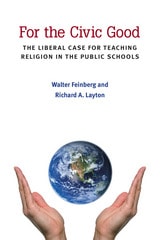
For the Civic Good
The Liberal Case for Teaching Religion in the Public SchoolsWalter Feinberg and Richard A. Layton
University of Michigan Press, 2014
Why teach about religion in public schools? What educational value can such courses potentially have for students?
In For the Civic Good, Walter Feinberg and Richard A. Layton offer an argument for the contribution of Bible and world religion electives. The authors argue that such courses can, if taught properly, promote an essential aim of public education: the construction of a civic public, where strangers engage with one another in building a common future. The humanities serve to awaken students to the significance of interpretive and analytic skills, and religion and Bible courses have the potential to add a reflective element to these skills. In so doing, students awaken to the fact of their own interpretive framework and how it influences their understanding of texts and practices. The argument of the book is developed by reports on the authors’ field research, a two-year period in which they observed religion courses taught in various public high schools throughout the country, from the “Bible Belt” to the suburban parkway. They document the problems in teaching religion courses in an educationally appropriate way, but also illustrate the argument for a humanities-based approach to religion by providing real classroom models of religion courses that advance the skills critical to the development of a civic public.
For the Long Haul
An Activist Academic's MemoirIra Harkavy with John L. Puckett
Temple University Press, 2027
Ira Harkavy has spent his fifty-plus-year career at the University of Pennsylvania advocating for the democratization of teaching, research, and learning. Since 1992, he has been the Founding Director of the Netter Center for Community Partnerships, whose mission is to develop democratic, mutually beneficial partnerships between Penn and its local community of West Philadelphia.
For the Long Haul is a conversational memoir, moderated by Harkavy’s colleague John Puckett, that features social history and pragmatic arguments stressing the importance of education. The authors discuss Harkavy’s distinguished career and put his life’s work in local and historical context, including his engagement of diverse faculty, students, and staff to take his projects to the nation and the wider world.
Puckett traces Harkavy’s activist origins from his childhood in the Bronx through his undergraduate and graduate studies at Penn. As he developed university-assisted community schools, Harkavy encountered challenges such as the impact of racism and local communities’ distrust of universities. Those experiences show how his learning shaped his thinking about “participation, partnership, and producing change in the world.”
In this era where universities are under attack, For the Long Haul emphasizes Harkavy’s considerable achievements and the importance of higher education for democracy.
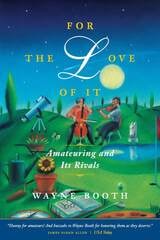
For the Love of It
Amateuring and Its RivalsWayne C. Booth
University of Chicago Press, 1999
"If, in truth, Booth is an amateur player now in his fifth decade of amateuring, he is certainly not an amateur thinker about music and culture. . . . Would that all of us who think and teach and care about music could be so practical and profound at the same time."—Peter Kountz, New York Times Book Review
"[T]his book serves as a running commentary on the nature and depth of this love, and all the connections it has formed in his life. . . . The music, he concludes, has become part of him, and that is worth the price."—Clea Simon, Boston Globe
"The book will be read with delight by every well-meaning amateur who has ever struggled. . . . Even general readers will come away with a valuable lesson for living: Never mind the outcome of a possibly vain pursuit; in the passion that is expended lies the glory."—John von Rhein, Chicago Tribune
"Hooray for amateurs! And huzzahs to Wayne Booth for honoring them as they deserve. For the Love of It celebrates amateurism with genial philosophizing and pointed cultural criticism, as well as with personal reminiscences and self-effacing wit."—James Sloan Allen, USA Today
"Wayne Booth, the prominent American literary critic, has written the only sustained study of the interior experience of musical amateurism in recent years, For the Love of It. [It] succeeds as a meditation on the tension between the centrality of music in Booth's life, both inner and social, and its marginality. . . . It causes the reader to acknowledge the heterogeneity of the pleasures involved in making music; the satisfaction in playing well, the pride one takes in learning a difficult piece or passage or technique, the buzz in one's fingertips and the sense of completeness with the bow when the turn is done just right, the pleasure of playing with others, the comfort of a shared society, the joy of not just hearing, but making, the music, the wonder at the notes lingering in the air."—Times Literary Supplement
For “Children Who Vary from the Normal Type”
Robert Osgood
Gallaudet University Press, 2000
For “Children Who Vary from the Normal Type” describes the growth of Boston and its educational system during this period, then examines closely the emergence of individual programs that catered to students formally identified as having special needs: intermediate schools and ungraded classes; three separate programs for students with children; special classes for mentally retarded children; and other programs established between 1908 and 1913. Osgood describes these programs and their relations with each other, and also the rationales offered for their establishment and support. This detailed examination graphically depicts how patterns of integration and segregation in special education shifted over time in Boston, and provides a foundation for continuing the present-day discussion of the politics and realities of inclusion.

Forever New
The Speeches of James Wright, President of Dartmouth College, 1998–2009James Wright
Dartmouth College Press, 2012
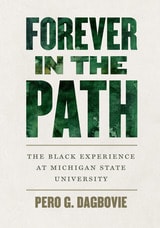
Forever in the Path
The Black Experience at Michigan State UniversityPero G Dagbovie
Michigan State University Press, 2025
Michigan State University—founded in 1855 as the Agricultural College of the State of Michigan—has a fascinating past, a history shaped by vacillating local and national contexts as well as by people from different walks of life. The first Black students arrived on campus during the late nineteenth and early twentieth centuries, and the first full-time Black faculty member was hired in the late 1940s. Before and after the modern Civil Rights Movement, African Americans from various backgrounds were transformed by MSU while also profoundly contributing in vital ways to the institution’s growth and evolving identity.

Forging Deaf Education in Nineteenth-Century France
Biographical Sketches of Bébian, Sicard, Massieu, and ClercFerdinand Berthier
Gallaudet University Press, 2009
In 1811, deaf student Ferdinand Berthier commenced his education at the National Institute for the Deaf in Paris under its director Abbé Sicard and his teachers Auguste Bébian, Jean Massieu, and Laurent Clerc. Their tutelage eventually led Berthier to join the faculty at the Institute and become a life-long proponent of sign language and Deaf culture. Berthier earned fame for instituting the famous silent banquets in Paris in 1834. He also learned to advance his agenda by writing biographies of important figures who advocated sign over oralism to educate deaf French students. Forging Deaf Education in Nineteenth-Century France offers the first translation of Berthier’s biographical sketches of the four men above who influenced him most.
Berthier wrote first about Bébian in 1839, timed to advocate sign language for teaching deaf students after the death of the pro-oralism Institute Director Désiré Ordinaire. Berthier extolled Bébian’s linguistic acumen and his educational philosophy. In later sketches, however, he described Sicard and Massieu in positive terms, but also criticized them for supporting “methodical” signing that conformed to spoken language conventions. In contrast, he lauded Clerc in his portrayal for using “natural” signing to teach deaf students. The clarity of these translations will introduce a brand new audience to Berthier’s biographies shaped by his unswerving beliefs about Deaf French education.