Results by title
130 books match the query 'Educators' and 7 start with f
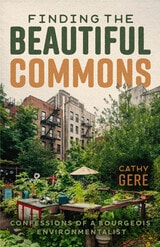
Finding the Beautiful Commons
Confessions of a Bourgeois EnvironmentalistCathy Gere
University of Chicago Press, 2027
A call to pleasurable and sustainable action that centers our shared stewardship of shared spaces.
Environmentally-conscious decision-making can seem like an exercise in self-denial: don’t fly, don’t drive, don’t eat meat. But bringing our tote bags to the grocery store will never be enough to solve the climate crisis, nor will dropping out of society. Many of us crave a collective movement that acknowledges the value of comfort, a framework for making choices that are inherently imperfect, but ones we can live with.
In Finding the Beautiful Commons, historian Cathy Gere offers a relatable and inspiring guide to environmental action in a consumerist culture. Recounting her experiences as a young activist at the Greenham Common Women’s Peace Camp in Berkshire, as an anarchist and guerrilla gardener in a New York City squat, and as an academic working to decarbonize the University of California system, Gere argues for initiatives grounded in common property—streets, libraries, parks, and other shared spaces—where our communal interests can drive sustainability. These are also sites where we can put bourgeois values like beauty and personal enjoyment to good use protecting local landscapes and resources.
Funny, wise, and honest about the contradictions of life during climate crisis, Gere shows us that the commons we already know—the everyday infrastructure of mass transit, natural reserves, and public beaches—is the very foundation for a livable future.
Fireweed
A Political AutobiographyGerda Lerner
Temple University Press, 2003
For Duty and Destiny
The Life and Civil War Diary of William Taylor Stott, Hoosier Soldier and EducatorLloyd A. Hunter
Indiana Historical Society Press, 2011
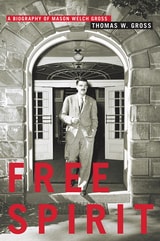
Free Spirit
A Biography of Mason Welch GrossThomas W. Gross
Rutgers University Press, 2022
Free Spirit explores how Gross helped reshape Rutgers from a sleepy college into a world-renowned public research university. It also reveals how he steered the university through the tumult of the Red Scare, civil rights era, and the Vietnam War by taking principled stands in favor of both racial equality and academic freedom. This biography tells the story of how, from an early age, Gross came to believe in the importance of doing what was right, even when the backlash took a toll on his own health.
Written by his youngest son Thomas, this book offers a uniquely well-rounded portrait of Gross as both a public figure and a private person. Covering everything from his service in World War II to his stints as a game-show personality, Free Spirit introduces the reader to a remarkable academic leader.
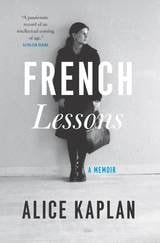
French Lessons
A MemoirAlice Kaplan
University of Chicago Press, 2018
The daughter of a Jewish lawyer who prosecuted Nazi war criminals at Nuremburg, Kaplan grew up in the 1960s in the Midwest. After her father's death when she was seven, French became her way of "leaving home" and finding herself in another language and culture. In spare, midwestern prose, by turns intimate and wry, Kaplan describes how, as a student in a Swiss boarding school and later in a junior year abroad in Bordeaux, she passionately sought the French "r," attentively honed her accent, and learned the idioms of her French lover.
When, as a graduate student, her passion for French culture turned to the elegance and sophistication of its intellectual life, she found herself drawn to the language and style of the novelist Louis-Ferdinand Celine. At the same time she was repulsed by his anti-Semitism. At Yale in the late 70s, during the heyday of deconstruction she chose to transgress its apolitical purity and work on a subject "that made history impossible to ignore:" French fascist intellectuals. Kaplan's discussion of the "de Man affair" — the discovery that her brilliant and charismatic Yale professor had written compromising articles for the pro-Nazi Belgian press—and her personal account of the paradoxes of deconstruction are among the most compelling available on this subject.
French Lessons belongs in the company of Sartre's Words and the memoirs of Nathalie Sarraute, Annie Ernaux, and Eva Hoffman. No book so engrossingly conveys both the excitement of learning and the moral dilemmas of the intellectual life.
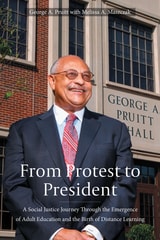
From Protest to President
A Social Justice Journey through the Emergence of Adult Education and the Birth of Distance LearningGeorge A Pruitt
Rutgers University Press, 2023
From barbershop encounters with Malcolm X to death threats at Illinois State University and gunfire at Towson State, Pruitt provides a powerful narrative poised at the intersection of social justice, higher education and politics. He recounts leadership experiences at HBCUs and public universities across the country, as he advocated for autonomy at Morgan State and fought to preserve Tennessee State University.
His steadfast activism, integrity and courage led to groundbreaking work in providing access to higher education for working adults and the military.
From his days as a student protester in high school and college to his appearances on Capitol Hill, Pruitt has earned the reputation as a candid and influential leader in higher education.
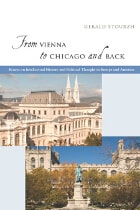
From Vienna to Chicago and Back
Essays on Intellectual History and Political Thought in Europe and AmericaGerald Stourzh
University of Chicago Press, 2007
Spanning both the history of the modern West and his own five-decade journey as a historian, Gerald Stourzh’s sweeping new essay collection covers the same breadth of topics that has characterized his career—from Benjamin Franklin to Gustav Mahler, from Alexis de Tocqueville to Charles Beard, from the notion of constitution in seventeenth-century England to the concept of neutrality in twentieth-century Austria.
This storied career brought him in the 1950s from the University of Vienna to the University of Chicago—of which he draws a brilliant picture—and later took him to Berlin and eventually back to Austria. One of the few prominent scholars equally at home with U.S. history and the history of central Europe, Stourzh has informed these geographically diverse experiences and subjects with the overarching themes of his scholarly achievement: the comparative study of liberal constitutionalism and the struggle for equal rights at the core of Western notions of free government. Composed between 1953 and 2005 and including a new autobiographical essay written especially for this volume, From Vienna to Chicago and Back will delight Stourzh fans, attract new admirers, and make an important contribution to transatlantic history.