Results by title
193 books match the query 'Empire' and 6 start with f
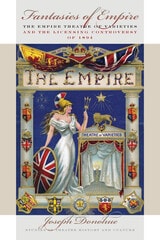
Fantasies of Empire
The Empire Theatre of Varieties and the Licensing Controversy of 1894Joseph Donohue
University of Iowa Press, 2005
In the London summer of 1894, members of the National Vigilance Society, led by the well-known social reformer Laura Ormiston Chant, confronted the Empire Theatre of Varieties, Leicester Square, and its brilliant manager George Edwardes as he applied for a routine license renewal. On grounds that the Empire’s promenade was the nightly resort of prostitutes, that the costumes in the theatre’s ballets were grossly indecent, and that the moral health of the nation was imperiled, Chant demanded that the London County Council either deny the theatre its license or require radical changes in the Empire’s entertainment and clientele before granting renewal. The resulting license restriction and the tremendous public controversy that ensued raised important issues—social, cultural, intellectual, and moral—still pertinent today.
Fantasies of Empire is the first book to recount in full the story of the Empire licensing controversy in all its captivating detail. Contemporaneous accounts are interwoven with Donohue’s identification and analysis of the larger issues raised: What the controversy reveals about contemporary sexual and social relations, what light it sheds on opposing views regarding the place of art and entertainment in modern society, and what it says about the pervasive effect of British imperialism on society’s behavior in the later years of Queen Victoria’s reign. Donohue connects the controversy to one of the most interesting developments in the history of modern theatre, the simultaneous emergence of a more sophisticated, varied, and moneyed audience and a municipal government insistent on its right to control and regulate that audience’s social and cultural character and even its moral behavior.
Rich in illustrations and entertainingly written, Fantasies of Empire will appeal to theatre, dance, and social historians and to students of popular entertainment, the Victorian period, urban studies, gender studies, leisure studies, and the social history of architecture.
[more]

Fiction, Crime, and Empire
CLUES TO MODERNITY AND POSTMODERNISMJon Thompson
University of Illinois Press, 1993
[more]
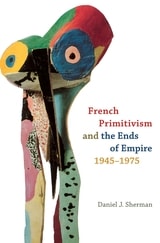
French Primitivism and the Ends of Empire, 1945-1975
Daniel J. Sherman
University of Chicago Press, 2011
For over a century, the idea of primitivism has motivated artistic modernism. Focusing on the three decades after World War II, known in France as “les trentes glorieuses” despite the loss of most of the country’s colonial empire, this probing and expansive book argues that primitivism played a key role in a French society marked by both economic growth and political turmoil.
In a series of chapters that consider significant aspects of French culture—including the creation of new museums of French folklore and of African and Oceanic arts and the development of tourism against the backdrop of nuclear testing in French Polynesia—Daniel J. Sherman shows how primitivism, a collective fantasy born of the colonial encounter, proved adaptable to a postcolonial, inward-looking age of mass consumption. Following the likes of Claude Lévi-Strauss, Andrée Putman, and Jean Dubuffet through decorating magazines, museum galleries, and Tahiti’s pristine lagoons, this interdisciplinary study provides a new perspective on primitivism as a cultural phenomenon and offers fresh insights into the eccentric edges of contemporary French history.
[more]
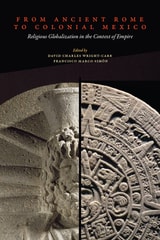
From Ancient Rome to Colonial Mexico
Religious Globalization in the Context of EmpireDavid Charles Wright-Carr
University Press of Colorado, 2023
From Ancient Rome to Colonial Mexico compares the Christianization of the Roman Empire with the evangelization of Mesoamerica, offering novel perspectives on the historical processes involved in the spread of Christianity. Combining concepts of empire and globalization with the notion of religion from a postcolonial perspective, the book proposes the method of analytical comparison as a point of departure to conceptualize historical affinities and differences between the ancient Roman Empire and colonial Mesoamerica.
An international team of specialists in classical scholarship and Mesoamerican studies engage in an interdisciplinary discussion involving ideas from history, anthropology, archaeology, art history, iconography, and philology. Key themes include the role of religion in processes of imperial domination; religion’s use as an instrument of resistance or the imposition, appropriation, incorporation, and adaptation of various elements of religious systems by hegemonic groups and subaltern peoples; the creative misunderstandings that can arise on the “middle ground”; and Christianity’s rejection of ritual violence and its use of this rejection as a pretext for inflicting other kinds of violence against peoples classified as “barbarian,” “pagan,” or “diabolical.”
From Ancient Rome to Colonial Mexico presents a sympathetic vantage point for discussing and attempting to decipher past processes of social communication in multicultural contexts of present-day realities. It will be significant for scholars and specialists in the history of religions, ethnohistory, classical antiquity, and Mesoamerican studies.
Publication supported, in part, by Spain’s Ministry of Economy and Competitiveness.
Contributors: Sergio Botta,Maria Celia Fontana Calvo, Martin Devecka, György Németh, Guilhem Olivier, Francisco Marco Simón, Paolo Taviani, Greg Woolf, David Charles Wright-Carr, Lorenzo Pérez Yarza
Translators: Emma Chesterman, Benjamin Adam Jerue, Layla Wright-Contreras
[more]
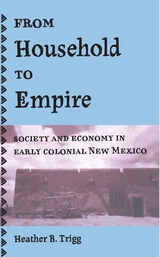
From Household to Empire
Society and Economy in Early Colonial New MexicoHeather B. Trigg
University of Arizona Press, 2005
Published in cooperation with the
William P. Clements Center for Southwest Studies, Southern Methodist University
Settlers at Santa Fe and outlying homesteads during the seventeenth century established a thriving economy that saw the exchange of commodities produced by indigenous peoples, settlers, and Franciscan friars for goods manufactured as far away as China, France, and Turkey. This early Spanish colonial period in New Mexico provides an opportunity to explore both economic activity within a colony and the relations between colony and homeland. By examining the material remains of this era from 1598 to 1680, Heather Trigg reveals a more complete picture of colonial life. Drawing on both archaeological and historical sources, Trigg analyzes the various levels of economic activity that developed: production of items in colonial households, exchanges between households, and trade between the colony and Mexico. Rather than focusing only on the flow of products and services, she also explores the social mechanisms that likely had a significant impact on the economic life of the colony. Because economic activity was important to so many aspects of daily life, she is able to show how and why colonial society worked the way it did. While focusing on the colonists, she also explores their relations with Pueblo peoples. Through her analysis of these two pools of data, Trigg generates insights not usually gleaned from the limited texts of the period, providing information about average colonists in addition to the governors and clergy usually covered in historical accounts. By using specific examples from historical documents and archaeological materials, she shows that colonists from all levels of society modified both formal and informal rules of economic behavior to better fit the reality of the colonial frontier. With its valuable comparative data on colonization, From Household to Empire provides a novel way of examining colonial economies by focusing on the maintenance and modification of social values. For all readers fascinated by the history of the Southwest, this book provides a fuller picture of life in early New Mexico than has previously been seen.
[more]
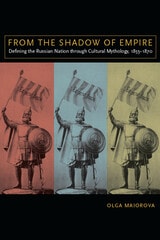
From the Shadow of Empire
Defining the Russian Nation through Cultural Mythology, 1855–1870Olga Maiorova
University of Wisconsin Press, 2010
As nationalism spread across nineteenth-century Europe, Russia’s national identity remained murky: there was no clear distinction between the Russian nation and the expanding multiethnic empire that called itself “Russian.” When Tsar Alexander II’s Great Reforms (1855–1870s) allowed some freedom for public debate, Russian nationalist intellectuals embarked on a major project—which they undertook in daily press, popular historiography, and works of fiction—of finding the Russian nation within the empire and rendering the empire in nationalistic terms.
From the Shadow of Empire traces how these nationalist writers refashioned key historical myths—the legend of the nation’s spiritual birth, the tale of the founding of Russia, stories of Cossack independence—to portray the Russian people as the ruling nationality, whose character would define the empire. In an effort to press the government to alter its traditional imperial policies, writers from across the political spectrum made the cult of military victories into the dominant form of national myth-making: in the absence of popular political participation, wars allowed for the people’s involvement in public affairs and conjured an image of unity between ruler and nation. With their increasing reliance on the war metaphor, Reform-era thinkers prepared the ground for the brutal Russification policies of the late nineteenth century and contributed to the aggressive character of twentieth-century Russian nationalism.
From the Shadow of Empire traces how these nationalist writers refashioned key historical myths—the legend of the nation’s spiritual birth, the tale of the founding of Russia, stories of Cossack independence—to portray the Russian people as the ruling nationality, whose character would define the empire. In an effort to press the government to alter its traditional imperial policies, writers from across the political spectrum made the cult of military victories into the dominant form of national myth-making: in the absence of popular political participation, wars allowed for the people’s involvement in public affairs and conjured an image of unity between ruler and nation. With their increasing reliance on the war metaphor, Reform-era thinkers prepared the ground for the brutal Russification policies of the late nineteenth century and contributed to the aggressive character of twentieth-century Russian nationalism.
[more]