615 books match the query 'England' and 24 start with f
cover of FEMINIST REALISM AT THE FIN DE SIÈCLE: The Influence of the Late-Victorian Woman’s Press on the Development of the Novel

FEMINIST REALISM AT THE FIN DE SIÈCLE

The Influence of the Late-Victorian Woman’s Press on the Development of the Novel

Molly Youngkin

The Ohio State University Press, 2007
Molly Youngkin takes on a major literary problem of the turn-of-the-century: Was the transition from the Victorian novel to the modern novel enabled by antirealist or realist narrative strategies? To answer this question, Youngkin analyzes book reviews that appeared in two prominent feminist periodicals circulated during the late-Victorian era—Shafts and The Woman’s Herald.
 
Through reviews of the works of important male and female authors of the decade—Thomas Hardy, Sarah Grand, George Gissing, Mona Caird, George Meredith, Ménie Dowie, George Moore, and Henrietta Stannard—these periodicals developed a feminist realist aesthetic that drew on three aspects of woman’s agency (consciousness, spoken word, and action) and emphasized corresponding narrative strategies (internal perspective, dialogue, and description of characters’ actions). Still, these periodicals privileged consciousness over spoken word and action and, by doing so, encouraged authors to push the boundaries of traditional realism and anticipate the modernist aesthetic.
 
By acknowledging the role of the woman’s press in the development of the novel, this book revises our understanding of the transition from Victorianism to modernism, which often is characterized as antirealist. Late-Victorian authors working within the realist tradition also contributed to this transition, particularly through their engagement with feminist realism. Youngkin deftly illustrates this transition and in so doing proves that it cannot be attributed to antirealist narrative strategies alone.
[more]
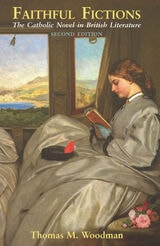
cover of Faithful Fictions: The Catholic Novel in British Literature

Faithful Fictions

The Catholic Novel in British Literature

Thomas M. Woodman

Catholic University of America Press, 2022

Catholic writers have made a rich contribution to British fiction, despite their minority status. Evelyn Waugh, Graham Greene, and Muriel Spark are well-known examples, but there are many other significant novelists whose work has a Catholic aspect. This is the first book to survey the whole range of this material and examine whether valid generalizations can be made about it. In charting such fiction from its development in the Victorian period through to the work of contemporaries such as David Lodge, the author analyses its complex relationships with changes in British society and the international Church. There is more than one way of being a Catholic, as Woodman shows, but he also demosntrates that many of these writers share common themes and a distinctive perspective. They often wish in particular to use their religion as a weapon against what they portray as a complacent Protestant or secular society. Their consciousness of writing in the midst of such a society gives a special edge to their treatments of the perennial Catholic themes of suffering, sin and sex. It also has implications for literary form and relates to what has been seen as the extremist mode of Catholic fiction. The final question that Woodman puts is whether the changes in the Church since the Second Vatican Council must inevitably lead to the loss of this distinctive Catholic contribution to the novel.
[more]
cover of Faithful Translators: Authorship, Gender, and Religion in Early Modern England

Faithful Translators

Authorship, Gender, and Religion in Early Modern England

Jaime Goodrich

Northwestern University Press, 2014
With Faithful Translators, Jaime Goodrich offers the first in-depth examination of women’s devotional translations and of religious translations in general within early modern England. Placing female translators such as Queen Elizabeth I and Mary Sidney Herbert, Countess of Pembroke, alongside their male counterparts, such as Sir Thomas More and Sir Philip Sidney, Goodrich argues that both male and female translators constructed authorial poses that allowed their works to serve four distinct cultural functions: creating privacy, spreading propaganda, providing counsel, and representing religious groups. Ultimately, Faithful Translators calls for a reconsideration of the apparent simplicity of "faithful" translations and aims to reconfigure perceptions of early modern authorship, translation, and women writers.
[more]
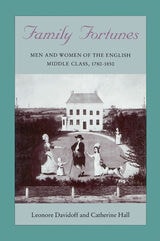
cover of Family Fortunes: Men and Women of the English Middle Class, 1780-1850

Family Fortunes

Men and Women of the English Middle Class, 1780-1850

Leonore Davidoff and Catherine Hall

University of Chicago Press, 1987

"Family Fortunes is a major groundbreaking study that will become a classic in its field. I was fascinated by the information it provided and the argument it established about the role of gender in the construction of middle-class values, family life, and property relations.

"The book explores how the middle class constructed its own institutions, material culture and values during the industrial revolution, looking at two settings—urban manufacturing Birmingham and rural Essex—both centers of active capitalist development. The use of sources is dazzling: family business records, architectural designs, diaries, wills and trusts, newspapers, prescriptive literature, sermons, manuscript census tracts, the papers of philanthropic societies, popular fiction, and poetry.

"Family Fortunes occupies a place beside Mary Ryan's The Cradle of the Middle Class and Suzanne Lebsock's Free Women of Petersburg. It provides scholars with a definitive study of the middle class in England, and facilitates a comparative perspective on the history of middle-class women, property, and the family."—Judith Walkowitz, Johns Hopkins University
[more]
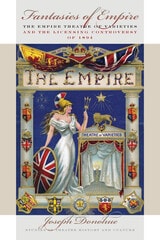
cover of Fantasies of Empire: The Empire Theatre of Varieties and the Licensing Controversy of 1894

Fantasies of Empire

The Empire Theatre of Varieties and the Licensing Controversy of 1894

Joseph Donohue

University of Iowa Press, 2005

In the London summer of 1894, members of the National Vigilance Society, led by the well-known social reformer Laura Ormiston Chant, confronted the Empire Theatre of Varieties, Leicester Square, and its brilliant manager George Edwardes as he applied for a routine license renewal. On grounds that the Empire’s promenade was the nightly resort of prostitutes, that the costumes in the theatre’s ballets were grossly indecent, and that the moral health of the nation was imperiled, Chant demanded that the London County Council either deny the theatre its license or require radical changes in the Empire’s entertainment and clientele before granting renewal. The resulting license restriction and the tremendous public controversy that ensued raised important issues—social, cultural, intellectual, and moral—still pertinent today.

Fantasies of Empire is the first book to recount in full the story of the Empire licensing controversy in all its captivating detail. Contemporaneous accounts are interwoven with Donohue’s identification and analysis of the larger issues raised: What the controversy reveals about contemporary sexual and social relations, what light it sheds on opposing views regarding the place of art and entertainment in modern society, and what it says about the pervasive effect of British imperialism on society’s behavior in the later years of Queen Victoria’s reign. Donohue connects the controversy to one of the most interesting developments in the history of modern theatre, the simultaneous emergence of a more sophisticated, varied, and moneyed audience and a municipal government insistent on its right to control and regulate that audience’s social and cultural character and even its moral behavior.

Rich in illustrations and entertainingly written, Fantasies of Empire will appeal to theatre, dance, and social historians and to students of popular entertainment, the Victorian period, urban studies, gender studies, leisure studies, and the social history of architecture.
[more]
cover of Fashioning Change: The Trope of Clothing in High- and Late-Medieval England

Fashioning Change

The Trope of Clothing in High- and Late-Medieval England

Andrea Denny-Brown

The Ohio State University Press, 2012
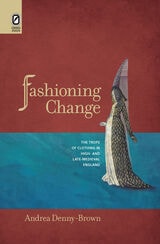
Medieval European culture was obsessed with clothing. In Fashioning Change: The Trope of Clothing in High-and Late-Medieval England, Andrea Denny-Brown explores the central impact of clothing in medieval ideas about impermanence and the ethical stakes of human transience. Studies of dress frequently contend with a prevailing cultural belief that bodily adornment speaks to interests that are frivolous, superficial, and cursory. Taking up the vexed topic of clothing’s inherent changeability, Denny-Brown uncovers an important new genealogy of clothing as a representational device, one imbued with a surprising philosophical pedigree and a long history of analytical weightiness.
Considering writers as diverse as Boethius, Alain de Lille, William Durand, Chaucer, and Lydgate, among others, Denny-Brown tracks the development of a literary and cultural trope that begins in the sixth century and finds its highest expression in the vernacular poetry of fifteenth-century England. Among the topics covered are Boethian discourses on the care of the self, the changing garments of Lady Fortune, novelty in ecclesiastical fashions, the sartorial legacy of Chaucer’s Griselda, and the emergence of the English gallant. These literary treatments of vestimentary variation—which develop an aesthetics of change itself—enhance our understanding of clothing as a phenomenological and philosophical category in medieval Europe and illustrate the centrality of the Middle Ages to theories of aesthetics, of materiality, and of cultural change.
[more]
cover of Fashioning Femininity and English Renaissance Drama

Fashioning Femininity and English Renaissance Drama

Karen Newman

University of Chicago Press, 1991

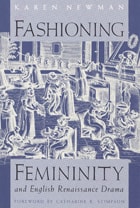
By examining representations of women on stage and in the many printed materials aimed at them, Karen Newman shows how female subjectivity—both the construction of the gendered subject and the ideology of women's subjection to men—was fashioned in Elizabethan and Jacobean England. Her emphasis is not on "women" so much as on the category of "femininity" as deployed in the late sixteenth and early seventeenth centuries.

Through the critical lens of poststructuralism, Newman reads anatomies, conduct and domesticity handbooks, sermons, homilies, ballads, and court cases to delineate the ideologies of femininity they represented and produced. Arguing that drama, as spectacle, provides a peculiarly useful locus for analyzing the management of femininity, Newman considers the culture of early modern London to reveal how female subjectivity was fashioned and staged in the plays of Shakespeare, Jonson, and others.
[more]
cover of Feminist Comedy: Women Playwrights of London

Feminist Comedy

Women Playwrights of London

Willow White

University of Delaware Press, 2024
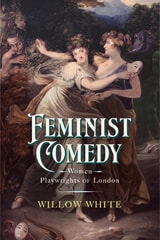
Feminist Comedy: Women Playwrights of London identifies the eighteenth-century comedic stage as a key site of feminist critique, practice, and experimentation. While the history of feminism and comedy is undeniably vexed, by focusing on five women playwrights of the latter half of the eighteenth century--Catherine Clive, Frances Brooke, Frances Burney, Hannah Cowley, and Elizabeth Inchbald--this book demonstrates that stage comedy was crucial to these women’s professional success in a male-dominated industry and reveals a unifying thread of feminist critique that connects their works. Though male detractors denied women’s comic ability throughout the era, eighteenth-century women playwrights were on the cutting edge of comedy and their work had important feminist influence that can be traced to today’s stages and screens.
[more]
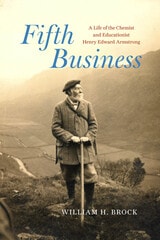
cover of Fifth Business: A Life of the Chemist and Educationist Henry Edward Armstrong

Fifth Business

A Life of the Chemist and Educationist Henry Edward Armstrong

William H. Brock

University of Chicago Press, 2025

A biography of Henry Edward Armstrong, an underappreciated maverick in the history of chemistry.
 
Fifth Business is a biography of the English chemist, educator, and scientific critic Henry Edward Armstrong. Today, Armstrong, who was a central figure in the development of the science of chemistry between 1885 and 1914, is more remembered for his campaigns to improve the teaching of chemistry, and science generally, and less for his theory of residual affinity and reverse electrolysis—or his hostility toward physical chemistry. However, right up until his retirement, Armstrong was a significant and prolific organic chemist, as well as a major figure in the academic and social life of the Chemical Society.
 
Fifth Business
is structured as chronologically as possible, with Armstrong’s life and achievements as an active chemist in Part I (1848–1911) and as a critic in his long retirement in Part II (1911–1937). Brock’s authoritative biography provides a unique inside look at its subject, allowing us to better understand the history of British science, scientific institutions, scientific education, pedagogical theory, and social relations of science during the last third of the nineteenth century and the first third of the twentieth.
[more]
cover of Filth: Dirt, Digust, and Modern Life

Filth

Dirt, Digust, and Modern Life

William A. Cohen

University of Minnesota Press, 2004
From floating barges of urban refuse to dung-encrusted works of art, from toxic landfills to dirty movies, filth has become a major presence and a point of volatile contention in modern life. This book explores the question of what filth has to do with culture: what critical role the lost, the rejected, the abject, and the dirty play in social management and identity formation. It suggests the ongoing power of culturally mandated categories of exclusion and repression.Focusing on filth in literary and cultural materials from London, Paris, and their colonial outposts in the nineteenth and early twentieth centuries, the essays in Filth, all but one previously unpublished, range over topics as diverse as the building of sewers in nineteenth-century European metropolises, the link between interior design and bourgeois sanitary phobias, fictional representations of laboring women and foreigners as polluting, and relations among disease, disorder, and sexual-racial disharmony. Filth provides the first sustained consideration, both theoretical and historical, of a subject whose power to horrify, fascinate, and repel is as old as civilization itself.Contributors: David S. Barnes, U of Pennsylvania; Neil Blackadder, Knox College; Joseph Bristow, U of California, Los Angeles; Joseph W. Childers, U of California, Riverside; Eileen Cleere, Southwestern U; Natalka Freeland, U of California, Irvine; Pamela K. Gilbert, U of Florida; Christopher Hamlin, U of Notre Dame; William Kupinse, U of Puget Sound; Benjamin Lazier, U of Chicago; David L. Pike, American U; David Trotter, U of Cambridge.William A. Cohen is associate professor of English at the University of Maryland and the author of Sex Scandal: The Private Parts of Victorian Fiction.Ryan Johnson is completing his Ph.D. in the Department of English at Stanford University, where he has served as general editor of the Stanford Humanities Review.
[more]
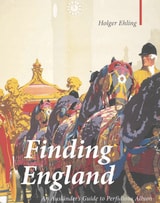
cover of Finding England: An Auslander's Guide to Perfidious Albion

Finding England

An Auslander's Guide to Perfidious Albion

Holger Ehling

Haus Publishing, 2013

It is easy to find England on a map—it is part of that conspicuous thing in the North Sea, just off the French coast, and to the left of Denmark and Norway. It gets trickier once you are there: not even the English are keen to explain what England really is. Why do the English eat what they eat? Why do they do what they do? And why does the world think that England and Englishness is something to aspire to, something to adore? Holger Ehling takes us on a journey to iconic places, from London to Jarrow, from Stonehenge to Chipping Norton, from Shakespeare's Globe to the marvels of Blackpool, pondering along the way about history and everyday life and about what it is that makes these places and these people so quintessentially English and, therefore, different. We will meet royals and beggars, con-artists and real artists, heroes and villains, English roses and the legacy of the Empire Windrush. And perhaps, just perhaps—we will find England.
[more]
cover of Flowers in the Dustbin: Culture, Anarchy, and Postwar England

Flowers in the Dustbin

Culture, Anarchy, and Postwar England

Neil Nehring

University of Michigan Press, 1993

Flowers in the Dustbin looks at the volatile relations between literature, rock music, and youth subcultures in postwar England. Neil Nehring traces the continuities between the original avant-garde of the twenties and thirties and the postwar youth culture, arguing that anarchism never really disappeared from the world. The author shows that British youth groups like the Mods, the Rockers, Punks, and Teddy Boys and the music that inspired them appear increasingly more acute than their literary counterparts, belying conventional assumptions about the relative powers of "high" and "low" culture. By examining literary texts as part of a larger sampling of cultural forms and their uses in everyday life, Flowers in the Dustbin provides a striking illustration of the significance the field of cultural studies holds for studies in English.
[more]
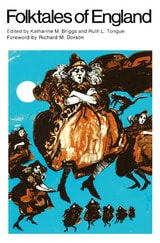
cover of Folktales of England

Folktales of England

Edited by Katharine M. Briggs and Ruth L. Tongue

University of Chicago Press, 1968

If wonder tales are not abundant in England, other kinds of folktales thrive: local traditions, historical legends, humorous anecdotes. Many of the favorite tales which English-speaking peoples carry with them from childhood come from a long tradition—stories as familiar to Shakespeare, Ben Jonson, Spenser, and their many contemporaries as they are to us.

"This is a fine, homely feast, immediately intelligble. . . ."—Times Educational Supplement

". . . should be of special concern to Americans since many of the tales are parallel to or the source of our own folk stories."—Choice

"This is entertainment, to be sure, but is also part of man's attempts to comprehend his world."—Quartet

"Folktales of England is by all odds the most satisfactory general collection of folktales to come out of England since the advent of modern collection and classification techniques."—Ernest W. Baughman, Journal of American Folklore
[more]
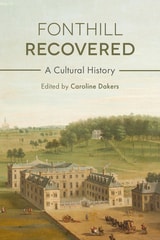
cover of Fonthill Recovered: A Cultural History

Fonthill Recovered

A Cultural History

Edited by Caroline Dakers

University College London, 2018

Fonthill, Wiltshire, is typically associated with the writer and collector William Beckford, who built his Gothic fantasy house, Fonthill Abbey, there at the end of the eighteenth century. The collapse of the Abbey’s tower in 1825 transformed the name Fonthill into a symbol for overarching ambition and folly. But Fonthill is much more than the story of one man’s excesses, and the Abbey was only one of several important houses to be built there, all eventually consumed by fire or deliberately demolished—and all strangely forgotten by contemporary history

Fonthill Recovered draws on new research to explore the rich cultural history of this place where little remains today—a tower, a stable block, the ruins of what was once a kitchen, and an indentation in a field. The first half of the book traces the occupation of Fonthill from the Bronze Age to the twenty-first century. Some of the owners surpassed Beckford in terms of their wealth and political power—and even, in one case, their sexual proclivities. They include Charles I’s Chancellor of the Exchequer and the richest British commoner of the nineteenth century. The second half of the book consists of essays on specific topics, examining such crucial areas as the complex history of the designed landscape, the sources of the Beckfords’ wealth and their extensive art collection, and the recent appearance of the Abbey in a video game.
 
[more]
cover of Forget Me Not: The Rise of the British Literary Annual, 1823–1835

Forget Me Not

The Rise of the British Literary Annual, 1823–1835

Katherine D. Harris

Ohio University Press, 2015

By November 1822, the British reading public had already voraciously consumed both Walter Scott’s expensive novels and Rudolf Ackermann’s exquisite lithographs. The next decade, referred to by some scholars as dormant and unproductive, is in fact bursting with Forget Me Nots, Friendship’s Offerings, Keepsakes, and Literary Souvenirs. By wrapping literature, poetry, and art into an alluring package, editors and publishers saturated the market with a new, popular, and best-selling genre, the literary annual. In Forget Me Not, Katherine D. Harris assesses the phenomenal rise of the annual and its origins in other English, German, and French literary forms as well as its social influence on women, its redefinition of the feminine, and its effects on late nineteenth- and early twentieth-century print culture. Harris adopts an interdisciplinary approach that uses textual and social contexts to explore a forum of subversive femininity, where warfare and the masculine hero were not celebrated.

Initially published in diminutive, decoratively bound volumes filled with engravings of popularly recognized artwork and “sentimental” poetry and prose, the annuals attracted a primarily middle-class female readership. The annuals were released each November, making them an ideal Christmas gift, lover’s present, or token of friendship. Selling more than 100,000 copies during each holiday season, the annuals were accused of causing an epidemic and inspiring an “unmasculine and unbawdy age” that lasted through 1860 and lingered in derivative forms until the early twentieth century in both the United States and Europe. The annual thrived in the 1820s and after despite—or perhaps because of—its “feminine” writing and beautiful form.
[more]
cover of Forms of Nationhood: The Elizabethan Writing of England

Forms of Nationhood

The Elizabethan Writing of England

Richard Helgerson

University of Chicago Press, 1992
What have poems and maps, law books and plays, ecclesiastical polemics and narratives of overseas exploration to do with one another? By most accounts, very little. They belong to different genres and have been appropriated by scholars in different disciplines. But, as Richard Helgerson shows in this ambitious and wide-ranging study, all were part of an extraordinary sixteenth- and seventeenth-century enterprise: the project of making England.
[more]
cover of Fragments and Assemblages: Forming Compilations of Medieval London

Fragments and Assemblages

Forming Compilations of Medieval London

Arthur Bahr

University of Chicago Press, 2013
In Fragments and Assemblages, Arthur Bahr expands the ways in which we interpret medieval manuscripts, examining the formal characteristics of both physical manuscripts and literary works. Specifically, Bahr argues that manuscript compilations from fourteenth-century London reward interpretation as both assemblages and fragments: as meaningfully constructed objects whose forms and textual contents shed light on the city’s literary, social, and political cultures, but also as artifacts whose physical fragmentation invites forms of literary criticism that were unintended by their medieval makers. Such compilations are not simply repositories of data to be used for the reconstruction of the distant past; their physical forms reward literary and aesthetic analysis in their own right. The compilations analyzed reflect the full vibrancy of fourteenth-century London’s literary cultures: the multilingual codices of Edwardian civil servant Andrew Horn and Ricardian poet John Gower, the famous Auchinleck manuscript of texts in Middle English, and Chaucer’s Canterbury Tales. By reading these compilations as both formal shapes and historical occurrences, Bahr uncovers neglected literary histories specific to the time and place of their production. The book offers a less empiricist way of interpreting the relationship between textual and physical form that will be of interest to a wide range of literary critics and manuscript scholars.
[more]
cover of Frances Burney: The Life in the Works

Frances Burney

The Life in the Works

Doody, Margaret A

Rutgers University Press, 1988
Treating Frances Burney (1752-1840) with the seriousness usually reserved for later novelists of the nineteenth and twentieth centuries, Margaret Anne Doody combines biographical narrative with informed literary criticism as she analyzes not only Burney's published novels, but her plays, fragments of novels, poems, and other works never published. Doody also draws upon a mine of letters and diaries for detailed and sometimes surprising biographical information. Burney's feelings and emotions forcefully emerge in her sophisticated and complex late novels, Camilla and The Wanderer. Her novels all relate to personal experience; as an artist she is attracted to the violent, the grotesque, and the macabre. She is a powerful comic writer, but her comedy is far from reflecting a shallow cheerfulness. Bringing a novelist's perspective to her material, in this 1989 book Doody shows an appreciation of the many dimensions of a predecessor's writings and she tells her story with force and conviction.
[more]
cover of Frances Burney: The Life in the Works

Frances Burney

The Life in the Works

Doody, Margaret A

Rutgers University Press, 1988
Treating Frances Burney (1752-1840) with the seriousness usually reserved for later novelists of the nineteenth and twentieth centuries, Margaret Anne Doody combines biographical narrative with informed literary criticism as she analyzes not only Burney's published novels, but her plays, fragments of novels, poems, and other works never published. Doody also draws upon a mine of letters and diaries for detailed and sometimes surprising biographical information. Burney's feelings and emotions forcefully emerge in her sophisticated and complex late novels, Camilla and The Wanderer. Her novels all relate to personal experience; as an artist she is attracted to the violent, the grotesque, and the macabre. She is a powerful comic writer, but her comedy is far from reflecting a shallow cheerfulness. Bringing a novelist's perspective to her material, in this 1989 book Doody shows an appreciation of the many dimensions of a predecessor's writings and she tells her story with force and conviction.
[more]
cover of Francis Bacon: The Logic of Sensation

Francis Bacon

The Logic of Sensation

Gilles Deleuze

University of Minnesota Press, 2005

Translated and with an Introduction by Daniel W. Smith
 Afterword by Tom Conley 

Gilles Deleuze had several paintings by Francis Bacon hanging in his Paris apartment, and the painter’s method and style as well as his motifs of seriality, difference, and repetition influenced Deleuze’s work. This first English translation shows us one of the most original and important French philosophers of the twentieth century in intimate confrontation with one of that century’s most original and important painters. 

In considering Bacon, Deleuze offers implicit and explicit insights into the origins and development of his own philosophical and aesthetic ideas, ideas that represent a turning point in his intellectual trajectory. First published in French in 1981, Francis Bacon has come to be recognized as one of Deleuze’s most significant texts in aesthetics. Anticipating his work on cinema, the baroque, and literary criticism, the book can be read not only as a study of Bacon’s paintings but also as a crucial text within Deleuze’s broader philosophy of art. 

In it, Deleuze creates a series of philosophical concepts, each of which relates to a particular aspect of Bacon’s paintings but at the same time finds a place in the “general logic of sensation.” Illuminating Bacon’s paintings, the nonrational logic of sensation, and the act of painting itself, this work—presented in lucid and nuanced translation—also points beyond painting toward connections with other arts such as music, cinema, and literature. Francis Bacon is an indispensable entry point into the conceptual proliferation of Deleuze’s philosophy as a whole. 

Gilles Deleuze (1925–1995) was professor of philosophy at the University of Paris, Vincennes–St. Denis. He coauthored Anti-Oedipus and A Thousand Plateaus with Félix Guattari. These works, as well as Cinema 1, Cinema 2, The Fold, Proust and Signs, and others, are published in English by Minnesota. 

Daniel W. Smith teaches in the Department of Philosophy at Purdue University.

[more]
cover of Freddie Mercury: An Illustrated Life

Freddie Mercury

An Illustrated Life

Alfonso Casas; translated by Ned Sublette

University of Texas Press, 2020

The music of Queen and powerhouse lead singer Freddie Mercury are best experienced with the volume turned all the way up. Alfonso Casas’s Freddie Mercury delivers a sonorous homage to the formidable singer and the turning points that produced a game-changing body of music that continues to inspire fans around the globe.

First published in Spain and now available worldwide, this luminous work covers Freddie's three “births”: his birth as Farrokh Bulsara in Zanzibar; his adoption of the last name of Mercury and the launch of Queen with Brian May and Roger Taylor; and the emergence of the lasting legend after Freddie’s death at the age of forty-five. Casas's evocative illustrations highlight the key moments in the singer’s transformation from child prodigy to superstar, bringing to life the bold innovator who broke free of his conventional upbringing. Chronicling events from Freddie’s marriage to Mary Austin and early fame in London’s 1970s glam scene, to the making of multiple megahits (including the six-minute chart-topper “Bohemian Rhapsody”), to his final years in a lasting relationship with Jim Hutton, Freddie Mercury is an exhilarating, poignant portrait of a creative genius who lived life to the hilt.
[more]
cover of Freud's Couch, Scott's Buttocks, Brontë's Grave

Freud's Couch, Scott's Buttocks, Brontë's Grave

Simon Goldhill

University of Chicago Press, 2011

The Victorian era was the high point of literary tourism. Writers such as Charles Dickens, George Eliot, and Sir Walter Scott became celebrities, and readers trekked far and wide for a glimpse of the places where their heroes wrote and thought, walked and talked. Even Shakespeare was roped in, as Victorian entrepreneurs transformed quiet Stratford-upon-Avon into a combination shrine and tourist trap.

Stratford continues to lure the tourists today, as do many other sites of literary pilgrimage throughout Britain. And our modern age could have no better guide to such places than Simon Goldhill. In Freud's Couch, Scott’s Buttocks, Brontë's Grave, Goldhill makes a pilgrimage to Sir Walter Scott's baronial mansion, Wordsworth's cottage in the Lake District, the Bront ë parsonage, Shakespeare's birthplace, and Freud's office in Hampstead. Traveling, as much as possible, by methods available to Victorians—and gamely negotiating distractions ranging from broken bicycles to a flock of giggling Japanese schoolgirls—he tries to discern what our forebears were looking for at these sites, as well as what they have to say to the modern mind. What does it matter that Emily Brontë’s hidden passions burned in this specific room? What does it mean, especially now that his fame has faded, that Scott self-consciously built an extravagant castle suitable for Ivanhoe—and star-struck tourists visited it while he was still living there? Or that Freud's meticulous recreation of his Vienna office is now a meticulously preserved museum of itself? Or that Shakespeare’s birthplace features student actors declaiming snippets of his plays . . . in the garden of a house where he almost certainly never wrote a single line?

Goldhill brings to these inquiries his trademark wry humor and a lifetime's engagement with literature. The result is a travel book like no other, a reminder that even today, the writing life still has the power to inspire.
[more]
cover of From Renaissance to Baroque: Essays on Literature and Art

From Renaissance to Baroque

Essays on Literature and Art

Louis L. Martz

University of Missouri Press, 1991

Distinguished critic and scholar Louis L. Martz refreshingly addresses some of the central concerns in current studies of English poetry from the sixteenth and seventeenth centuries, exploring the context of religious controversy within which this poetry developed and the relationship of poetry to the visual arts.
[more]
cover of Fêting the Queen: Civic Entertainments and the Elizabethan Progress

Fêting the Queen

Civic Entertainments and the Elizabethan Progress

John M Adrian

University of Massachusetts Press, 2021

In a 1572 visit to Warwick, Queen Elizabeth looked out the window of her lodgings and saw local people dancing in the courtyard, a seemingly spontaneous performance meant to entertain her. During her travels, she was treated to fireworks, theatrical performances, and lavish banquets. Reconstructing the formal and informal events that took place throughout Elizabeth's progress visits, events rich in pageantry and ceremony, John M. Adrian demonstrates how communities communicated their character, as well as their financial and political needs, to noble guests.

While previous scholars have studied Elizabeth I and her visits to the homes of influential courtiers, Fêting the Queen places a new emphasis on the civic communities that hosted the monarch and their efforts to secure much needed support. Case studies of the cities of Oxford, Canterbury, Sandwich, Bristol, Worcester, and Norwich focus on the concepts of hospitality and space—including the intimate details of the built environment.
[more]