Results by title
475 books match the query 'Environmental' and 18 start with f
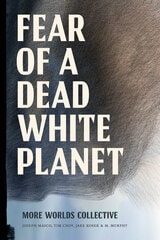
Fear of a Dead White Planet
More Worlds Collective. Joseph Masco, Tim Choy, Jake Kosek, M. Murphy
Duke University Press, 2025
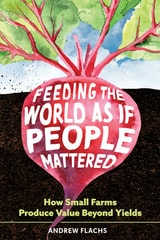
Feeding the World as if People Mattered
How Small Farms Produce Value Beyond YieldsAndrew Flachs
University of Arizona Press, 2026
The dominant view of agriculture has focused only on what we produce. It sees value in terms of capital gains or yield efficiency, masking how our global food system produces tremendous amounts of food commodities while failing to feed people, support rural communities, or enhance ecological well-being. Feeding the World as if People Mattered asks us to look more deeply and more humanely at what we perceive to be most valuable in our agricultural systems.
This book draws on fifteen years of anthropological research, taking readers to fields in South India, Eastern Europe, and North America, where people are already feeding the future amid global change. From these fields, Flachs shows us how a radical rethinking of the value of small farms and farmers is already happening. Bringing together conversations in agriculture, economics, anthropology, and the environmental humanities, Flachs deftly shows how small farms reproduce social and ecological relationships that are the only sustainable path forward.
For anyone who is curious about the food on their plate and the people who helped to get it there, Feeding the World as if People Mattered will offer a new way to find value in the food we grow and the people who grow it.

Fighting for the Future of Food
Activists versus Agribusiness in the Struggle over BiotechnologyRachel Schurman
University of Minnesota Press, 2010
Fighting for the Future of Food tells the story of how a small group of social activists, working together across tables, continents, and the Internet, took on the biotech industry and achieved stunning success. Rachel Schurman and William A. Munro detail how the anti-biotech movement managed to alter public perceptions about GMOs and close markets to such products. Drawing strength from an alternative worldview that sustained its members' sense of urgency and commitment, the anti-GMO movement exploited political opportunities created by the organization and culture of the biotechnology industry itself.
Fighting for the Future of Food ultimately addresses society's understanding and trust (or mistrust) of technological innovation and the complexities of the global agricultural system that provides our food.
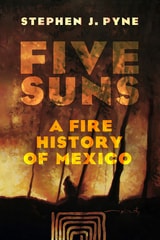
Five Suns
A Fire History of MexicoStephen J. Pyne
University of Arizona Press, 2024
Narrating Mexico’s evolution of fire through five eras, historian Stephen J. Pyne describes the pre-human, pre-Hispanic, colonial, industrializing (1880–1980), and contemporary (1980–2015) fire biography of this diverse and dynamic country. Creatively deploying the Aztec New Fire Ceremony and the “five suns” that it birthed, Pyne addresses the question, “Why does fire appear in Mexico the way it does?” Five Suns tells the saga through a pyric prism.
Mexico has become one of the top ten “firepowers” in the world today through its fire suppression capabilities, fire research, and industrial combustion, but also by those continuing customary practices that have become increasingly significant to a world that suffers too much combustion and too little fire.
Five Suns completes a North American fire-history trilogy written by Pyne over the past 40 years, complementing his histories of Canada and the United States.
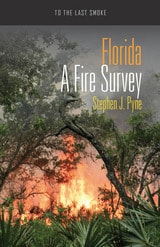
Florida
A Fire SurveyStephen J. Pyne
University of Arizona Press, 2016
In this important new collection of essays on the region, Stephen J. Pyne colorfully explores the ways the region has approached fire management. Florida has long resisted national models of fire suppression in favor of prescribed burning, for which it has ideal environmental conditions and a robust culture. Out of this heritage the fire community has created institutions to match. The Tallahassee region became the ignition point for the national fire revolution of the 1960s. Today, it remains the Silicon Valley of prescription burning. How and why this happened is the topic of a fire reconnaissance that begins in the panhandle and follows Floridian fire south to the Everglades.
Florida is the first book in a multivolume series describing the nation’s fire scene region by region. The volumes in To the Last Smoke will also cover California, the Northern Rockies, the Great Plains, the Southwest, and several other critical fire regions. The series serves as an important punctuation point to Pyne’s fifty-year career with wildland fire—both as a firefighter and a fire scholar. These unique surveys of regional pyrogeography are Pyne’s way of “keeping with it to the end,” encompassing the directive from his rookie season to stay with every fire “to the last smoke.”
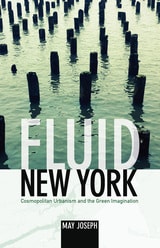
Fluid New York
Cosmopolitan Urbanism and the Green ImaginationMay Joseph
Duke University Press, 2013
Joseph considers New York's relation to the water that surrounds and defines it. Her reflections reach back to the city's heyday as a world-class port—a past embodied in a Dutch East India Company cannon recently unearthed from the rubble at the World Trade Center site—and they encompass the devastation caused by Hurricane Sandy in 2012. They suggest that New York's future lies in the reclamation of its great water resources—for artistic creativity, civic engagement, and ecological sustainability.

Food, Fiber, and the Arid Lands
Edited by William G. McGinnies, Bram J. Goldman, and Patricia G. Paylore
University of Arizona Press, 1971
The world’s dramatic awakening to the impact of ecology on the quality of human life, and a new awareness of the potential for exploitation of the desert environment—in which our particular interest lies—give rise to more thoughtful, even sober, attention to the problems faced by those aspiring only to bigger yields from crops and more protein from animals. To these very basic needs of food and fiber, we are, therefore, addressing ourselves further to a consideration of housing, educational programs, and nonagrarian resource evolution, to the end that the planners and the decision makers may have the benefit of the most intelligent and contemporary understanding possible of the cultural and social aspects of arid lands as well as the latest technological advances on a wide-ranging spectrum of scientific developments.
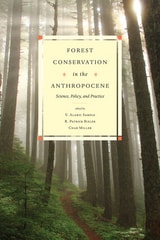
Forest Conservation in the Anthropocene
Science, Policy, and PracticeV. Alaric Sample
University Press of Colorado, 2016
Forest Conservation in the Anthropocene provides thought-provoking insight into the ongoing environmental crises that climate change is generating and raises critical questions about how public and private land managers in North America will adapt to the climatological disruptions that are already transforming the ecological structures of these forests.
In this pathbreaking anthology, a team of leading environmental researchers probes the central dilemmas that ecologists, forest land managers, state and federal agencies, and grassroots organizations are confronting—and will continue to confront—in the coming century. Each chapter examines strategies that are currently being tested across the country as scientists, citizen-scientists, policy makers, academics, and activists work to grasp their options and opportunities for a future that will be shaped by ongoing environmental upheaval.
Successful adaptation to the challenges of climate change requires a transdisciplinary perspective. Forest Conservation in the Anthropocene provides a compelling set of arguments and case studies that underscores the need for innovative policies and energetic actions.
Contributors: Craig D. Allen, Mark Anderson, Susan Beecher, R. Travis Belote, Timothy J. Brown, Anne A. Carlson, Tim Caro, Grace K. Charles, Dave Cleaves, Dena J. Clink, Ayesha Dinshaw, R. Kasten Dumroese, Jonas Epstein, Alexander M. Evans, Todd Gartner, Jessica E. Halofsky, Nels Johnson, Linda A. Joyce, Paige Lewis, Laura Falk McCarthy, Heather McGray, Constance I. Millar, James Mulligan, Chadwick Dearing, David L. Peterson, Will Price, Janine M. Rice, Jason Riggio, Tania Schoennagel, Mark L. Shaffer, Curt Stager, Scott L. Stephens, Thomas W. Swetnam, Gary M. Tabor, Christopher Topik, Monica G. Turner, Thomas T. Veblen, Alexandra M. Weill, Anthony L. Westerling, Carolyn Whitesell, Mary I. Williams
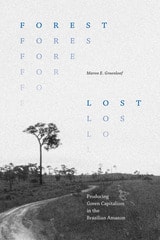
Forest Lost
Producing Green Capitalism in the Brazilian AmazonMaron E. Greenleaf
Duke University Press, 2024
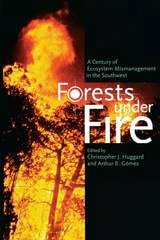
Forests under Fire
A Century of Ecosystem Mismanagement in the SouthwestEdited by Christopher J. Huggard and Arthur R. Gómez
University of Arizona Press, 2001
In this book, leading environmental historians show us what has been happening to these fragile woodlands. Taking us from lumber towns to Indian reservations to grazing lands, Forests under Fire reveals the interaction of Anglos, Hispanics, and Native Americans with the forests of the American Southwest. It examines recent controversies ranging from red squirrel conservation on Mt. Graham to increased tourism in our national forests. These case studies offer insights into human-forest relationships in places such as the Coconino National Forest, the Vallecitos Sustained Yield Unit, and the Gila Wilderness Area while also drawing on issues and concerns about similar biospheres in other parts of the West.
Over the past century, forest management has evolved from a field dominated by the "conservationist" perspective—with humans exploiting natural resources-to one that emphasizes biocentrism, in which forests are seen as dynamic ecosystems. Yet despite this progressive shift, the assault on our forests continues through overgrazing of rangelands, lumbering, eroding mountainsides, fire suppression, and threats to the habitats of endangered species. Forests under Fire takes a closer look at the people calling the shots in our national forests, from advocates of timber harvesting to champions of ecosystem management, and calls for a reassessment of our priorities—before our forests are gone.
Contents
Introduction: Toward a Twenty-First-Century Forest Ecosystem Management Strategy / Christopher J. Huggard
Industry and Indian Self-Determination: Northern Arizona’s Apache Lumbering Empire, 1870-1970 / Arthur R. Gómez
A Social History of McPhee: Colorado’s Largest Lumber Town / Duane A. Smith
The Vallecitos Federal Sustained-Yield Unit: The (All Too) Human Dimension of Forest Management in Northern New Mexico, 1945-1998 / Suzanne S. Forrest
Grazing the Southwest Borderlands: The Peloncillo-Animas District of the Coronado National Forest in Arizona and New Mexico, 1906-1996 / Diana Hadley
America’s First Wilderness Area: Aldo Leopold, the Forest Service, and the Gila of New Mexico, 1924-1980 / Christopher J. Huggard
"Where There’s Smoke": Wildfire Policy and Suppression in the American Southwest / John Herron
Struggle in an Endangered Empire: The Search for Total Ecosystem Management in the Forests of Southern Utah, 1976-1999 / Thomas G. Alexander
Biopolitics: A Case Study of Political Influence on Forest Management Decisions, Coronado National Forest, Arizona, 1980s-1990s / Paul W. Hirt
Epilogue: Seeing the Forest Not for the Trees: The Future of Southwestern Forests in Retrospect / Hal K. Rothman

Forever Open, Clear, and Free
The Struggle for Chicago's LakefrontLois Wille
University of Chicago Press, 1991
Illustrated with historic and contemporary photographs, Wille's book tells how Chicago's lakefront has survived a century of development. The story serves as a warning to anyone who thinks the struggle for the lakefront is over, or who takes for granted the beauty of its public beaches and parks.
"A thoroughly fascinating and well-documented narrative which draws the reader into the sights, smells and sounds of Chicago's story. . . . Everyone who cares about the development of land and its conservation will benefit from reading Miss Wille's book."—Daniel J. Shannon, Architectural Forum
"Not only good reading, it is also a splendid example of how to equip concerned citizens for their necessary participation in the politics of planning and a more livable environment."—Library Journal

Foundations of Conservation Biology
A Guide to the Classic LiteratureEdited by Jeffrey D. Brawn, Erica Fleishman, Curt Meine
University of Chicago Press, 2026
This book summarizes over a century of multidisciplinary scientific literature that contributed to the development of conservation biology. It explores how different scientific, social, and cultural traditions have informed that literature, enabling a deeper comprehension of the natural world and conservation practices. The volume traces conservation biology’s scientific and cultural foundations and its emergence in the mid-1980s in response to the accelerating effects of human activity on biological diversity. As conservation moved beyond its early emphasis on sustaining yields of selected natural resources and responding to environmental degradation, it both reflected and required changes in its scope and foundations. Today, conservation biologists aim to understand the complex ecological and social causes of biodiversity loss and apply that integrated understanding to sustain life and ecological integrity at all levels.
Examining this evolving field’s foundations in philosophy and culture, population genetics, landscape ecology, management techniques, law, the social sciences, and climate change science, the contributors to this volume identify and provide historical and contextual interpretations of the key literature. Foundations of Conservation Biology shows how insights from the past have influenced contemporary studies, and how they may continue to shape future research and actions.
Fractivism
Corporate Bodies and Chemical BondsSara Ann Wylie
Duke University Press, 2018
Fractured Communities
Risk, Impacts, and Protest Against Hydraulic Fracking in U.S. Shale RegionsLadd, Anthony E.
Rutgers University Press, 2017

From Here to There and Back Again
Sue Hubbell
University of Michigan Press, 2004
"Sue Hubbell's From Here to There and Back Again is stylish and thought-provoking. As her brother I have long admired her mince pies and her ability to knit her own thermal underwear."
---Bil Gilbert
"The real masterwork that Sue Hubbell has created is her life."
---New York Times Book Review
"A latter-day Henry Thoreau with a sense of the absurd."
---Chicago Sun-Times
"Sue Hubbell writes splendidly."
---William Least Heat-Moon
"Prose as clear, languorous and beautiful as honey poured from a jar."
---People
From Here to There and Back Again is the much-anticipated collection of essays on an array of offbeat and engrossing subjects by magazine essayist and nature writer Sue Hubbell, author of A Country Year, Shrinking the Cat, and Waiting for Aphrodite.
Reading Sue Hubbell is like embarking on a journey of discovery with a close friend. Her writing is witty, learned yet unassuming, intensely personal, and pointedly honest as she ranges far and wide on such topics as after-hours truck stops, the country's best pie restaurants, bowling shoes, Costa Rica's blue morpho butterfly, earthquakes, and the honey trade. Several of her pieces take place in Michigan locales as well, including Elvis sightings in Vicksburg and the magicians' convention in Colon. In the end you'll return from these travels refreshed, enlightened-and wiser.
From Workshop to Waste Magnet
Environmental Inequality in the Philadelphia RegionSicotte, Diane
Rutgers University Press, 2016

Fuel
A Speculative DictionaryKaren Pinkus
University of Minnesota Press, 2016
Fuel is an idiosyncratic, speculative dictionary of fuels, real and imagined, historical and futuristic, hopeless and utopian. Drawing on literature, film, and scientific treatises—most produced long before “climate change” was in circulation—Fuel argues for a distinction between energy (a system of power) and fuel (a substance, which can be thought of as “potentiality”) as it endeavors to undo the dream that we can simply switch to renewables and all will be golden.
From “Air” to “Zyklon B,” entries in this unusual “dictionary” include Algae, Clathrates, Dilithium, Fleece, Goats, Theology, Whale Oil, and many, many more. The tone of the entries ranges as widely as the topics: from historical anecdotes (the Ford Fiesta “boozemobile”) to eccentric readings of the classics of “energy lit” (Germinal and Oil!); from literary observations (a high octane Odyssey?) to excursions into literary theory. The dictionary draws from an eccentric canon, including works by Jules Verne, George Eliot’s Silas Marner, Paolo Bacigalupi’s Windup Girl, and the Tom Cruise vehicle Oblivion, among others.
A message from this ambitious project is that energy can be understood as a heterogeneous set of self-mystifying systems or machines that block access to thought as they fascinate us. Fuels emerge as more primal elements that the audience can grasp at various points along the way to consumption/combustion. This dictionary can help scramble our thinking about fuel—not in order to demonize energy and not in order to create a new hierarchy in which certain renewables take over from fossil fuels but instead to open up potential ways of interacting with real and imaginary substances, by wrenching them out of narrative and placing them into an idiosyncratic dictionary to be applied by readers into new narratives.
Futures of the Sun
The Struggle over Renewable LifeImre Szeman
University of Minnesota Press, 2024
Who will lead the transition from fossil fuel–dependent societies into renewable energy futures?
Energy transition is crucial to the struggle against climate change. But even while embracing the death of fossil fuels, some want to preserve the current social and political order. Futures of the Sun explores the competing eco-stories being offered by people intent on shaping the transition to fit their vision and version of a renewable society. Imre Szeman explains how and why key players are working hard to make sure a greener, cleaner future will look much like the world we live in today. He examines the rhetoric, ideology, and politics of liberal nationalists intent on fighting a war against climate change, billionaire solar entrepreneurs who believe only in themselves, and the populist far right who want no change at all.
Offering possible new critical and political avenues, Szeman reveals how those on the environmental left can ensure their vision of egalitarianism beyond the status quo can become the reality of our renewable future.