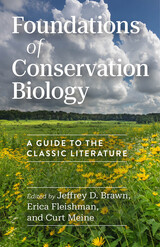
Foundations of Conservation Biology: A Guide to the Classic Literature
University of Chicago Press, 2026
Cloth: 978-0-226-84776-4 | Paper: 978-0-226-84777-1 | eISBN: 978-0-226-84778-8 (all)
Library of Congress Classification QH77.3.C65F68 2026
See other books on: Classic Literature | Conservation biology | Foundations | Guide | Meine, Curt
See other titles from University of Chicago Press
Cloth: 978-0-226-84776-4 | Paper: 978-0-226-84777-1 | eISBN: 978-0-226-84778-8 (all)
Library of Congress Classification QH77.3.C65F68 2026
ABOUT THIS BOOK | AUTHOR BIOGRAPHY | REVIEWS | TOC | REQUEST ACCESSIBLE FILE
ABOUT THIS BOOK
For students, practitioners, and researchers, a comprehensive guide to conservation biology’s foundational literature.
This book summarizes over a century of multidisciplinary scientific literature that contributed to the development of conservation biology. It explores how different scientific, social, and cultural traditions have informed that literature, enabling a deeper comprehension of the natural world and conservation practices. The volume traces conservation biology’s scientific and cultural foundations and its emergence in the mid-1980s in response to the accelerating effects of human activity on biological diversity. As conservation moved beyond its early emphasis on sustaining yields of selected natural resources and responding to environmental degradation, it both reflected and required changes in its scope and foundations. Today, conservation biologists aim to understand the complex ecological and social causes of biodiversity loss and apply that integrated understanding to sustain life and ecological integrity at all levels.
Examining this evolving field’s foundations in philosophy and culture, population genetics, landscape ecology, management techniques, law, the social sciences, and climate change science, the contributors to this volume identify and provide historical and contextual interpretations of the key literature. Foundations of Conservation Biology shows how insights from the past have influenced contemporary studies, and how they may continue to shape future research and actions.
See other books on: Classic Literature | Conservation biology | Foundations | Guide | Meine, Curt
See other titles from University of Chicago Press