Results by title
496 books match the query 'Ethnic identity' and 12 start with f
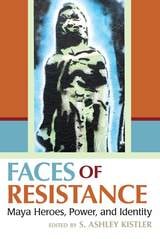
Faces of Resistance
Maya Heroes, Power, and IdentityEdited by S. Ashley Kistler
University of Alabama Press, 2018
In the sixteenth century, Q’eqchi’ Maya leader Aj Poop B’atz’ changed the course of Q’eqchi’ history by welcoming Spanish invaders to his community in peace to protect his people from almost certain violence. Today, he is revered as a powerful symbol of Q’eqchi’ identity. Aj Poop B’atz’ is only one of many indigenous heroes who has been recognized by Maya in Mexico and Guatemala throughout centuries of subjugation, oppression, and state-sponsored violence.
Faces of Resistance: Maya Heroes, Power, and Identity explores the importance of heroes through the analyses of heroic figures, some controversial and alternative, from the Maya area. Contributors examine stories of hero figures as a primary way through which Maya preserve public memory, fortify their identities, and legitimize their place in their country’s historical and political landscape. Leading anthropologists, linguists, historians, and others incorporate ethnographic, ethnohistoric, and archival material into their chapters, resulting in a uniquely interdisciplinary book for scholars as well as students.
The essays offer the first critical survey of the broad significance of these figures and their stories and the ways that they have been appropriated by national governments to impose repressive political agendas. Related themes include the role of heroic figures in the Maya resurgence movement in Guatemala, contemporary Maya concepts of “hero,” and why some assert that all contemporary Maya are heroes.
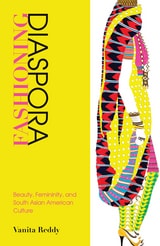
Fashioning Diaspora
Beauty, Femininity, and South Asian American CultureVanita Reddy
Temple University Press, 2015
One of the first books to consider beauty and fashion as a point of entry into an examination of South Asian diasporic public cultures, Fashioning Diaspora examines a range of literature, visual art, and live performance. Through careful analyses of novels by Bharati Mukherjee and Jhumpa Lahiri, young adult literature, performance art by Shailja Patel, as well as objects of popular culture including an Indian American fashion doll, and beauty and adornment practices, Reddy challenges fashion and beauty as a set of dematerialized, overly commodified cultural practices. She argues instead that beauty and fashion structure South Asian Americans’ uneven access to social mobility, capital, and citizenship, and demonstrates their varying capacities to produce social attachments across national, class, racial, gender, and generational divides.
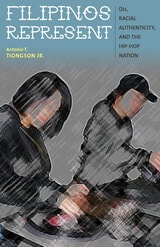
Filipinos Represent
DJs, Racial Authenticity, and the Hip-hop NationAntonio T. Tiongson Jr.
University of Minnesota Press, 2013
The “Hip-hop Nation” has been scouted, staked out, and settled by journalists and scholars alike. Antonio T. Tiongson Jr. steps into this well-mapped territory with questions aimed at interrogating how nation is conceptualized within the context of hip-hop. What happens, Tiongson asks, to notions of authenticity based on hip-hop’s apparent blackness when Filipino youth make hip-hop their own?
Tiongson draws on interviews with Bay Area–based Filipino American DJs to explore the authenticating strategies they rely on to carve out a niche within DJ culture. He shows how Filipino American youth involvement in DJing reconfigures the normal boundaries of Filipinoness predicated on nostalgia and cultural links with an idealized homeland. Filipinos Represent makes the case that while the engagement of Filipino youth with DJ culture speaks to the broadening racial scope of hip-hop—and of what it means to be Filipino—such involvement is also problematic in that it upholds deracialized accounts of hip-hop and renders difference benign.
Looking at the ways in which Filipino DJs legitimize their place in an expressive form historically associated with African Americans, Tiongson examines what these complex forms of identification reveal about the contours and trajectory of contemporary U.S. racial formations and discourses in the post–civil rights era.
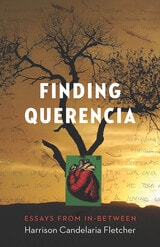
Finding Querencia
Essays from In-BetweenHarrison Candelaria Fletcher
The Ohio State University Press, 2022
With its roots in the Spanish verb querer—“to want, to love”—the term querencia has been called untranslatable but has come to mean a place of safety and belonging, that which we yearn for when we yearn for home. In this striking essay collection, Harrison Candelaria Fletcher shows that querencia is also a state of being: the peace that arises when we reconcile who we are. A New Mexican of mixed Latinx and white ethnicity, Candelaria Fletcher ventures into the fault lines of culture, landscape, and spirit to discover the source of his lifelong hauntings. Writing in the persona of coyote, New Mexican slang for “mixed,” he explores the hyphenated elements within himself, including his whiteness. Blending memory, imagination, form, and language, each essay spirals outward to investigate, accept, and embrace hybridity. Ultimately, Finding Querencia offers a new vocabulary of mixed-ness, a way to reconcile the crosscurrents of self and soul.
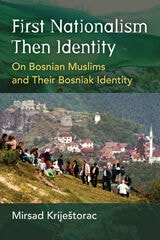
First Nationalism Then Identity
On Bosnian Muslims and Their Bosniak IdentityMirsad Kriještorac
University of Michigan Press, 2022
First Nationalism Then Identity focuses on the case of Bosnian Muslims, a rare historic instance of a new nation emerging. Although for Bosnian Muslims the process of national emergence and the assertion of a new salient identity have been going on for over two decades, Mirsad Kriještorac is the first to explain the significance of the whole process and how the adoption of their new Bosniak identity occurred. He provides a historical overview of Yugoslav and Bosnian Slavic Muslims’ transformation into a full-fledged distinct and independent national group as well as addresses the important question in the field of nationalism studies about the relationship between and workings of nationalism and identity. While this book is noteworthy for ordinary readers interested in the case of Bosnian Muslims, it is an important contribution to the scholarly debate on the role of nationalism in the political life of a group and adds an interdisciplinary perspective to comparative politics scholarship by drawing from anthropology, history, geography, and sociology.

Flavor and Soul
Italian America at Its African American EdgeJohn Gennari
University of Chicago Press, 2017
In Flavor and Soul, John Gennari spotlights this affinity, calling it “the edge”—now smooth, sometimes serrated—between Italian American and African American culture. He argues that the edge is a space of mutual emulation and suspicion, a joyous cultural meeting sometimes darkened by violent collision. Through studies of music and sound, film and media, sports and foodways, Gennari shows how an Afro-Italian sensibility has nourished and vitalized American culture writ large, even as Italian Americans and African Americans have fought each other for urban space, recognition of overlapping histories of suffering and exclusion, and political and personal rispetto.
Thus, Flavor and Soul is a cultural contact zone—a piazza where people express deep feelings of joy and pleasure, wariness and distrust, amity and enmity. And it is only at such cultural edges, Gennari argues, that America can come to truly understand its racial and ethnic dynamics.
Forever Foreigners or Honorary Whites?
The Asian Ethnic Experience TodayMia Tuan
Rutgers University Press, 1999
What does it mean to be an Asian-American in the United States today? Are Asian-Americans considered "honorary whites" or forever thought of as "foreigners?"
Mia Tuan examines the salience and meaning of ethnicity for later generation Chinese- and Japanese-Americans, and asks how their concepts of ethnicity differ from that of white ethnic Americans. She interviewed 95 middle-class Chinese and Japanese Californians and analyzes the importance of ethnic identities and the concept of becoming a "real" American for both Asian and white ethnics. She asks her subjects about their early memories and experiences with Chinese/Japanese culture; current lifestyle and emerging cultural practices; experiences with racism and discrimination; and attitudes toward current Asian immigration.
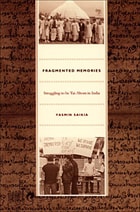
Fragmented Memories
Struggling to be Tai-Ahom in IndiaYasmin Saikia
Duke University Press, 2004
Assamese herself, Saikia lived in several different Tai-Ahom villages between 1994 and 1996. She spoke with political activists, intellectuals, militant leaders, shamans, and students and observed and participated in Tai-Ahom religious, social, and political events. She read Tai-Ahom sacred texts and did archival research—looking at colonial documents and government reports—in Calcutta, New Delhi, and London. In Fragmented Memories, Saikia reveals the different narratives relating to the Tai-Ahom as told by the postcolonial Indian government, British colonists, and various texts reaching back to the thirteenth century. She shows how Tai-Ahom identity is practiced in Assam and also in Thailand. Revealing how the “dead” history of Tai-Ahom has been transformed into living memory to demand rights of citizenship, Fragmented Memories is a landmark history told from the periphery of the Indian nation.
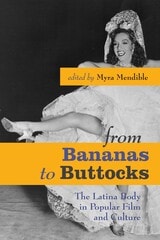
From Bananas to Buttocks
The Latina Body in Popular Film and CultureEdited by Myra Mendible
University of Texas Press, 2007
From the exuberant excesses of Carmen Miranda in the "tutti frutti hat" to the curvaceous posterior of Jennifer Lopez, the Latina body has long been a signifier of Latina/o identity in U.S. popular culture. But how does this stereotype of the exotic, erotic Latina "bombshell" relate, if at all, to real Latina women who represent a wide spectrum of ethnicities, national origins, cultures, and physical appearances? How are ideas about "Latinidad" imagined, challenged, and inscribed on Latina bodies? What racial, class, and other markers of identity do representations of the Latina body signal or reject?
In this broadly interdisciplinary book, experts from the fields of Latina/o studies, media studies, communication, comparative literature, women's studies, and sociology come together to offer the first wide-ranging look at the construction and representation of Latina identity in U.S. popular culture. The authors consider such popular figures as actresses Lupe Vélez, Salma Hayek, and Jennifer Lopez; singers Shakira and Celia Cruz; and even the Hispanic Barbie doll in her many guises. They investigate the media discourses surrounding controversial Latinas such as Lorena Bobbitt and Marisleysis González. And they discuss Latina representations in Lupe Solano's series of mystery books and in the popular TV shows El Show de Cristina and Laura en América. This extensive treatment of Latina representation in popular culture not only sheds new light on how meaning is produced through images of the Latina body, but also on how these representations of Latinas are received, revised, and challenged.
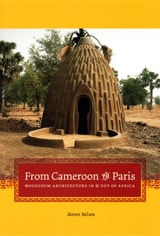
From Cameroon to Paris
Mousgoum Architecture In and Out of AfricaSteven Nelson
University of Chicago Press, 2007
The kind of extraordinary domed house constructed by Chad and Cameroon’s Mousgoum peoples has long held sway over the Western imagination. In fact, as Steven Nelson shows here, this prototypical beehive-shaped structure known as the teleukhas been cast as everything from a sign of authenticity to a tourist destination to a perfect fusion of form and function in an unselfconscious culture. And in this multifaceted history of the teleuk, thought of by the Mousgoum themselves as a three-dimensional symbol of their culture, Nelson charts how a singular building’s meaning has the capacity to change over time and in different places.
Drawing on fieldwork in Cameroon and Japan as well as archival research in Africa, the United States, and Europe, Nelson explores how the teleuk has been understood by groups ranging from contemporary tourists to the Cameroonian government and—most importantly—today’s Mousgoum people. In doing so, he moves in and out of Africa to provide a window into a changing Mousgoum culture and to show how both African and Western peoples use the built environment to advance their own needs and desires. Highlighting the global impact of African architecture, From Cameroon to Paris will appeal to scholars and students of African art history and architectural history, as well as those interested in Western interactions with Africa.
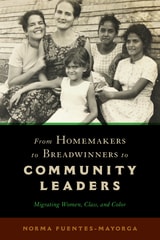
From Homemakers to Breadwinners to Community Leaders
Migrating Women, Class, and ColorNorma Fuentes-Mayorga
Rutgers University Press, 2022
From the Skin
Defending Indigenous Nations Using Theory and PraxisEdited by J. Jeffery Clark and Elise Boxer; Foreword by Nick Estes
University of Arizona Press, 2023
In this volume, contributors demonstrate the real-world application of Indigenous theory to the work they do in their own communities and how this work is driven by urgency, responsibility, and justice—work that is from the skin.
In From the Skin, contributors reflect on and describe how they apply the theories and concepts of Indigenous studies to their communities, programs, and organizations, and the ways the discipline has informed and influenced the same. They show the ways these efforts advance disciplinary theories, methodologies, and praxes. Chapters cover topics including librarianship, health programs, community organizing, knowledge recovery, youth programming, and gendered violence. Through their examples, the contributors show how they negotiate their peoples’ knowledge systems with knowledge produced in Indigenous studies programs, demonstrating how they understand the relationship between their people, their nations, and academia.
Editors J. Jeffery Clark and Elise Boxer propose and develop the term practitioner-theorist to describe how the contributors theorize and practice knowledge within and between their nations and academia. Because they live and exist in their community, these practitioner-theorists always consider how their thinking and actions benefit their people and nations. The practitioner-theorists of this volume envision and labor toward decolonial futures where Indigenous peoples and nations exist on their own terms.
Contributors
Randi Lynn Boucher-Giago
Elise Boxer
Shawn Brigman
J. Jeffery Clark
Nick Estes
Eric Hardy
Shalene Joseph
Jennifer Marley
Brittani R. Orona
Alexander Soto