Results by title

7 books match the query 'Allegories'

cover of Allegories Of Underdevelopment: Aesthetics and Politics in Modern Brazilian Cinema

Allegories Of Underdevelopment

Aesthetics and Politics in Modern Brazilian Cinema

Ismail Xavier

University of Minnesota Press, 1997

Examines the centrality of Cinema Novo to filmmaking in Brazil.

“A camera in the hand and ideas in the head” was the primary axiom of the young originators of Brazil’s Cinema Novo. This movement of the 1960s and early 1970s overcame technical constraints and produced films on minimal budgets. In Allegories of Underdevelopment, Ismail Xavier examines a number of these films, arguing that they served to represent a nation undergoing a political and social transformation into modernity.

Its best-known voice, filmmaker Glauber Rocha claimed that Cinema Novo was driven by an “aesthetics of hunger.” This scarcity of means demanded new cinematic approaches that eventually gave rise to a legitimate and unique Third World cinema. Xavier stands in the vanguard of scholars presenting and interpreting these revolutionary films—from the masterworks of Rocha to the groundbreaking experiments of Julio Bressane, Rogério Sganzerla, Andrea Tonacci and Arthur Omar—to an English-speaking audience. Focusing on each filmmaker’s use of narrative allegories for the “conservative modernization” Brazil and other nations underwent in the 1960s and 1970s, Xavier asks questions relating to the connection between film and history. He examines the way Cinema Novo transformed Brazil’s cultural memory and charts the controversial roles that Marginal Cinema and Tropicalism played in this process. Among the films he discusses are Black God, White Devil, Land in Anguish, Red Light Bandit, Macunaíma, Antônio das Mortes, The Angel Is Born, and Killed the Family and Went to the Movies.A compelling chronicle of the history of modern Brazilian cinema, Allegories of Underdevelopment brings to light the work of many filmmakers who are virtually unknown in the English-speaking world.

[more]
cover of Allegories of Empire: The Figure of Woman in the Colonial Text

Allegories of Empire

The Figure of Woman in the Colonial Text

Jenny Sharpe

University of Minnesota Press, 1993
Allegories of Empire was first published in 1993.“Allegories of Empire re-constellates a metropolitan masterpiece, Forster’s A Passage to India, within colonial discourse studies. Sharpe, a materialist feminist, is scrupulous in her use of theory to articulate nationalism, historical race-gendering, and contemporary feminist critique.” -Gayatri Chakravorty Spivak, Columbia University“Jenny Sharpe has done a great service in opening up the virtually taboo subject of the rape of the white woman by the colored man, and, furthermore, in teaching us theory - making by locating this frenzy of fantasy and reality within a specific crisis of European colonialism in India. ... In showing how a ‘wild anthropology’ must continuously rework feminism in the face of racism, and vice versa, she shows how the margins of empire were and still are at its center.” -Michael Taussig, New York UniversityAllegories of Empire introduces race and colonialism to feminist theories of rape and sexual difference, deploying women’s writing to undo the appropriation of English (universal) womanhood for the perpetuation of Empire.Sharpe brings the historical memory of the 1857 Indian Mutiny to bear upon the theme of rape in British adn Anglo-Indian fiction. She argues that the idea of Indian men raping white women was not part of the colonial landscape prior to the revolt that was remembered as the savage attack of mutinous Indian soldiers on defenseless English women.By showing how contemporary theories of female agency are implicated in an imperial past, Sharpe argues that such models are inappropriate, not only for discussion of colonized women, but for European women as well. Ultimately, she insists that feminist theory must begin from difference and dislocation rather than from identity and correspondence if it is to get beyond the race-gender-class impasse.Jenny Sharpe received her Ph.D. in comparative literature at the University of Texas at Austin and is currently a professor of English at the University of California at Los Angeles. She has contributed articles to Modern Fiction Studies, Genders, and boundary 2.
[more]
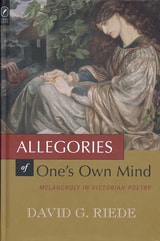
cover of Allegories of One’s Own Mind: MELANCHOLY IN VICTORIAN POETRY

Allegories of One’s Own Mind

MELANCHOLY IN VICTORIAN POETRY

David G. Riede

The Ohio State University Press, 2005

[more]
cover of Allegories of One’s Own Mind: Melancholy in Victorian Poetry

Allegories of One’s Own Mind

Melancholy in Victorian Poetry

David G. Riede

The Ohio State University Press, 1900

[more]
cover of Allegories of the Anthropocene

Allegories of the Anthropocene

Elizabeth M. DeLoughrey

Duke University Press, 2019
In Allegories of the Anthropocene Elizabeth M. DeLoughrey traces how indigenous and postcolonial peoples in the Caribbean and Pacific Islands grapple with the enormity of colonialism and anthropogenic climate change through art, poetry, and literature. In these works, authors and artists use allegory as a means to understand the multiscalar complexities of the Anthropocene and to critique the violence of capitalism, militarism, and the postcolonial state. DeLoughrey examines the work of a wide range of artists and writers—including poets Kamau Brathwaite and Kathy Jetñil-Kijiner, Dominican installation artist Tony Capellán, and authors Keri Hulme and Erna Brodber—whose work addresses Caribbean plantations, irradiated Pacific atolls, global flows of waste, and allegorical representations of the ocean and the island. In examining how island writers and artists address the experience of finding themselves at the forefront of the existential threat posed by climate change, DeLoughrey demonstrates how the Anthropocene and empire are mutually constitutive and establishes the vital importance of  allegorical art and literature in understanding our global environmental crisis.
[more]
cover of Patron to Painter: Elizabethan Programs for Five Allegorical Paintings

Patron to Painter

Elizabethan Programs for Five Allegorical Paintings

David Evett

Arizona Center for Medieval and Renaissance Studies, 2020
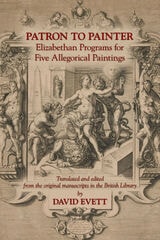
For more than two centuries the group of early modern English manuscripts presented in this volume sat mostly ignored on the shelves of the British Library, known only to the librarians who catalogued them. Six of them, for four different elaborate allegorical paintings, appear in the manuscript catalog of the Sloane Collection as “Instructions to painters.” A seventh, from the Harley collection in the same library, has more recently been added to the group. On art historical, iconographic, and historical grounds the manuscripts add significantly to our knowledge of Elizabethan visual allegory, and reveal a provocative new contribution to the evolution of English political thought. And the development across three of the programs of a warm personal relationship between the patron and the artist opens a unique window into early modern relationships of this kind. Unlike most other surviving artistic programs, this one reveals its author’s personality and interests in a rich and beguiling way, and although as a writer he is no Sidney or Nashe, the naïve yet widely informed enthusiasm with which he addresses his readers has considerable force and charm.
[more]
cover of The Temptation of Saint Redon: Biography, Ideology, and Style in the Noirs of Odilon Redon

The Temptation of Saint Redon

Biography, Ideology, and Style in the Noirs of Odilon Redon

Stephen F. Eisenman

University of Chicago Press, 1992

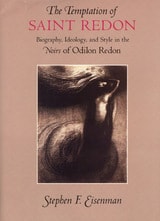
Bristling with demons, grotesques, and bizarre apparitions, the graphic work of Odilon Redon has often seemed to be the product of a mind unhinged. In The Temptation of Saint Redon, Stephen F. Eisenman argues instead that these works are Redon's conscious and considered response to changing social realities—an attempt to find refuge from the forces of modernization in an imaginative world of the macabre and the fantastic. Eisenman's careful attention to the circumstances of Redon's life (1840-1916) allows him to bring into focus the interconnections between Redon's complex style and the culture and society of his time. Born and raised on a sixteenth-century estate near Bordeaux, Redon was immersed as a child in traditional rural culture. "I spent my entire childhood in the Médoc completely free, among peasant children," he recalled in his memoirs. "I heard them tell supernatural tales—witches still exist there."

Indeed, local tales and legends of witches, ghosts, one-eyed monsters, evil eyes, and wood fairies figure prominently in Redon's graphic works, which he called his noirs, or "blacks." After formal training at Bordeaux and Paris in the 1850s and 1860s, Redon began to chart his independent artistic course. Eisenman shows how, rejecting both naturalism and classicism, Redon, a prototypical Symbolist, found in grotesque and epic genres the expression of organic communities and precapitalist societies. He places Redon's desire for this imagined world of superstitious simplicity a desire manifest in his entire mature artistic practice in the context of contemporary avant-garde movements.

Redon's great noirs of the 1870s and 1880s, dreamlike configurations of seemingly irreconcilable elements from portraits, still lifes, and landscapes, show an increasingly subtle control of connotation and a complex indebtedness to caricature, allegory, and puns. Many of the noirs also visually interpret works by like-minded authors, including Baudelaire, Flaubert, Poe, and Mallarmé, one of Redon's close friends. Eisenman's analysis of the noirs underscores Redon's interest in creating an imaginative, even fantastic art, that could act directly on the human spirit. In addition to deepening our understanding of Redon and his art, The Temptation of Saint Redon exposes a link between place, politics, personal history, and the artistic imagination.
[more]