Results by title
81 books match the query 'Executive Branch' and 2 start with f
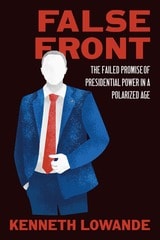
False Front
The Failed Promise of Presidential Power in a Polarized AgeKenneth Lowande
University of Chicago Press, 2024
A provocative new perspective on presidential power.
Border walls, school bathrooms, student loans, gun control, diversity, abortion, climate change—today, nothing seems out of reach for the president's pen. But after all the press releases, ceremonies, and speeches, shockingly little gets done. The American presidency promises to solve America's problems, but presidents' unilateral solutions are often weak, even empty.
Kenneth Lowande argues this is no accident. The US political system is not set up to allow presidents to solve major policy problems, yet it lays these problems at their doorstep, and there is no other elected official better positioned to attract attention by appearing to govern. Like any politician, presidents are strategic actors who seek symbolic wins. They pursue executive actions, even when they know that these will fail, because doing so allows them to put on a compelling show for key constituencies. But these empty presidential actions are not without their costs: they divert energy from effective government—and, over time, undermine public trust. Drawing on thousands of executive actions, news coverage, interviews, and presidential archives, False Front shows that the real root of presidential power is in what presidents can get away with not doing.
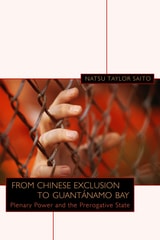
From Chinese Exclusion to Guantánamo Bay
Plenary Power and the Prerogative StateNatsu Taylor Saito
University Press of Colorado, 2007
From Chinese Exclusion to Guantánamo Bay also provides a larger context for understanding problems resulting from the exercise of plenary power. Saito explains how the rights of individuals and groups deemed Other by virtue of race or national origin have been violated under both the Constitution and international law. The differing treatment of José Padilla and John Walker Lindh - both Americans accused of terrorism - provides an example of such disparate approaches. Such executive actions and their sanction by Congress and the judiciary, Saito argues, undermine not just individual rights but the very foundations of our national security - democracy and the rule of law.
From Chinese Exclusion to Guantánamo Bay will interest readers concerned with the historical background of constitutional protection in times of war and peace and will provide fascinating new material for scholars, teachers, and students of law, history, and ethnic studies