Results by title
78 books match the query 'Fascism & Totalitarianism' and 8 start with f
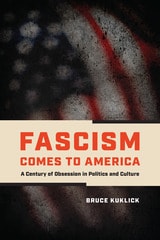
Fascism Comes to America
A Century of Obsession in Politics and CultureBruce Kuklick
University of Chicago Press, 2022
From the time Mussolini took power in Italy in 1922, Americans have been obsessed with and brooded over the meaning of fascism and how it might migrate to the United States. Fascism Comes to America examines how we have viewed fascism overseas and its implications for our own country. Bruce Kuklick explores the rhetoric of politicians, who have used the language of fascism to smear opponents, and he looks at the discussions of pundits, the analyses of academics, and the displays of fascism in popular culture, including fiction, radio, TV, theater, and film. Kuklick argues that fascism has little informational meaning in the United States, but instead, it is used to denigrate or insult. For example, every political position has been besmirched as fascist. As a result, the term does not describe a phenomenon so much as it denounces what one does not like. Finally, in displaying fascism for most Americans, entertainment—and most importantly film—has been crucial in conveying to citizens what fascism is about. Fascism Comes to America has been enhanced by many illustrations that exhibit how fascism was absorbed into the US public consciousness.
Fascism Comes to America
A Century of Obsession in Politics and CultureBruce Kuklick
University of Chicago Press, 2022
A deeply relevant look at what fascism means to Americans.
From the time Mussolini took power in Italy in 1922, Americans have been obsessed with and brooded over the meaning of fascism and how it might migrate to the United States. Fascism Comes to America examines how we have viewed fascism overseas and its implications for our own country. Bruce Kuklick explores the rhetoric of politicians, who have used the language of fascism to smear opponents, and he looks at the discussions of pundits, the analyses of academics, and the displays of fascism in popular culture, including fiction, radio, TV, theater, and film. Kuklick argues that fascism has little informational meaning in the United States, but instead, it is used to denigrate or insult. For example, every political position has been besmirched as fascist. As a result, the term does not describe a phenomenon so much as it denounces what one does not like. Finally, in displaying fascism for most Americans, entertainment—and most importantly film—has been crucial in conveying to citizens what fascism is about. Fascism Comes to America has been enhanced by many illustrations that exhibit how fascism was absorbed into the US public consciousness.
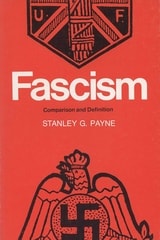
Fascism
Comparison and DefinitionStanley G. Payne
University of Wisconsin Press, 1983
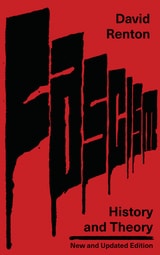
Fascism
History and TheoryDavid Renton
Pluto Press, 2020
To explain this disturbing trend, David Renton surveys the history of fascism in Europe from its pre-war origins to the present day, examining Marxist responses to fascism in the age of Hitler and Mussolini, the writings of Trotsky and Gramsci and contemporary theorists. Renton theorizes that fascism was driven by the chaotic and unstable balance between reactionary ambitions and the mass character of its support. This approach will arm a new generation of anti-fascists to resist those who seek to re-enact fascism.
Rewritten and revised for the twentieth anniversary of its first publication, Renton's classic book synthesizes the Marxist theory of fascism and updates it for our own times.
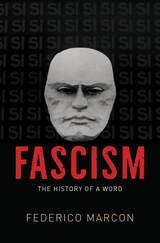
Fascism
The History of a WordFederico Marcon
University of Chicago Press, 2025
The rise and popular support for authoritarianism around the world and within traditional democracies have spurred debates over the meaning of the term “fascist” and when and whether it is appropriate to use it. The landmark study Fascism: The History of a Word takes this debate further by tackling its most fundamental questions: How did the terms “fascism” and “fascist” come to be in the first place? How and in what circumstances have they been used? How can they be understood today? And what are the advantages (or disadvantages) of using “fascism” to make sense of interwar authoritarianism as well as contemporary politics?
Exploring the writings and deeds of political leaders, activists, artists, authors, and philosophers, Federico Marcon traces the history of the term’s use (and usefulness) in relation to Mussolini’s political regime, antifascist resistance, and the quest of postwar historians to develop a definition of a “fascist minimum.” This investigation of the semiotics of “fascism” also aims to inquire about people’s voluntary renunciation of the modern emancipatory ideals of freedom, equality, and solidarity.
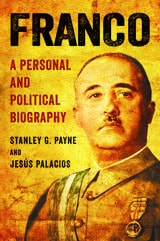
Franco
A Personal and Political BiographyStanley G. Payne and Jesús Palacios
University of Wisconsin Press, 2018
Franco: A Personal and Political Biography depicts his early life, explains his career and rise to prominence as an army officer who became Europe's youngest interwar brigadier general in 1926, and then discusses his role in the affairs of the troubled Second Spanish Republic (1931–36). Stanley G. Payne and Jesús Palacios examine in detail how Franco became dictator and how his leadership led to victory in the Spanish Civil War that consolidated his regime. They also explore Franco's role in the great repression that accompanied the Civil War—resulting in tens of thousands of executions—and examine at length his controversial role in World War II. This masterful biography highlights Franco's metamorphoses and adaptations to retain power as politics, culture, and economics shifted in the four decades of his dictatorship.
Best Books for General Audiences, selected by the American Association of School Librarians
Best Books for General Audiences, selected by the Public Library Reviewers
“An important book, destined to elicit a heated academic debate surrounding the man who ruled Spain for forty years and whose figure still casts a long shadow four decades after his death.”—Journal of Modern History
Free Speech and Koch Money
Manufacturing a Campus Culture WarRalph Wilson
Pluto Press, 2021
In recent years hundreds of high-profile ‘free speech’ incidents have rocked US college campuses. Milo Yiannopoulos, Ben Shapiro, Ann Coulter and other right-wing speakers have faced considerable protest, with many being disinvited from speaking. These incidents are widely circulated as examples of the academy’s intolerance towards conservative views.
But this response is not the spontaneous outrage of the liberal colleges. There is a darker element manufacturing the crisis, funded by political operatives, and designed to achieve specific political outcomes. If you follow the money, at the heart of the issue lies the infamous and ultra-libertarian Koch donor network.
Grooming extremist celebrities, funding media platforms that promote these controversies, developing legal organzations to sue universities and corrupting legislators, the influence of the Koch network runs deep. We need to abandon the ‘campus free speech’ narrative and instead follow the money if we ever want to root out this dangerous network from our universities.

Furnishing Fascism
Modernist Design and Politics in ItalyIgnacio G. Galán
University of Minnesota Press, 2025
The role of modernist interior design in the construction of Italian nationalism
Along with the rise of Mussolini’s fascist regime, the interwar years in Italy also saw the widespread development of its modernist interior design and furnishing practices. While the regime’s politics were overtly manifest in monumental government architecture, Furnishing Fascism examines the subtler yet effective role of household goods and decor in the cultivation of Italy’s exclusionary sense of national identity.
Presenting a fresh look at the work of various architects and designers, including iconic figures such as Gio Ponti and Carlo Enrico Rava, Ignacio G. Galán explores how seemingly neutral products of everyday life contributed to the propagation of fascist ideology. Through extensive promotion in popular magazines and department stores, on the film sets of Cinecittà Studios, and throughout the country’s colonial territories, Italy’s modernist design practices were part of a larger political project that aimed to produce a totalizing image of cultural hegemony.
Interweaving design theory, architectural history, and media scholarship, Furnishing Fascism reexamines the period’s so-called minor arts to reveal the political entanglement of modernism in early twentieth-century Italy and offers valuable insight into the complications of cultural production under the auspices of authoritarian power.
Retail e-book files for this title are screen-reader friendly with images accompanied by short alt text and/or extended descriptions.