Results by title
3388 books match the query 'Fiction' and 135 start with f
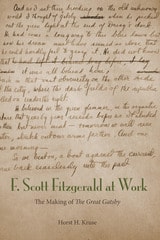
F. Scott Fitzgerald at Work
The Making of "The Great Gatsby"Horst H. Kruse
University of Alabama Press, 2014
The essays in F. Scott Fitzgerald at Work examine fresh facts that illuminate the experiences and source materials upon which Fitzgerald based this quintessentially American masterpiece. They confirm author Horst Kruse’s view that Fitzgerald’s flights of fancy, even at their most spectacular, are firmly grounded in biographical experience as well as in the social, literary, and philosophical circumstances of his era.
In the first essay, Kruse reconstructs the life story of the individual who allegedly inspired the character of Jay Gatsby: Max von Gerlach. Kruse recounts his journeys to various archives and libraries in the United States as well as in Germany to unearth new facts about the genesis of the Gatsby characters. In another journey, readers travel with Kruse to Long Island to explore its physical and moral geography in relation to Fitzgerald, specifically the role of certain elite Long Island families in the advancement of the “science of eugenics” movement. The final two essays take Kruse across the globe to various destinations to consider the broader place of The Great Gatsby in American and international intellectual history.
Replete with fascinating discoveries and insights, F. Scott Fitzgerald at Work both corrects previous assumptions about The Great Gatsby and deepens our appreciation and understanding of Fitzgerald‘s imagination.
Faces in the Fire
The Women of Beowulf: Book OneDonnita L. Rogers
Arizona Center for Medieval and Renaissance Studies, 2013
Fact, Fiction, and Form
Selected EssaysRalph W. Rader
The Ohio State University Press, 2011
Fadeout
A Dave Brandstetter MysteryJoseph Hansen
University of Wisconsin Press, 2004
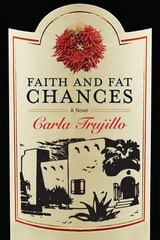
Faith and Fat Chances
A NovelCarla Trujillo
Northwestern University Press, 2015
Finalist, 2012 PEN/Bellwether Prize for Socially Engaged Fiction
Carla Trujillo brings to life another side of the fabled city of Santa Fe in this rollicking novel set in Dogtown, a dilapidated neighborhood on the outskirts of town. Home to a hardscrabble community of working people struggling to make a living on meager means, Dogtown is worlds apart from the tourists, artists, and upscale eateries just a stone’s throw away. The close-knit neighborhood thrives in its own way, until an entrepreneur arrives with a plan to cast out its occupants and construct a winery in its place.
Led by Dogtown’s unofficial mayor, Pepa Romero—an irreverent healer with old-world wisdom and new-age knowledge—the citizens of Dogtown revolt. Using everything at their disposal, including spying, supernatural powers, the law, and individual cunning, they set in motion a thrilling and at times hilarious chain of events that culminates in a storm of epic proportions. With an unforgettable cast of characters, Faith and Fat Chances illuminates the ingenuity and resilience of people fighting to preserve their way of life.
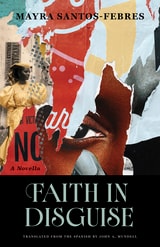
Faith in Disguise
A NovellaMayra Santos-Febres; Translated from the Spanish by John A. Mundell
Vanderbilt University Press, 2026
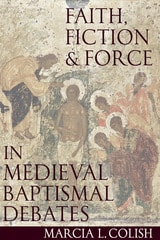
Faith, Force and Fiction in Medieval Baptismal Debates
Marcia L. Colish
Catholic University of America Press, 2014
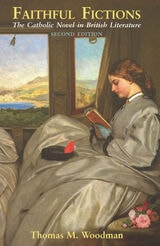
Faithful Fictions
The Catholic Novel in British LiteratureThomas M. Woodman
Catholic University of America Press, 2022
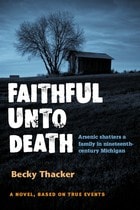
Faithful Unto Death
Becky Thacker
University of Michigan Press, 2011
Benzonia, Michigan, 1894: a sleepy Congregationalist community, dedicated to the education of hardworking and virtuous young people of both sexes and all races. Anna Spencer Thacker is the daughter of missionaries, a faithful wife, and mother of five, pious to a fault. She is suddenly stricken with a mysterious ailment that soon proves fatal. Was it truly an unfortunate illness? Or was it murder—or suicide?
Taking a true story of a murder in her own family, Becky Thacker has crafted a historical mystery novel whose cast of characters rapidly builds, including William Henry Thacker as deputy sheriff, deacon in his church, a kind man . . . but perhaps just a trifle too fond of the attractive young housekeeper; and Charlotte Spencer, the pretty missionary sister, almost saintly in her efforts to bring Jesus to the Armenians in the mountains of Turkey, though a bit prone to exaggeration. She could be a suspect—or the next target.
The children are Roy, 19: musical, a good student, but a little too wild for Benzonia; Ralph, 17: trying to shoulder the responsibilities of farm and family; and Lottie, 14: a talented young artist trying to take care of young Will and Josie. Faithful Unto Death provides a window into the daily lives of small-town Michiganders at the turn of the century wrapped up in a riveting whodunit.
Cover image by Hemera/Thinkstock
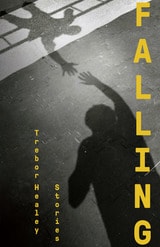
Falling
Trebor Healey
University of Wisconsin Press, 2019
Together, these vignettes cover the dizzying breadth of human experience. From a contemporary reimagination of the life of Evita Perón with a gay man in the starring role to the story of an abandoned building full of ghosts in the center of Mexico City, this collection suggests other ways of seeing in a world overburdened by history.
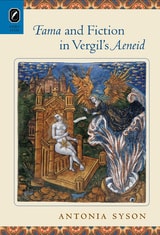
Fama and Fiction in Vergil's Aeneid
Antonia Syson
The Ohio State University Press, 2013
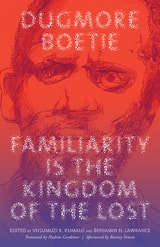
Familiarity Is the Kingdom of the Lost
Dugmore Boetie
Ohio University Press, 2020
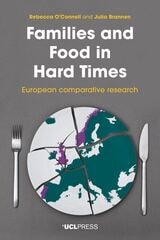
Families and Food in Hard Times
European Comparative ResearchRebecca O'Connell and Julia Brannen
University College London, 2021
Food is fundamental, yet food poverty has increased in the Global North. Adopting a comparative case approach, Food and Families in Hard Times addresses the global problem of economic retrenchment and the burden it places on the most vulnerable. This timely book examines food poverty in the United Kingdom, Portugal, and Norway following the 2008 financial crisis, examining the resources available to families in relation to the intersection of public policies, local institutions, and kinship networks. The book explores the ways that low income impacts household food provisioning, formal and informal support for struggling families, the provision and role of school meals, and constraints upon families’ social participation. Drawing upon extensive and intensive knowledge on the conditions and experiences of low-income families, the book also draws upon current research in European social science literature to shed light on the causes and consequences of food poverty in austerity-era Europe.
Family Feeling
Jean Ross Justice
University of Iowa Press, 2014
Many of the stories revolve around end-of-life scenes. An elderly man is visited by his middle-aged son’s young second wife and child, whom the son has temporarily abandoned in order to tend to his dying ex-wife. A recently widowed woman faces a complicated relationship with a troubled home health-care worker who had been uncommonly kind to her dying husband. Four middle-aged siblings reconvene in their childhood home to attend to the death of their father and find themselves simultaneously children of, and parents to, their own parents.
The unobtrusive historical breadth of the stories is remarkable. Reflecting back to Depression-era southern America from the perspective of the early twenty-first century, the characters provide us with an intimate view of the changing cultural landscape of our country. Issues of class are not merely ideological here—they are fluid and intricate aspects of fate and of soul.
Justice’s prose is characterized by quiet humor and attention to gesture. The deeply self-reflective and self-contained narrators offer us a window into issues of aging and mortality that is real and rare. In the manner of Alice Munro or William Trevor, Jean Ross Justice’s thought-driven fiction centers on pivotal moments of action or conversation that haunt—or reverberate—for decades.
Family Ties
By Clarice Lispector
University of Texas Press, 1972
The silent rage that seizes a matriarch whose family is feting her eighty-ninth year.The tangle of emotions felt by a sophisticated young woman toward her elderly mother. An adolescent girl's obsessive fear of being looked at. The "giddying sense of compassion" that a blind man introduces into a young housewife's settled existence. Of such is made the world of Clarice Lispector, the Brazilian writer whose finest work is acknowledged to be her exquisitely crafted short stories. Here, in these thirteen of Lispector's most brilliantly conceived stories, mysterious and unexpected moments of crisis propel characters to self-discovery or keenly felt intuitions about the human condition. Her characters mirror states of mind. Alienated by their unsettling sense of life's absurdity, they seem at times absorbed in their interior lives and in the passions that dominate and usually defeat them.
Giovanni Pontiero's translation has been lauded by Gregory Rabassa as "magnificent."
Famous Children and Famished Adults
StoriesEvelyn Hampton
University of Alabama Press, 2019
Stories that remap the world to reveal hidden places we have always suspected of existing and scenarios that show us glimpses of ourselves
In these stories, readers encounter a wizened, silent child; a documentary filmmaker lost in the Amazon; a writer physically overwhelmed by the amount of content she has generated; the disappearance of the world’s cats; and an enormous houseplant that has become quietly malevolent. Through these encounters, which are presented with insightful, intricate, and often very funny writing, readers come to know the scintillating zone where fiction and reality become indistinguishable.
Working in the tradition of voice impressionists like Maria Bamford, Hampton draws on a wide range of styles and voices to tell stories that seem at once familiar and strange, spoofed and invented. Readers who have enjoyed the work of Shirley Jackson, George Saunders, Lydia Davis, or Robert Walser will be at home in these pages, but so too will readers who have given up on fiction. These stories show us that insouciance can be beautiful, confusion can be intricate and ordered, and rule-breaking can be a discipline all its own.
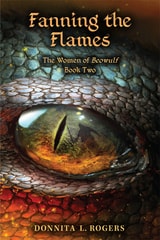
Fanning the Flames
The Women of Beowulf Book 2Donnita L. Rogers
Arizona Center for Medieval and Renaissance Studies, 2014

Fanny Herself
Edna Ferber
University of Illinois Press, 1917
"You could not have lived a week in Winnebago without being aware of Mrs. Brandeis," Ferber begins, and likewise the story of Fanny Brandeis is inextricable from that of her vigorous, enterprising mother. Molly Brandeis is the owner and operator of Brandeis' Bazaar, a modest general store left to her by her idealistic, commercially inept late husband. As Fanny strives to carve out her own sense of herself, Molly becomes the standard by which she measures her intellectual and spiritual progress.
Fanny's ambivalent feelings about being Jewish, her self-deprecating attitude toward her gift for sketching and drawing, and her inspired success as a businesswoman all contribute to the flesh-and-blood complexity of Ferber's youthful, eminently believable protagonist. She is accompanied on her journey by impeccably drawn characters such as Father Fitzpatrick, the Catholic priest in Winnebago; Ella Monahan, buyer for the glove department of the Haynes-Cooper mail order house; Fanny's brother, Theodore, a gifted violinist for whose musical education Molly sacrifices Fanny's future; and Clarence Heyl, the scrappy columnist who never forgot how Fanny rescued him from the school bullies.
Ferber's only work of fiction with a strong autobiographical element, Fanny Herself showcases the author's enduring interest in the capacity of strong women to transcend the limitations of their environment and control their own circumstances. Through Fanny's honest struggle with conflicting values–financial security and corporate success versus altruism and artistic integrity–Ferber grapples with some of the most deeply embedded contradictions of the American spirit.
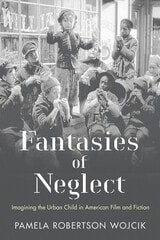
Fantasies of Neglect
Imagining the Urban Child in American Film and FictionPamela Robertson Wojcik
Rutgers University Press, 2016

Fantastic Stories
Abram Tertz
Northwestern University Press, 1986
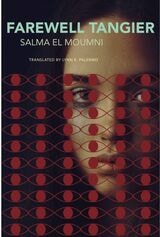
Farewell Tangier
Salma El Moumni
Seagull Books, 2026
For Alia, being a teenager in Tangier means constantly facing a gauntlet of unwanted encounters by men in the streets who look her over, grab her, or make comments about her body. At night, in the privacy of her bedroom, Alia begins to take photos of her body in order to understand what those men see when they look at her, becoming her own voyeur. When Alia’s photos somehow end up on the internet, she decides to flee the country, as the photos violate Moroccan law. She seeks refuge in Lyon, France, but is unable to escape the past.
Farewell Tangier is a searing exploration of the male gaze and its potential to shatter a young woman’s life, exploring themes of desire, dissociation, and exile. It is both a feminist critique of the policing of female bodies and an affecting narrative of one young woman’s struggle with her identity.
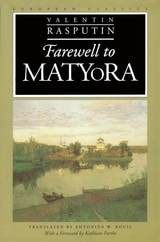
Farewell to Matyora
Valentin Rasputin
Northwestern University Press, 1995
It is the final summer of the peasant village of Matyora. A dam will be completed in the fall, destroying the village. Although their departure is inevitable, the characters over when, and even whether, they should leave. A haunting story with a heartfelt theme, Farewell to Matyora is a passionate plea for humanity and an eloquent cry for a return to an organic life.
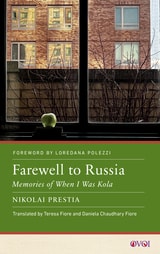
Farewell to Russia
Memories of When I Was KolaNikolai Prestia
Rutgers University Press, 2026
Growing up in 1990s Russia in a family marked by poverty, substance abuse, and neglect, Kola and his sister are eventually admitted into the orphanage system. Here, Kola comes face to face with a different but equally daunting challenge: navigating an unfamiliar and sometimes hostile world haunted by the absence of his mother. The ensuing journey, which eventually culminates in the adoption by an Italian family, alternates moments of both trauma and deliverance, while asking fundamental questions about our ability to reconcile ourselves with unfathomable loss.
Harrowing yet lyrical, Nikolai Prestia’s prize-winning 2021 novel is a testament to the duality of memory in its ability to both hurt and heal, and to the transformative power of those figures, adults and peers alike, who contribute to a child’s development. Translated into English as part of a collaboration between the author and a mother-daughter translator duo, the novel serves up a wrenching glimpse into the back stories that often precede the adoption of an older child.
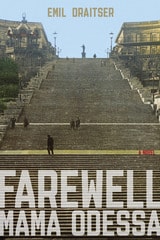
Farewell, Mama Odessa
A NovelEmil Draitser
Northwestern University Press, 2020
Set in the summer of 1979 at the height of the movement to free Soviet Jewry, Farewell, Mama Odessa is an autobiographical novel whose intertwined storylines follow a variety of people—dissidents, victims of ethnic discrimination, and black marketeers among them—as they bid farewell to their beloved hometown of Odessa, Ukraine, and make their way to the West. At the book’s center is Boris, a young writer thwarted by state censorship and antisemitism. With an Angora kitten for his companion and together with other émigrés, he puts the old country in his rear-view mirror and sets out on a journey that will take him to Bratislava, Vienna, Rome, and New York on his way to Los Angeles. Will Boris be able to rekindle his creative passion and inspiration in the West? Will other Jewish émigrés fit into the new society, so much different than the one they left behind? With humor and compassion, Farewell, Mama
Odessa describes the émigrés’ attempts at adjustment to the free world.

Farewell, Summer
Helen Hooven Santmyer
The Ohio State University Press, 2001
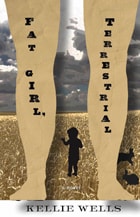
Fat Girl, Terrestrial
A NovelKellie Wells
University of Alabama Press, 2012
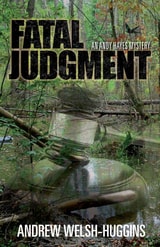
Fatal Judgment
An Andy Hayes MysteryAndrew Welsh-Huggins
Ohio University Press, 2024
Judge Laura Porter fiercely guarded her privacy, and never more so than during her long-running—and long in the past—affair with disgraced quarterback-turned-private investigator Andy Hayes. Now she’s missing, disappeared just hours after she calls Andy out of the blue explaining she’s in trouble and needs his help.
A trail of clues leads Andy to a central Ohio swamp whose future lies in the judge’s hands as she weighs a lawsuit pitting environmentalists against developers. Soon Hayes encounters the case of another missing person, a young man who vanished without a trace in a different swamp two counties away. As he looks for links between the two disappearances, Hayes is led from Columbus to Cleveland, unearthing a history of secrets and betrayals threatening not just the judge but her family as well.
Along the way, Hayes is forced to confront a newly strained relationship with his older son, now a budding football star himself, and revisit his tumultuous days as a Cleveland Browns quarterback and the gridiron failures that haunt him to this day. In partnership with a cop on her own quest for justice, Hayes rushes to find the judge, and the truth, before it’s too late.
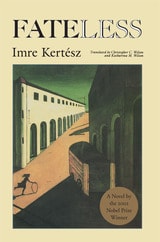
Fateless
Imre Kertesz
Northwestern University Press, 1992
One of Publishers Weekly's Fifty Best Books of 1992
Fateless is a moving and disturbing novel about a Hungarian Jewish boy’s experiences in German concentration camps and his attempts to reconcile himself to those experiences after the war. Upon his return to his native Budapest still clad in his striped prison clothes, fourteen-year-old George Koves senses the indifference, even hostility, of people on the street. His former neighbors and friends urge him to put the ordeal out of his mind, while a sympathetic journalist refers to the camps as "the lowest circle of hell." The boy can relate to neither cliche and is left to ponder the meaning of his experience alone.
George's response to his experience is curiously ambivalent. In the camps he tries to adjust to his ever-worsening situation by imputing human motives to his inhumane captors. By imposing his logic--that of a bright, sensitive, though in many ways ordinary teenager - he maintains a precarious semblance of normalcy. Once freed, he must contend with the "banality of evil" to which he has become accustomed: when asked why he uses words like "naturally," "undeniably," and "without question" to describe the most horrendous of experiences, he responds, "In the concentration camp it was natural." Without emotional or spiritual ties to his Jewish heritage and rejected by his country, he ultimately comes to the conclusion that neither his Hungarianness nor his Jewishness was really at the heart of his fate: rather, there are only "given situations, and within these, further givens."
Father Flashes
Tricia Bauer
University of Alabama Press, 2011
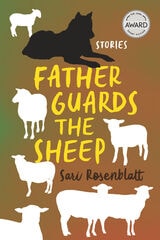
Father Guards the Sheep
Sari Rosenblatt
University of Iowa Press, 2020
In Sari Rosenblatt’s collection, by turns tender and hilarious, we see fathers who are bullies and nervous watchdogs, haunted by their own pasts and fear of the future they may never see. And who do their daughters become? A substitute teacher who encounters mouthy students who believe she’s not real. Another lands a job on her city’s arson squad, researching derelict properties their owners might want to burn. A beleaguered mother, humiliated by the PTA’s queen bee, finds solace in an ancient piece of caramel candy. “I keep sucking,” she says, “until some flavor, no longer caramel, comes out.” In the end, this is what all these finely wrought characters want: to wring sweetness from what’s been passed down to them.
Rosenblatt’s comic sensibility, so present in these stories, entertains and consoles, while seeming to say to her readers: you might as well laugh.

Fathers
Allen Tate
Ohio University Press, 1984
Old Major Buchan of Pleasant Hill, Fairfax County, Virginia, lived by a gentlemen's agreement to ignore what was base or rude, to live a life which was gentle and comfortable because it was formal. Into this life George Posey came dashing, as Henry Steele Commager observed, “to defy Major Buchan, marry Susan, betray Charles and Semmes, dazzle young Lacy, challenge and destroy the old order of things.”
The Fathers was published in 1938. It sold respectably in both the United States and England, perhaps because people expected it to be another Gone With the Wind, wheras it is in fact the novel Gone With the Wind ought to have been. Since its publication it has received very little attention, considering that it is one of the most remarkable novels of our time. Its occasion is a public one, the achievement and the destruction of Virginia's antebellum civilization. Within that occasion it discovers a terrible conflict between two fundamental and irreconcilable modes of existence, a conflict that has haunted American experience, but exists in some form at all times. The Fathers moves between the public and the private aspects of this conflict with an ease very unusual in American novels, and this ease is the most obvious illustration of the novel's remarkable unity of idea and form, for it is itself a manifestation of the novel's central idea, that “the belief widely held today, that men may live apart from the political order, that indeed the only humane and honorable satisfactions must be gained in spite of the public order, “is a fantasy.”
— From the introduction of The Fathers
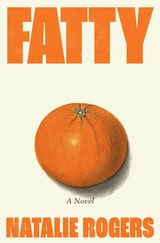
Fatty
A NovelNatalie Rogers
Northwestern University Press, 2027
A poignant coming-of-age novel inspired by martial arts films and family lore about powerful ghost brides
Fatty Wong is a streetwise eleven-year-old in 1960s colonial Hong Kong who dreams of ruling the world. She fights daily for a better life, but in an era of great political turmoil, Fatty faces struggles in the streets of her working-class village—and inside her own home. As the city’s youth begins protesting British rule and local communists mimic the Cultural Revolution that has ignited chaos across mainland China, Fatty grapples with her own desire for freedom and spars with the neighborhood kids to discover her strength through kung fu. She takes a job at a convenience store to carve a space of her own, only to be sexually abused by the owner. Increasingly attuned to the spirit world, Fatty is visited by a neighbor boy who was shot and killed during a riot; his ghost offers to help her escape her anguish if she cares for his grieving mother. Now Fatty must embark on an adventure that will demand she discover her true identity—and raise a fist to anyone attempting to stifle her spirit.
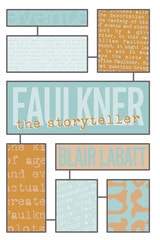
Faulkner the Storyteller
Blair Labatt
University of Alabama Press, 2006
A study exploring the role of event and plot in William Faulkner’s fiction.
Faulkner the Storyteller addresses the role of event and plot in Faulkner's fiction and the creation of an implied teller behind the tale. Novels like The Sound and the Fury and Absalom, Absalom! are often thought of as canonical modernist texts antagonistic to traditional notions of plot and storytelling. Blair Labatt, however, argues that Faulkner's fiction, regardless of its modernist gestures, is filled and driven by sophisticated manifestations of plot—willed challenges, structural targets, gambits, designs, engagements, and battles—a language of competition and conflict and a syntax of events.
Labatt examines Faulkner's short stories, such as "Mountain Victory," "That Evening Sun," and "Barn Burning," and the architecture of the Snopes Trilogy (The Hamlet, The Town, and The Mansion), and finds that Faulkner's deployment of cause and effect is central to his narratives. Labatt also explores how Faulkner's use of plot creates an implied voice that lends a humorous element to his story's twists and turns that often brackets and encloses the pathos of his characters.

Faulkner's Narrative Poetics
Style as VisionArthur F. Kinney
University of Massachusetts Press, 1978
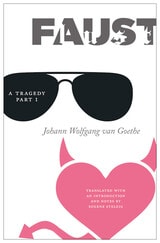
Faust
A Tragedy, Part IEugene Stelzig
Bucknell University Press, 2019
Published by Bucknell University Press. Distributed worldwide by Rutgers University Press.
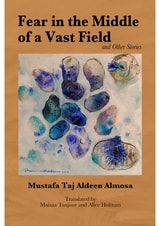
Fear in the Middle of a Vast Field and Other Stories
Mustafa Taj Aldeen Almosa; translated by Maisaa Tanjour and Alice Holttum
University of Texas Press, 2025
Short stories by a celebrated playwright bare the horrors of the Syrian civil war.
A selection of stories by Syrian author and playwright Mustafa Taj Aldeen Almosa about characters enduring the horrors of the Syrian civil war. With exquisite wit and lightness of touch, Almosa portrays the internal world of characters facing great physical violence or psychological pressures. Using both realism and fantastic elements, Almosa weaves short stories that are strange, violent, and delicate at the same time. This collection is an invaluable attempt to denounce war, to exist, to love life in all its manifestations and to learn how to cope with loss and disappointment. It is a cry against fear and death as much as it is an ode and a homage to life and love in times of both war and peace.
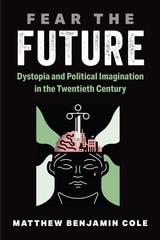
Fear the Future
Dystopia and Political Imagination in the Twentieth CenturyMatthew Benjamin Cole
University of Michigan Press, 2025
Offering a novel reading of major themes and thinkers, Fear the Future explores visions of the future from literary figures such as Yevgeny Zamyatin, Aldous Huxley, and George Orwell; political theorists such as Max Weber, Hannah Arendt, Herbert Marcuse, Jürgen Habermas, and Michel Foucault; and mid-century social scientists such as Erich Fromm, Max Horkheimer, Theodor Adorno, David Reisman, C. Wright Mills, and Jacques Ellul. It offers a comparative analysis of distinct intellectual and literary traditions, including modern utopianism and anti-utopianism, midcentury social science, Frankfurt School critical theory, and continental political philosophy. With detailed case studies of key thinkers from the Enlightenment to the late twentieth century, the book synthesizes secondary literature and research from a range of disciplinary areas, including in political theory, intellectual history, literary studies, and utopian studies. This wide-ranging reconstruction shows that while dystopian thinking has illustrated the dangers of domination and dehumanization, it has also illuminated new possibilities for freedom.
Feathers
Haim Be’er
Brandeis University Press, 2006
Felix Faure Street
A NovelKen Bugul; Translated from the French by Julie Huntington
Vanderbilt University Press, 2026
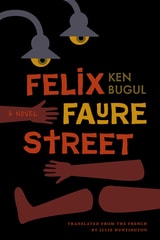
Felix Faure Street opens with a gruesome scene, with two incompetent police officers standing before a bloody and dismembered body found strewn across the sidewalk in a working-class neighborhood in Dakar, Senegal. At the onset of the investigation, the body of the murdered man begins to tell the story of the events leading up to his death, but no one is listening to him. Life on Felix Faure Street goes on, just as it does every day. As the mystery unfolds, community members get involved in the investigation. Guided by supernatural elements that manifest in the form of four elusive veiled figures, they will come face to face with a brutal truth about the horrifically mutilated man and those he has abused.
Feminist Fabulation
Space/Postmodern FictionMarleen S. Barr
University of Iowa Press, 1992
Fertility and Other Stories
Vsevolod Ivanov
Northwestern University Press, 1998
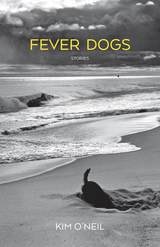
Fever Dogs
StoriesKim O'Neil
Northwestern University Press, 2017
Kim O’Neil’s debut collection, Fever Dogs, is a fictional biography of three generations of women. It begins at the turn of the twenty-first century with Jean, a young woman at an impasse. Romantically adrift, in a dying profession, she decides that to make herself a future, she must first make herself a past.
To deal with a violent history, Jean’s mother has violently erased it. Starting from a bare outline that includes an unspoken death, a predatory father, and a homeless stint, Jean reconstructs the life her mother, Jane, might have lived. But origin stories can never completely cover their tracks: like Jean’s story, Jane’s cannot be told apart from that of her own mother.
What follows is a set of stories spanning nearly a century in response to questions the narrator wishes she had asked her mother and to which she has disjointed answers at best. In the absence of answers, the narrator, in various points of view, invents them. As the stories progress backward in time, the footholds in fact grow fewer and the shift to fabulism greater. But in her attempt to unravel her mother's origin and her own, Jean finds that the stories she invents—like the dogs who run through them as witnesses, allies, and objects of desire—serve as well as any other in the makeshift task of authoring a life.
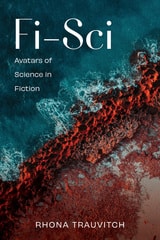
Fi-Sci
Avatars of Science in FictionRhona Trauvitch
The Ohio State University Press, 2026
In Fi-Sci, Rhona Trauvitch melds literary and scientific thought to advance a theory of how narrative, and specifically fictionality, is one of the most powerful tools we have for understanding science, particularly those concepts that defy imagination. Centering her argument on a rhetorical approach to fictionality, she proposes that fiction uniquely offers a means of conceptualizing and understanding perplexing and counterintuitive scientific phenomena, such as recombinant DNA or quantum superposition: Through finding analogous patterns in fiction, we can open up new pathways to understanding. Put another way, our abilities to perceive strange and confounding science phenomena are bolstered and even enabled by our experiences with fiction.
Drawing on a range of theorists such as James Phelan, Gérard Genette, Erwin Schrödinger, and others in her analysis of texts by Jorge Luis Borges, Julio Cortázar, Ursula K. Le Guin, Richard Powers, and many more, Trauvitch shows how literary forms—such as metafiction, metalepsis, and recursion—mirror and clarify complex scientific concepts including genetics, spacetime curvature, and quantum mechanics. In this way, she shows us how fiction is key to unlocking conceptual access to the indiscernible and inconceivable.
Fiction And Incarnation
Rhetoric, Theology, and Literature in the Middle AgesAlexandre Leupin
University of Minnesota Press, 2002
A fresh look at the relationship between theology and rhetoric.
Focusing on the Incarnation-the only dogma original to Christianity, in which God becomes man and history-this book offers a wide-ranging and theoretically sophisticated investigation of the relationship between Christian discourse and literature from Roman antiquity to the fourteenth century through a look at texts by Cicero, Quintilian, Martianus Capella, Tertullian, Saint Augustine, Alain of Lille, Guillaume de Machaut, and others.
Alexandre Leupin asks if it is possible to go beyond the dialectics of the Incarnated God and the Devil without harking back to the beautiful but partially obsolete truths of paganism and sophistry. Employing a method inspired by psychoanalysis, Leupin repudiates the sophistry and relativism of postmodern theory while calling into question old commonplaces that have been invalidated by modernity. He does so by attending to the larger and deeper structures hidden within the discourses of theology, rhetoric, literature, and psychoanalysis. The result is an innovative perspective on the Middle Ages, an original and promising view of the problems of Western literature in relation to theology and rhetoric. Alexandre Leupin is Gregorie Professor in French studies at Louisiana State University. He is the author of many books, including, in English translation, Barbarolexis: Medieval Literature and Sexuality (1989).David Laatsch is a Ph.D. candidate in the French department of Louisiana State University.
Fiction Refracts Science
Modernist Writers from Proust to BorgesAllen Thiher
University of Missouri Press, 2005
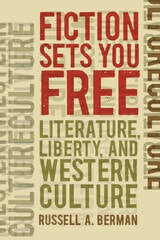
Fiction Sets You Free
Literature, Liberty, and Western CultureRussell A. Berman
University of Iowa Press, 2007
In what can only be called a genuine intellectual adventure, Russell Berman raises fundamental questions long ignored by literary scholars: Why does literature command our attention at all? Why would society want to cultivate a sphere of activity devoted to the careful study of literary ?ction? Written as a tonic to what he calls the debilitating cultural relativism of contemporary literary studies, Fiction Sets You Free advances the innovative argument that literature and capitalism, rather than representing merely commercialization, actually belie a long and positive association: literary autonomy is a central part of modern Western culture, thoroughly intertwined with political democracy and free-market capitalism.
Berman particularly challenges the issue of periodization, in which current scholarship emphasizes historical context over the integrity of a literary work and thus neglects the capacity of literature to remain interesting in other times and contexts. By moving from the origins of human language through the development of written alphabets and sacred texts, eventually probing the role of public literature in the creation of community, Berman elegantly and cogently surveys the intellectual landscape of Western societies. By giving us the license to dream and envision other worlds, literature sets us free.
Fiction and the Ways of Knowing
Essays on British NovelsBy Avrom Fleishman
University of Texas Press, 1978
In this highly individual study, Avrom Fleishman explores a wide range of literary references to human culture—the culture of ideas, facts, and images. Each critical essay in Fiction and the Ways of Knowing takes up for sustained analysis a major British novel of the nineteenth or the twentieth century. The novels are analyzed in the light of social, historical, philosophical, and other perspectives that can be grouped under the human sciences.
The diversity of critical contexts in these thirteen essays is organized by Avrom Fleishman's governing belief in the interrelations of literature and other ways of interpreting the world. The underlying assumptions of this approach—as explained in his introductory essay—are that fiction is capable of encompassing even the most recondite facts and recalcitrant ideas; that fiction, though never a mirror of reality, is linked to realities and takes part in the real; and that a critical reading may be informed by scientific knowledge without reducing the literary work to a schematic formula.
Fleishman investigates the matters of fact and belief that make up the designated meanings, the intellectual contexts, and the speculative parallels in three types of novel. Some of the novels discussed make it clear that their authors are informed on matters beyond the nonspecialist's range; these essays help bridge this information gap. Other fictional works are only to be grasped in an awareness of the cultural lore tacitly distributed in their own time; a modern reader must make the effort to fathom their anachronisms. And other novels can be found to open passageways that their authors can only have glimpsed intuitively; these must be pursued with great caution but equal diligence.
The novels discussed include Little Dorrit, The Way We Live Now, Daniel Deronda, he Return of the Native, and The Magus. Also examined are Wuthering Heights, Vanity Fair, Northanger Abbey, To the Lighthouse, Under Western Eyes, Ulysses, and A Passage to India.
Fiction, Crime, and Empire
CLUES TO MODERNITY AND POSTMODERNISMJon Thompson
University of Illinois Press, 1993
Fiction, Fact and Future
The Essence of EU DemocracyJames Elles
Haus Publishing, 2019
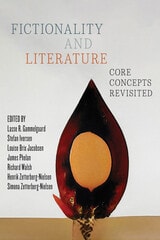
Fictionality and Literature
Core Concepts RevisitedEdited by Lasse R. Gammelgaard, Stefan Iversen, Louise Brix Jacobsen, James Phelan, Richard Walsh, Henrik Zetterberg-Nielsen, and Simona Zetterberg-Nielsen
The Ohio State University Press, 2022
Contributors:
H. Porter Abbott, Catherine Gallagher, Lasse R. Gammelgaard, Stefan Iversen, Louise Brix Jacobsen, Rikke Andersen Kraglund, Susan S. Lanser, Jakob Lothe, Maria Ma¨kela¨, Greta Olson, Sylvie Patron, James Phelan, Richard Walsh, Wendy Veronica Xin, Henrik Zetterberg-Nielsen, Simona Zetterberg-Nielsen