Results by title
102 books match the query 'Florida' and 9 start with f

Fair to Middlin'
The Antebellum Cotton Trade of the Apalachicola/Chattahoochee River ValleyLynn Willoughby
University of Alabama Press, 2009
This study focuses on the port of Apalachicola, Florida and the business men who lived the trade, flourishing amongst the poor conditions of transportation, communication, money, and banking. Cotton businessmen located along the waterway and on the coast neatly divided the labour necessary to market the region's major source of income.
Early regional economics revolved around and grew from the rivers that served as the primary form of transportation, and each patchwork of economy in the antebellum South relied on a different river system and its major transportation artery. Few people truly understand and realize how important cotton was to the world's economy, and no other American export came close to the importance of cotton. This power and success allowed the South to function self-sufficiently, eliminating the need to rely on other regions for goods. It was not until the introduction of the railroad system that these individual river economies blurred and faded into one another, gradually uniting to one integrated national economy.

Filibusters and Expansionists
Jeffersonian Manifest Destiny, 1800-1821Frank L. Owsley
University of Alabama Press, 2004
Uncover the untold story of America’s 19th-century adventurers and their quest for empire.
The first two decades of the 19th century found many Americans eager to move away from the crowded eastern seaboard and into new areas where their goals of landownership might be realized. Such movement was encouraged by Presidents Jefferson, Madison, and Monroe—collectively known as the Jeffersonians—who believed that the country's destiny was to have total control over the entire North American continent. Migration patterns during this time changed the country considerably and included the roots of the slavery controversy that ultimately led to the Civil War. By the end of the period, although expansionists had not succeeded in moving into British Canada, they had obtained command of large areas from the Spanish South and Southwest, including acreage previously controlled by Native Americans.
Utilizing memoirs, diaries, biographies, newspapers, and vast amounts of both foreign and domestic correspondence, Frank Lawrence Owsley Jr. and Gene A. Smith reveal an insider’s view of the filibusters and expansionists, the colorful—if not sometimes nefarious—characters on the front line of the United States’s land grab. Owsley and Smith describe in detail the actions and characters involving both the successful and the unsuccessful efforts to expand the United States during this period—as well as the outspoken opposition to expansion, found primarily among the Federalists in the Northeast.
Fishers At Work, Workers At Sea
Puerto Rican Journey Thru Labor & RefugeDavid Griffith and Manuel Valdés Pizzini
Temple University Press, 2002
Fishers at Work, Workers at Sea describes Puerto Rican fishing families as they negotiate homeland and diaspora. It considers how wage work affects their livelihoods and identities at home and how these independent producers move in and out of global commodity markets. Drawing on some 100 life histories and years of fieldwork, David Griffith and Manuel Valdés Pizzini have developed a complex, often moving portrait of the men and women who fiercely struggle to hang onto the coastal landscapes and cultural heritage tied to the Caribbean Sea.

Florida
Christine Schutt
Northwestern University Press, 2003
Florida is the portrait of the artist as a young woman, an orphan's story full of loss and wonder, a familiar tale told in original language. Alice Fivey, fatherless at age seven, is left in the care of her relatives at ten when her love-wearied mother loses custody of her and submits to the sanitarium and years of psychiatric care. A namesake daughter locked in the orphan's move-around life, she must hold still while the seamstress pins her into someone not her mother. But they share the same name, so she is her mother, isn't she?
Alice finds consolation in books and she herself is a storyteller who must build a home for herself word by right word. Florida is her story, recalled in brief scenes of spare beauty and strangeness as Alice moves from house to house, ever further from the desolation of her mother's actions, ever closer to the meaning of her experience. In this most elegiac and luminous novel, Schutt gives voice to the feast of memory, the mystery of the mad and missing, and above all, the life-giving power of language.
Florida Place-Names of Indian Origin and Seminole Personal Names
William A. Read
University of Alabama Press, 2003
A compendium of Indian-derived names from the three languages of the Muskhogean family—Seminole, Hitchiti, and Choctaw.
The first Native peoples of what is now the United States who met and interacted with Europeans were the people of the lower Southeast. They were individuals of the larger Maskókî linguistic family who inhabited much of present-day Florida, Georgia, Alabama, Mississippi, South Carolina, and eastern portions of Tennessee, Kentucky, and Louisiana. Today, sixteen federally recognized tribes trace their heritage from these early Maskókî peoples, and many of them in both Florida and Oklahoma still speak and understand this root language.
The continuing vitality of this core language, and of Seminole culture and influence, makes this linguistic examination by William Read ever more valuable. A companion to his study of Indian Place Names in Alabama, this long out-of-print guide offers a new introduction from Patricia Wickman in which she provides current understandings of Seminole language and derivations and a brief analysis of Read's contribution to the preservation of the Native linguistic record.
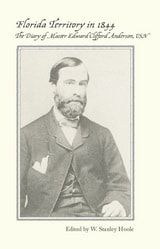
Florida Territory in 1844
The Diary of Master Edward Clifford Anderson, USNEdward Anderson, edited by W. Stanley Hoole
University of Alabama Press, 1977
Covers Edward Anderson’s service in Florida Territory from March 16 to December 31, 1844
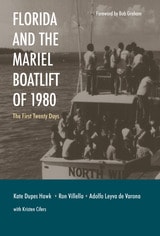
Florida and the Mariel Boatlift of 1980
The First Twenty DaysKate Dupes Hawk, Ron Villella, and Adolfo Leyva de Varona, with Kristen Cifers
University of Alabama Press, 2014
WINNER OF THE FLORIDA HISTORICAL SOCIETY'S STETSON KENNEDY AWARD
The definitive account of the first twenty days that transformed Florida, Cuba, and the American immigration debate.
The 1980 Mariel Boatlift was a profound episode in twentieth-century American history, impacting not just Florida, but the entire country. During the first twenty days of the boatlift, with little support from the federal government, the state of Florida coordinated and responded to the sudden arrival in Key West of more than thirty thousand Cuban refugees, the first wave of immigrants who became known as “Marielitos.”
Kathleen Dupes Hawk, Ron Villella, Adolfo Leyva de Varona, and Kristen Cifers combine the insights of expert observers with the experiences of actual participants. The authors organize and present a wealth of primary sources, first-hand accounts, archival research, government records, and interviews with policy-makers, volunteers, and refugees that bring into focus the many far-reaching human, political, and cultural outcomes of the Mariel Boatlift that continue to influence Florida, the United States, and Cuba today.
Emerging from these key records and accounts is a grand narrative of high human drama. Castro’s haphazard and temporary opening of Cuba spurred many thousands of Cubans to depart in calamitously rushed, unprepared, and dangerous conditions. The book tells the stories of these Cuban citizens, most legitimately seeking political asylum but also including subversive agents, convicted criminals, and the mentally ill, who began arriving in the US beginning in April 1980. It also recounts how local and state agencies and private volunteers with few directives or resources were left to improvise ways to provide the Marielitos food, shelter, and security as well as transportation away from Key West.
The book provides a definitive account of the political, legal, and administrative twists on the local, state, and federal levels in response to the crisis as well as of the often-dysfunctional attempts at collaboration between governmental and private institutions. Vivid and readable, Florida and the Mariel Boatlift of 1980 presents the significant details that illuminate and humanize this complex humanitarian, political, and logistical crisis.

Florida
A Fire SurveyStephen J. Pyne
University of Arizona Press, 2016
In this important new collection of essays on the region, Stephen J. Pyne colorfully explores the ways the region has approached fire management. Florida has long resisted national models of fire suppression in favor of prescribed burning, for which it has ideal environmental conditions and a robust culture. Out of this heritage the fire community has created institutions to match. The Tallahassee region became the ignition point for the national fire revolution of the 1960s. Today, it remains the Silicon Valley of prescription burning. How and why this happened is the topic of a fire reconnaissance that begins in the panhandle and follows Floridian fire south to the Everglades.
Florida is the first book in a multivolume series describing the nation’s fire scene region by region. The volumes in To the Last Smoke will also cover California, the Northern Rockies, the Great Plains, the Southwest, and several other critical fire regions. The series serves as an important punctuation point to Pyne’s fifty-year career with wildland fire—both as a firefighter and a fire scholar. These unique surveys of regional pyrogeography are Pyne’s way of “keeping with it to the end,” encompassing the directive from his rookie season to stay with every fire “to the last smoke.”
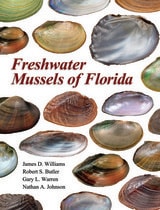
Freshwater Mussels of Florida
James D. Williams, Robert S. Butler, Gary L. Warren, and Nathan A. Johnson
University of Alabama Press, 2014
Each entry in this definitive guide provides a detailed description and multiple depictions of the species as well as select characteristics of its soft anatomy and miscellaneous notes of interest. Individual distribution maps pinpoint the historical and present occurrence of each bivalve species and are just one component of the rich set of 307 mussel and habitat photographs, seventy-four maps, and thirteen tables that illustrate the book. Of particular interest are remarkable electron micrographs of glochidia, the specialized larval life history stage parasitic upon fishes.
Freshwater Mussels of Florida will be of lasting value to state and federal conservation agencies as well as other government and nongovernment entities that manage aquatic resources in Florida. The research provides a key baseline for future study of Florida mussels. The survey results in this guide, along with extensive reviews of historical mussel collections in natural history museums, provide a complete picture of the Florida mussel fauna, past and present.