Results by title
93 books match the query 'Genocide & War Crimes' and 7 start with f

Failing Peace
Gaza and the Palestinian-Israeli ConflictSara Roy
Pluto Press, 2006
Discussion of Israeli policy toward Palestinians is often regarded as a taboo subject, with the result that few people - especially in the US - understand the origins and consequences of the conflict. This book provides an indispensable context for understanding why the situation remains so intractable.
The book focuses on the Gaza Strip, an area that remains consistently neglected and misunderstood despite its political centrality. Drawing on more than two thousand interviews and extensive firsthand experience, Sara Roy chronicles the impact of Israeli occupation in Palestine over nearly a generation.
Exploring the devastating consequences of socio-economic and political decline, this is a unique and powerful account of the reality of life in the West Bank and Gaza. Written by one of the world's foremost scholars of the region, it offers an unrivalled breadth of scholarship and insight.
[more]

Ferryman of Memories
The Films of Rithy PanhDeirdre Boyle
Rutgers University Press, 2023
Ferryman of Memories: The Films of Rithy Panh is an unconventional book about an unconventional filmmaker. Rithy Panh survived the Cambodian genocide and found refuge in France where he discovered in film a language that allowed him to tell what happened to the two million souls who suffered hunger, overwork, disease, and death at the hands of the Khmer Rouge. His innovative cinema is made with people, not about them—even those guilty of crimes against humanity. Whether he is directing Isabelle Huppert in The Sea Wall, following laborers digging trenches, or interrogating the infamous director of S-21 prison, aesthetics and ethics inform all he does. With remarkable access to the director and his work, Deirdre Boyle introduces readers to Panh’s groundbreaking approach to perpetrator cinema and dazzling critique of colonialism, globalization, and the refugee crisis. Ferryman of Memories reveals the art of one of the masters of world cinema today, focusing on nineteen of his award-winning films, including Rice People, The Land of Wandering Souls, S-21: The Khmer Rouge Killing Machine, and The Missing Picture.
[more]
Fools' Crusade
Yugoslavia, NATO and Western DelusionsDiana Johnstone
Pluto Press, 2002
In the endless series of United States military interventions, the 'humanitarian' bombing of Yugoslavia played a key role in gaining support of the centre left for war as an instrument of policy.
Thanks to massive deception and self-deception by media and politicians, even the anti-globalisation movement failed to grasp the implications of the aggressive military globalisation pursued by the United States, from Iraq to Afghanistan and beyond.
In this study, Diana Johnstone identifies the common geopolitical interests running through all these past, present and future military interventions. She argues persuasively that outside intervention creates rather than solves problems and cannot be justified.
Johnstone shows that the 'War in Kosovo' was in reality the model for future destruction of countries seen as potential threats to the hegemony of the 'International Community', led by the United States.
[more]
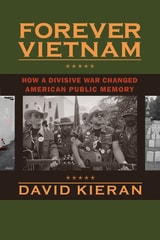
Forever Vietnam
How a Divisive War Changed American Public MemoryDavid Kieran
University of Massachusetts Press, 2014
Four decades after its end, the American war in Vietnam still haunts the nation's collective memory. Its lessons, real and imagined, continue to shape government policies and military strategies, while the divisions it spawned infect domestic politics and fuel the so-called culture wars. In Forever Vietnam, David Kieran shows how the contested memory of the Vietnam War has affected the commemoration of other events, and how those acts of remembrance have influenced postwar debates over the conduct and consequences of American foreign policy.
Kieran focuses his analysis on the recent remembrance of six events, three of which occurred before the Vietnam War and three after it ended. The first group includes the siege of the Alamo in 1836, the incarceration of Union troops at Andersonville during the Civil War, and the experience of American combat troops during World War II. The second comprises the 1993 U.S. intervention in Somalia, the crash of United Airlines Flight 93 on September 11, 2001, and the Iraq and Afghanistan wars.
In each case a range of actors—military veterans, policymakers, memorial planners, and the general public—used memorial practices associated with the Vietnam War to reinterpret the contemporary significance of past events. A PBS program about Andersonville sought to cultivate a sense of national responsibility for the My Lai massacre. A group of Vietnam veterans occupied the Alamo in 1985, seeing themselves as patriotic heirs to another lost cause. A World War II veteran published a memoir in 1980 that reads like a narrative of combat in Vietnam. Through these and other examples, Forever Vietnam reveals not only the persistence of the past in public memory but also its malleability in the service of the political present.
[more]
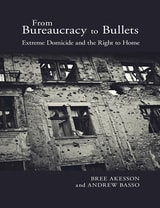
From Bureaucracy to Bullets
Extreme Domicide and the Right to HomeBree Akesson
Rutgers University Press, 2022
There are currently a record-setting number of forcibly displaced persons in the world. This number continues to rise as solutions to alleviate humanitarian catastrophes of large-scale violence and displacement continue to fail. The likelihood of the displaced returning to their homes is becoming increasingly unlikely. In many cases, their homes have been destroyed as the result of violence. Why are the homes of certain populations targeted for destruction? What are the impacts of loss of home upon children, adults, families, communities, and societies? If having a home is a fundamental human right, then why is the destruction of home not viewed as a rights violation and punished accordingly? From Bureaucracy to Bullets answers these questions and more by focusing on the violent practice of extreme domicide, or the intentional destruction of the home, as a central and overlooked human rights issue.
[more]
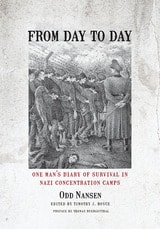
From Day to Day
One Man's Diary of Survival in Nazi Concentration CampsOdd Nansen
Vanderbilt University Press, 2016
This new hardcover edition of Odd Nansen's diary, the first in over sixty-five years, contains extensive annotations and other material not found in any other hardcover or paperback versions.
Nansen, a Norwegian, was arrested in 1942 by the Nazis, and spent the remainder of World War II in concentration camps--Grini in Oslo, Veidal above the Arctic Circle, and Sachsenhausen in Germany. For three and a half years, Nansen kept a secret diary on tissue-paper-thin pages later smuggled out by various means, including inside the prisoners' hollowed-out breadboards.
Unlike writers of retrospective Holocaust memoirs, Nansen recorded the mundane and horrific details of camp life as they happened, "from day to day." With an unsparing eye, Nansen described the casual brutality and random terror that was the fate of a camp prisoner. His entries reveal his constantly frustrated hopes for an early end to the war, his longing for his wife and children, his horror at the especially barbaric treatment reserved for Jews, and his disgust at the anti-Semitism of some of his fellow Norwegians. Nansen often confronted his German jailors with unusual outspokenness and sometimes with a sense of humor and absurdity that was not appreciated by his captors.
After the Putnam's edition received rave reviews in 1949, the book fell into obscurity. In 1956, in response to a poll about the "most undeservedly neglected" book of the preceding quarter-century, Carl Sandburg singled out From Day to Day, calling it "an epic narrative," which took "its place among the great affirmations of the power of the human spirit to rise above terror, torture, and death." Indeed, Nansen witnessed all the horrors of the camps, yet still saw hope for the future. He sought reconciliation with the German people, even donating the proceeds of the German edition of his book to German refugee relief work. Nansen was following in the footsteps of his father, Fridtjof, an Arctic explorer and humanitarian who was awarded the Nobel Peace Prize in 1922 for his work on behalf of World War I refugees. (Fridtjof also created the "Nansen passport" for stateless persons.)
Forty sketches of camp life and death by Nansen, an architect and talented draftsman, provide a sense of immediacy and acute observation matched by the diary entries. The preface is written by Thomas Buergenthal, who was "Tommy," the ten-year-old survivor of the Auschwitz Death March, whom Nansen met at Sachsenhausen and saved using his extra food rations. Buergenthal, author of A Lucky Child, formerly served as a judge on the International Court of Justice at The Hague and is a recipient of the 2015 Elie Wiesel Award from the US Holocaust Memorial Museum.
[more]
From War to Genocide
Criminal Politics in Rwanda, 1990–1994André Guichaoua, Translated by Don E. Webster, Foreword by Scott Straus
University of Wisconsin Press, 2017
In April 1994 Rwanda exploded in violence, with political, social, and economic divisions most visible along ethnic lines of the Hutu and Tutsi factions. The ensuing killings resulted in the deaths of as much as 20 percent of Rwanda's population. André Guichaoua, who was present as the genocide began, unfolds a complex story with multiple actors, including three major political parties that each encompassed a spectrum of positions, all reacting to and influencing a rapidly evolving situation. Economic polarities, famine-fueled privation, clientelism, corruption, north-south rivalries, and events in the neighboring nations of Burundi and Uganda all deepened ethnic tensions, allowing extremists to prevail over moderates.
Guichaoua draws on years of meticulous research to describe and analyze this history. He emphasizes that the same virulent controversies that fueled the conflict have often influenced judicial, political, and diplomatic responses to it, reproducing the partisan cleavages between the former belligerents and implicating state actors, international institutions, academics, and the media. Guichaoua insists upon the imperative of absolute intellectual independence in pursuing the truth about some of the gravest human rights violations of the twentieth century.
Guichaoua draws on years of meticulous research to describe and analyze this history. He emphasizes that the same virulent controversies that fueled the conflict have often influenced judicial, political, and diplomatic responses to it, reproducing the partisan cleavages between the former belligerents and implicating state actors, international institutions, academics, and the media. Guichaoua insists upon the imperative of absolute intellectual independence in pursuing the truth about some of the gravest human rights violations of the twentieth century.
[more]