Results by title
9 books match the query 'Ownership'
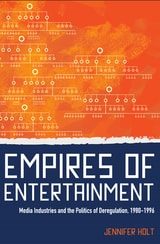
Empires of Entertainment
Media Industries and the Politics of Deregulation, 1980-1996Holt, Jennifer
Rutgers University Press, 2011
Empires of Entertainment integrates legal, regulatory, industrial, and political histories to chronicle the dramatic transformation within the media between 1980 and 1996. As film, broadcast, and cable grew from fundamentally separate industries to interconnected, synergistic components of global media conglomerates, the concepts of vertical and horizontal integration were redesigned. The parameters and boundaries of market concentration, consolidation, and government scrutiny began to shift as America's politics changed under the Reagan administration. Through the use of case studies that highlight key moments in this transformation, Jennifer Holt explores the politics of deregulation, the reinterpretation of antitrust law, and lasting modifications in the media landscape.
Holt skillfully expands the conventional models and boundaries of media history. A fundamental part of her argument is that these media industries have been intertwined for decades and, as such, cannot be considered separately. Instead, film, cable and broadcast must be understood in relation to one another, as critical components of a common history. Empires of Entertainment is a unique account of deregulation and its impact on political economy, industrial strategies, and media culture at the end of the twentieth century.
Geography and Ownership as Bases for Economic Accounting
Edited by Robert E. Baldwin, Robert E. Lipsey, and J. David Richardson
University of Chicago Press, 1998
This volume gives trade and international economists the data and resources to renew discussion of this timely issue.
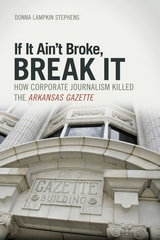
If It Ain't Broke, Break It
How Corporate Journalism Killed the Arkansas GazetteDonna Lampkin Stephens
University of Arkansas Press, 2015
Whereas the Heiskell/Patterson family had been committed to quality journalism, Gannett was focused on the bottom line. The corporation shifted the Gazette’s editorial focus from giving readers what they needed to be engaged citizens to informing them about what they should do in their leisure time. While in many ways the chain trivialized the Gazette’s mission, the paper managed to retain its superior quality. But financial concerns made the difference in Arkansas’s ongoing newspaper war. As the head of a privately held company, Hussman had only himself to answer to, and he never flinched while spending $42 million in his battle with the Pattersons and millions more against Gannett. Gannett ultimately lost $108 million during its five years in Little Rock; Hussman said his losses were far less but still in the tens of millions.
Gannett had to answer to nervous stockholders, most of whom had no tie to, or knowledge of, Arkansas or the Gazette. For Hussman, the Arkansan, the battle had been personal since at least 1978. It is no surprise that the corporation blinked first, and the Arkansas Gazette died on October 18, 1991, the victim of corporate journalism.

Managerial Capitalism
Ownership, Management, and the Coming New Mode of ProductionGérard Duménil and Dominique Lévy
Pluto Press, 2018
Drawing examples from the United States and Europe, the authors offer a historically rooted interpretation of major current economic and political trends. Without eschewing Marx’s theory of history and political economy, they update it to take account of the changes underway in class patterns and relationships to production. The result is a robust new Marxism for the present and the future.
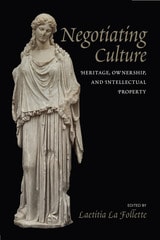
Negotiating Culture
Heritage, Ownership, and Intellectual PropertyLaetitia La Follette
University of Massachusetts Press, 2013
This provocative collection of essays—a series of case studies in cultural ownership by scholars from a range of fields—explores issues of cultural heritage and intellectual property in a variety of contexts, from contests over tangible artifacts as well as more abstract forms of culture such as language and oral traditions to current studies of DNA and genes that combine nature and culture, and even new, nonproprietary models for the sharing of digital technologies. Each chapter sets the debate in its historical and disciplinary context and suggests how the approaches to these issues are changing or should change.
One of the most innovative aspects of the volume is the way each author recognizes the social dimensions of group ownership and demonstrates the need for negotiation and new models. The collection as a whole thus challenges the reader to reevaluate traditional ways of thinking about cultural ownership and to examine the broader social contexts within which negotiation over the ownership of culture is taking place.
In addition to Laetitia La Follette, contributors include David Bollier, Stephen Clingman, Susan DiGiacomo, Oriol Pi-Sunyer, Margaret Speas, Banu Subramaniam, Joe Watkins, and H. Martin Wobst.

Nullius
The Anthropology of Ownership, Sovereignty, and the Law in IndiaKriti Kapila
HAU, 2022
Nullius is an award-winning anthropological account of the troubled status of ownership in India and its consequences for our understanding of sovereignty and social relations. Though property rights and ownership are said to be a cornerstone of modern law, in the Indian case they are often a spectral presence. Kapila offers a detailed study of paradigms where proprietary relations have been erased, denied, misappropriated.
The book examines three forms of negation, where the Indian state de facto adopted doctrines of terra nullius (in the erasure of indigenous title), res nullius (in acquiring museum objects), and, controversially, corpus nullius (in denying citizens ownership of their bodies under biometrics). The result is a pathbreaking reconnection of questions of property, exchange, dispossession, law, and sovereignty.
Nullius is the winner of the 2024 Bernard S. Cohn Prize, Association of Asian Studies.
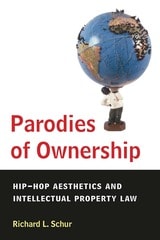
Parodies of Ownership
Hip-Hop Aesthetics and Intellectual Property LawRichard L. Schur
University of Michigan Press, 2009
"Richard Schur offers a provocative view of contemporary African American cultural politics and the relationship between African American cultural production and intellectual property law."
---Mark Anthony Neal, Duke University
"Whites used to own blacks. Now, they accomplish much the same thing by insisting that they 'own' ownership. Blacks shouldn't let them. A culture that makes all artists play by its rules will end up controlling new ideas and stifling change. Richard Schur's fine book explains why."
---Richard Delgado, Seattle University
What is the relationship between hip-hop and African American culture in the post--Civil Rights era? Does hip-hop share a criticism of American culture or stand as an isolated and unique phenomenon? How have African American texts responded to the increasing role intellectual property law plays in regulating images, sounds, words, and logos? Parodies of Ownership examines how contemporary African American writers, artists, and musicians have developed an artistic form that Schur terms "hip-hop aesthetics." This book offers an in-depth examination of a wide range of contemporary African American painters and writers, including Anna Deavere Smith, Toni Morrison, Adrian Piper, Colson Whitehead, Michael Ray Charles, Alice Randall, and Fred Wilson. Their absence from conversations about African American culture has caused a misunderstanding about the nature of contemporary cultural issues and resulted in neglect of their innovative responses to the post--Civil Rights era. By considering their work as a cross-disciplinary and specifically African American cultural movement, Schur shows how a new paradigm for artistic creation has developed.
Parodies of Ownership offers a broad analysis of post--Civil Rights era culture and provides the necessary context for understanding contemporary debates within American studies, African American studies, intellectual property law, African American literature, art history, and hip-hop studies. Weaving together law, literature, art, and music, Schur deftly clarifies the conceptual issues that unify contemporary African American culture, empowering this generation of artists, writers, and musicians to criticize how racism continues to affect our country.
Richard L. Schur is Director, Interdisciplinary Studies Center, and Associate Professor of Interdisciplinary Studies at Drury University. Visit the author's website: http://www2.drury.edu/rschur/index.htm.
The Rise of the African Novel
Politics of Language, Identity, and OwnershipMukoma Wa Ngugi
University of Michigan Press, 2018
Calling it a major crisis in African literary criticism, Mukoma Wa Ngugi considers key questions around the misreading of African literature: Why did Chinua Achebe’s generation privilege African literature in English despite the early South African example? What are the costs of locating the start of Africa’s literary tradition in the wrong literary and historical period? What does it mean for the current generation of writers and scholars of African literature not to have an imaginative consciousness of their literary past?
This book will become a foundational text in African literary studies, as it raises questions about the very nature of African literature and criticism. It will be essential reading for scholars of African literary studies as well as general readers seeking a greater understanding of African literary history and the ways in which critical consensus can be manufactured and rewarded at the expense of a larger and historical literary tradition.
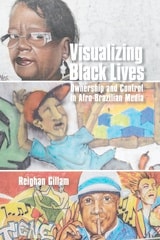
Visualizing Black Lives
Ownership and Control in Afro-Brazilian MediaReighan Gillam
University of Illinois Press, 2022
An eye-opening union of analysis and fieldwork, Visualizing Black Lives examines the alternative and activist Black media and the people creating it in today's Brazil.