Results by title
406 books match the query 'Greece' and 11 start with f

Fame, Money, and Power
The Rise of Peisistratos and "Democratic" Tyranny at AthensB. M. Lavelle
University of Michigan Press, 2005
--David Tandy, University of Tennessee
"Well researched and engaging, [Fame, Money, and Power] painstakingly builds [its] case for how the various phases of Peisistratos's career developed."
--Tony Podlecki, University of British Columbia
The Athenian "golden age" occurred in the fifth century B.C.E. and was attributed to their great achievements in art, literature, science, and philosophy. However, the most important achievement of the time was the political movement from tyranny to democracy. Though tyranny is thought to be democracy's opposite and deadly enemy, that is not always the case. In Fame, Money, and Power, Brian Lavelle states that the perceived polarity between tyranny and democracy does not reflect the truth in this instance.
The career of the tyrant Peisistratos resembles the careers and successes of early democratic soldier-politicians. As with any democratic political system, Peisistratos' governance depended upon the willingness of the Athenians who conceded governance to him. This book attempts to show how the rise of Peisistratos fits into an essentially democratic system already entrenched at Athens in the earlier sixth century B.C.E.
Emerging from the apparent backwater of eastern Attika, Peisistratos led the Athenians to victory over their neighbors, the Megarians, in a long, drawn out war. That victory earned him great popularity from the Athenians and propelled him along the road to monarchy. Yet, political success at Athens, even as Solon implies in his poems, depended upon the enrichment of the Athenian d?mos, not just fame and popularity. Peisistratos tried and failed two times to "root" his tyranny, his failures owing to a lack of sufficient money with which to appease the demos. Exiled from Athens, he spent the next ten years amassing money to enrich the Athenians and power to overcome his enemies. He then sustained his rule by grasping the realities of Athenian politics. Peisistratos' tyrannies were partnerships with the d?mos, the first two of which failed. His final formula for success, securing more money than his opponents possessed and then more resources for enriching the d?mos, provided the model for future democratic politicians of Athens who wanted to obtain and keep power in fifth-century Athens.
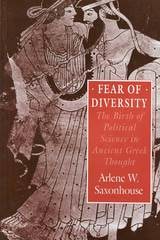
Fear of Diversity
The Birth of Political Science in Ancient Greek ThoughtArlene W. Saxonhouse
University of Chicago Press, 1992
Saxonhouse opens up fresh understandings of such issues as the Greeks' fear of the feminine and their attempts to ignore the demands that gender, reproduction, and the family inevitably make on the individual.
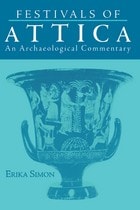
Festivals of Attica
An Archaeological CommentaryErika Simon
University of Wisconsin Press, 2002
The festivals of the Athenian sacred calendar constitute a vital key to classical Greek culture and religion. Erika Simon sets out here to explicate those complex and often obscure festivals. By careful marshaling of a variety of proofs from literary, historical, and archaeological sources, she is able to justify some startling conclusions and achieve a comprehensive and truly original synthesis that clarifies, as never before, the probable origins and meanings of the Attic cults.

Fictions of Sappho, 1546-1937
Joan DeJean
University of Chicago Press, 1989

Fields of Wheat, Hills of Blood
Passages to Nationhood in Greek Macedonia, 1870-1990Anastasia N. Karakasidou
University of Chicago Press, 1997
"Combining the thoughtful use of theory with a vivid historical ethnography, this is an important, courageous, and pioneering work which opens up the whole issue of nation-building in northern Greece."—Mark Mazower, University of Sussex
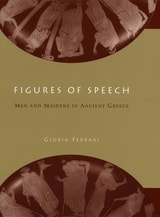
Figures of Speech
Men and Maidens in Ancient GreeceGloria Ferrari
University of Chicago Press, 2002
Ferrari begins by developing a theoretical perspective on visual representation, arguing that artistic images give us access to how their subjects were imagined rather than to the way they really were. For instance, Ferrari's examinations of the many representations of women working wool reveal that these images constitute powerful metaphors—metaphors, she argues, which both reflect and construct Greek conceptions of the ideal woman and her ideal behavior.
From this perspective, Ferrari studies a number of icons representing blameless femininity and ideal masculinity to reevaluate the rites of passage by which girls are made ready for marriage and boys become men. Representations of the nude male body in Archaic statues known as kouroi, for example, symbolize manhood itself and shed new light on the much-discussed institution of paiderastia. And, in Ferrari's hands, imagery equating maidens with arable land and buried treasure provides a fresh view of Greek ideas of matrimony.
Innovative, thought-provoking, and insightful throughout, Figures of Speech is a powerful demonstration of how the study of visual images as well as texts can reshape our understanding of ancient Greek culture.

Finding Italy
Travel, Nation, and Colonization in Vergil's AeneidK. F. B. Fletcher
University of Michigan Press, 2014
Finding Italy explores the journey of the Romans’ ancestor Aeneas and his fellow Trojans from their old home, Troy, to their new country, Italy, narrated in Vergil’s epic poem Aeneid. K. F. B. Fletcher argues that a main narrative theme is patriotism, specifically the problem of how one comes to love one’s new country. The various directions Aeneas receives throughout the first half of the poem are meant to create this love, explaining both to Aeneas and to Vergil’s readers how they should respond to the new, unified Italy synonymous with Rome. These directions come from the gods, or from people close to Aeneas who have divine connections, and they all serve to instill an emotional connection to the land, creating a mental image of Italy that tells him far more about his destination than merely its location, and ultimately making him fall in love with Italy enough to fight for it soon after his arrival. The poem thus dramatizes the birth of nationalism, as Italy is only a concept to Aeneas throughout his trip; these directions do not describe Italy as it is at the time of Aeneas’ journey, but as an ideal to be realized by Aeneas and his descendants, reaching its final, perfect form under Augustus Caesar.
Finding Italy provides a very detailed reading of the directions Aeneas receives by situating them within their relevant contexts: ancient geography, Greek colonization narratives, prophecy, and ancient views of wandering. Vergil draws on all of these concepts to craft instructions that create in Aeneas an attachment to Italy before he ever arrives, a process that dramatizes a key emotional problem in the late first century BCE in the wake of the Social and Civil Wars: how to balance the love of one's modest birthplace with the love of Rome, the larger city that now encompasses it.
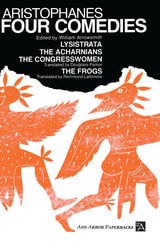
Four Comedies
Aristophanes
University of Michigan Press, 1969
Fragments of Death, Fables of Identity
An Athenian AnthropographyEleni Panourgia
University of Wisconsin Press, 1996
The death of her grandfather sets Neni Panourgiá and her readers on a path through the rituals of mourning and memory in modern urban Greece. Blending emotional richness and intellectual rigor, the anthropologist returns home in this exploration of kinship and identity within her own family and native city of Athens. What emerges is not only a new anthropological view of contemporary Greek culture, but also a reflective consideration of the self and subject.
Following men and women grappling with questions of mortality, Panourgiá moves through the streets and neighborhoods of Athens, seaside resorts and pistachio groves, the corridors and rooms of the Cancer Institute, wakes in apartments and observances in cemeteries. She mingles popular culture, venerable traditions, and contemporary theory as she considers how individuals define their identity as Athenians, as members of a family, as subjects of a polity, in sickness and in health, in death or in mourning. Memory is their guide as it negotiates their relationships with a personal, collective, and cultural past—and the memory of many deaths challenges and reaffirms, deconstructs and reconstructs who they are.
As intellectually ambitious as it is moving, Fragments of Death, Fables of Identity reconfigures the subject and object of anthropological study and recasts the line where experience ends and analysis begins.
From Villain to Hero
Odysseus in Ancient ThoughtSilvia Montiglio
University of Michigan Press, 2011
Praise for Silvia Montiglio
"[A] brilliant and important book. . . . "
---Journal of Religion, on Silence in the Land of Logos
"[A]n invigorating reevaluation of both the ancient symbolic landscape and our preconceptions of it."
---American Journal of Philology, on Wandering in Ancient Greek Culture
Best known for his adventures during his homeward journey as narrated in Homer's Odyssey, Odysseus remained a major figure and a source of inspiration in later literature, from Greek tragedy to Dante's Inferno to Joyce's Ulysses. Less commonly known, but equally interesting, are Odysseus' "wanderings" in ancient philosophy: Odysseus becomes a model of wisdom for Socrates and his followers, Cynics and Stoics, as well as for later Platonic thinkers. From Villain to Hero: Odysseus in Ancient Thought follows these wanderings in the world of ancient Greek and Roman philosophy, retracing the steps that led the cunning hero of Homeric epic and the villain of Attic tragedy to become a paradigm of the wise man.
From Villain to Hero explores the reception of Odysseus in philosophy, a subject that so far has been treated only in tangential or limited ways. Diverging from previous studies, Montiglio outlines the philosophers' Odysseus across the spectrum, from the Socratics to the Middle Platonists. By the early centuries CE, Odysseus' credentials as a wise man are firmly established, and the start of Odysseus' rehabilitation by philosophers challenges current perceptions of him as a villain. More than merely a study in ancient philosophy, From Villain to Hero seeks to understand the articulations between philosophical readings of Odysseus and nonphilosophical ones, with an eye to the larger cultural contexts of both. While this book is the work of a classicist, it will also be of interest to students of philosophy, comparative literature, and reception studies.
From a Year in Greece
By Frederic Will
University of Texas Press, 1967
In this book, the reader is privileged to take a leisurely and thoroughly enjoyable trip through the Greece of the mid-twentieth century, led by a poet-narrator who is a comfortable and engaging guide and complemented by the artwork of John Guerin.
Frederic Will recounts his odyssey: from Austria through Yugoslavia, across the northern Greek border, from Salonika to Athens and the Aegean Sea, to the site of remnants of Old Greece in Smyrna, Pergamum, and Ephesus, and finally to the monasteries on Mount Athos.
The author not only presents vivid descriptions of the towns and people in contemporary Greece but also conveys the still-present aura of the ancient Greek deities, in both the ruins and the modern cities. Witness the following passage written at Salonika, in Northern Greece, Will’s first stop of importance:
The sense-binding, sense-shaping ocean is omnipresent there. It is visible from nearly any point in the city. You only need to go up to your second story—if you have one. There is that pure, rhythmic, bounded but boundless element, spread somewhere at the bottom of the street. The same vision glimmers or stirs at the end of nearly every east-west-running street. Many townsmen spend much of their time promenading along the harbor. They seem to be subliminally magnetized to the sea.
I spent several weeks there. During that time I would often go up to the crowning Venetian walls, and look down onto Salonika and its harbor. From there Salonika’s deep dependence on the ocean became a fact proved by eyesight. The city is built on the half-moon-shaped plain of the Axios River. Two images came to me repeatedly: that Salonika is an amphitheater facing the ocean; or that she is a lover, reaching to embrace the ocean. Here are the hot, white (or cream-colored) buildings of the city; there is the element they thirst for.
Will gives a great deal of fascinating information but gives it gracefully and without excess. Above all, the narrative is suffused with the atmosphere, the emotions, and the beauty of Greece. The author has said he intends for this work to dramatize, not to instruct. Actually, it does both.