Results by title
438 books match the query 'Hispanic & Latino' and 20 start with f
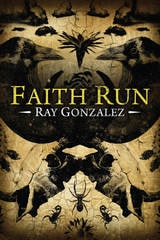
Faith Run
Ray Gonzalez
University of Arizona Press, 2009
For Gonzalez, it seems, we humans can transcend the ordinary—just as these poems transcend genre and create a poetic realm of their own—but we never actually leave behind our rooted, earthbound lives. Although our landscape may be invisible to us, we never escape its powerful magnetism. Nor do we ever abandon our ancestors. No matter how fast or far we run, we can never outrun them. Like gravity, their influence is inexorable.
These poems enchant with their language, which often leaps unexpectedly from worldly to otherworldly in the same stanza, but they cling and linger in our memories—not unlike the voices of friends and relatives.
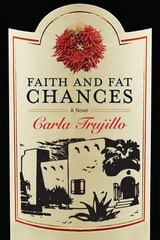
Faith and Fat Chances
A NovelCarla Trujillo
Northwestern University Press, 2015
Finalist, 2012 PEN/Bellwether Prize for Socially Engaged Fiction
Carla Trujillo brings to life another side of the fabled city of Santa Fe in this rollicking novel set in Dogtown, a dilapidated neighborhood on the outskirts of town. Home to a hardscrabble community of working people struggling to make a living on meager means, Dogtown is worlds apart from the tourists, artists, and upscale eateries just a stone’s throw away. The close-knit neighborhood thrives in its own way, until an entrepreneur arrives with a plan to cast out its occupants and construct a winery in its place.
Led by Dogtown’s unofficial mayor, Pepa Romero—an irreverent healer with old-world wisdom and new-age knowledge—the citizens of Dogtown revolt. Using everything at their disposal, including spying, supernatural powers, the law, and individual cunning, they set in motion a thrilling and at times hilarious chain of events that culminates in a storm of epic proportions. With an unforgettable cast of characters, Faith and Fat Chances illuminates the ingenuity and resilience of people fighting to preserve their way of life.
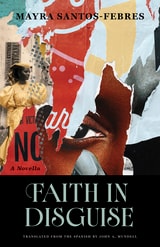
Faith in Disguise
A NovellaMayra Santos-Febres; Translated from the Spanish by John A. Mundell
Vanderbilt University Press, 2026
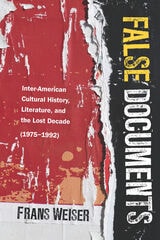
False Documents
Inter-American Cultural History, Literature, and the Lost Decade (1975–1992)Frans Weiser
The Ohio State University Press, 2020
After deconstructing economic accounts of the “two Americas" model of the hemisphere, including the lost decade (1981–1992) and the “end of history” (1975–1992), Weiser considers six case studies during the same period that reach very different conclusions by drawing on cultural history, including works by Tomás Eloy Martínez, Laura Antillano, Ana Maria Machado, Silviano Santiago, John Updike, and Jay Cantor. In order to expose how governments controlled and misrepresented recent events, these writers created false documents, or fake historical texts, that presented themselves as legitimate eyewitness accounts or archival documents. Weiser establishes how this alternative to postmodern irony more effectively galvanized citizen responses. As the first book to contextualize the parallel, hemispheric evolutions of postwar literary criticism and cultural historiography, False Documents responds to the methodological impasse between Latin American and American studies as well as the antagonism between history and literature, arguing that collaboration and synthesis are particularly vital at a moment when the humanities is increasingly under attack.
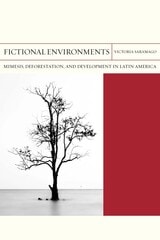
Fictional Environments
Mimesis, Deforestation, and Development in Latin AmericaVictoria Saramago
Northwestern University Press, 2021
Winner of the Brazilian Studies Association’s Roberto Reis Book Award for First Monograph • Honorable Mention for the Latin American Studies Association’s Antonio Candido Book Award • Shortlisted for the Association for the Study of Literature and Environment Book Award
Fictional Environments: Mimesis, Deforestation, and Development in Latin America investigates how fictional works have become sites for the production of knowledge, imagination, and intervention in Latin American environments. It investigates the dynamic relationship between fictional images and real places, as the lasting representations of forests, rural areas, and deserts in novels clash with collective perceptions of changes like deforestation and urbanization.
From the backlands of Brazil to a developing Rio de Janeiro, and from the rainforests of Venezuela and Peru to the Mexican countryside, rapid deforestation took place in Latin America in the second half of the twentieth century. How do fictional works and other cultural objects dramatize, resist, and intervene in these ecological transformations? Through analyses of work by João Guimarães Rosa, Alejo Carpentier, Juan Rulfo, Clarice Lispector, and Mario Vargas Llosa, Victoria Saramago shows how novels have inspired conservationist initiatives and offered counterpoints to developmentalist policies, and how environmental concerns have informed the agendas of novelists as essayists, politicians, and public intellectuals. This book seeks to understand the role of literary representation, or mimesis, in shaping, sustaining, and negotiating environmental imaginaries during the deep, ongoing transformations that have taken place from the 1950s to the present.
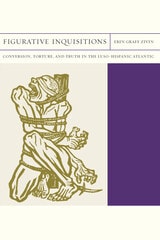
Figurative Inquisitions
Conversion, Torture, and Truth in the Luso-Hispanic AtlanticErin Graff Zivin
Northwestern University Press, 2014
Winner, 2015 LAJSA Best Book in Latin American Jewish Studies
The practices of interrogation, torture, and confession have resurfaced in public debates since the early 2000s following human rights abuses around the globe. Yet discussion of torture has remained restricted to three principal fields: the legal, the pragmatic, and the moral, eclipsing the less immediate but vital question of what torture does.Figurative Inquisitions seeks to correct this lacuna by approaching the question of torture from a literary vantage point.
This book investigates the uncanny presence of the Inquisition and marranismo (crypto-Judaism) in modern literature, theater, and film from Mexico, Brazil, and Portugal. Through a critique of fictional scenes of interrogation, it underscores the vital role of the literary in deconstructing the relation between torture and truth. Figurative Inquisitions traces the contours of a relationship among aesthetics, ethics, and politics in an account of the "Inquisitional logic" that continues to haunt contemporary political forms. In so doing, the book offers a unique humanistic perspective on current torture debates.
Filigrana encendida / Filigree of Light
Poemas / PoemsOlivia Maciel
Swan Isle Press, 2002
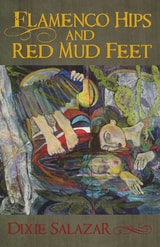
Flamenco Hips and Red Mud Feet
Dixie Salazar
University of Arizona Press, 2010
In the two sections of the book—“Inside” and “Outside”—parallelism and symmetry interact with themes both public and private. Flamenco Hips and Red Mud Feet presents thirty-nine poems in free verse and traditional poetic forms, especially the sonnet and adaptations of the sonnet. The sonnet—usually consisting of the octet (eight lines) that sets up the main idea of the poem and the sestet (six lines) that resolves, answers or completes the poem—is a natural form for a poet whose identity is divided. Double sonnets and “double-linked sonnets doubled” reflect the duality the poet feels inside her skin. And the poems written to and for a “lost sister” reinforce the theme.
Throughout this provocative book, Salazar navigates the alienation of her cultural in-between-ness. By the end, she appears to become more comfortable with her status of “outsider,” deciding that she doesn’t need to give in to pressures to pick a side or to accept others’ ideas of where her own “borders” begin or end.
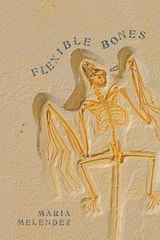
Flexible Bones
Maria Melendez
University of Arizona Press, 2010
The most modern of roller coasters ride on soft rubber tires and slithery smooth tracks. Gone are the days of jouncing along on steel wheels, smacking over hard metal joints. So it is with this book. Although readers are hurtled through time, space, and a universe of emotions, the ride is seductively smooth—and the transitions surprisingly seamless.
In the prologue, our attention bends to bridges, free-tail bats, soldiers, and peacemakers. These poems prepare us to watch for hopeful signs in the work ahead. In the first section, the spiritual seems to flow into the geopolitical—not in a hammer-you-over-the-head kind of way but in a blood-through-the-heart sort of way. In the second section, the spiritual mingles with the organic in a more personal way. By the end of the ride, we are aware that we have taken a trip with an intellectually fearless bushwhacker leading the way.
Anyone who has ever contemplated The Simpsons, sex-offender registries, desert internment camps, bats in flight, wars that never end, “la virgen,” grasshoppers, Google, or the cosmos will find a kindred spirit in Maria Melendez and a warm welcome in her work.
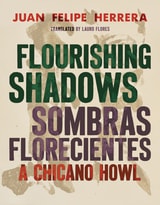
Flourishing Shadows / Sombras Florecientes
A Chicano HowlJuan Felipe Herrera; Translated by Lauro Flores
University of Arizona Press, 2026
From former U.S. poet laureate Juan Felipe Herrera comes a searing bilingual collection that speaks directly to America and all its peoples. Flourishing Shadows / Sombras Florecientes is a lyrical journey through migration, memory, and resistance—an urgent address to a nation grappling with its identity. Blending autobiography and Indigenous, Chicanx, and Beat traditions, Herrera reclaims language as a tool of compassion and truth. With ink drawings and evocative verse, this book honors the migrants who traverse borders and histories, flourishing even in the shadows. A call to listen, to remember, and to act.
More than a poetic critique, this book initiates a conversation—a direct address to readers that invites reflection, solidarity, and action. Drawing on his anthropological training and lived experience, Herrera weaves together the cultural richness of Indigenous Mexico, the urban vibrancy of San Francisco’s literary scene, and the enduring legacy of migrant journeys. Flourishing Shadows / Sombras Florecientes is a vital addition to the Camino del Sol series and a powerful testament to the resilience and humanity of those too often relegated to the margins.
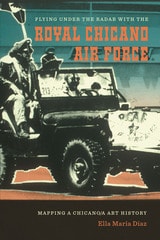
Flying Under the Radar with the Royal Chicano Air Force
Mapping a Chicano/a Art HistoryBy Ella Maria Diaz
University of Texas Press, 2017
Winner, National Association for Chicana and Chicano Studies Book Award, 2019
The Royal Chicano Air Force produced major works of visual art, poetry, prose, music, and performance during the second half of the twentieth century and first decades of the twenty-first. Materializing in Sacramento, California, in 1969 and established between 1970 and 1972, the RCAF helped redefine the meaning of artistic production and artwork to include community engagement projects such as breakfast programs, community art classes, and political and labor activism. The collective’s work has contributed significantly both to Chicano/a civil rights activism and to Chicano/a art history, literature, and culture.
Blending RCAF members’ biographies and accounts of their artistic production with art historical, cultural, and literary scholarship, Flying under the Radar with the Royal Chicano Air Force is the first in-depth study of this vanguard Chicano/a arts collective and activist group. Ella Maria Diaz investigates how the RCAF questioned and countered conventions of Western art, from the canon taught in US institutions to Mexican national art history, while advancing a Chicano/a historical consciousness in the cultural borderlands. In particular, she demonstrates how women significantly contributed to the collective’s output, navigating and challenging the overarching patriarchal cultural norms of the Chicano Movement and their manifestations in the RCAF. Diaz also shows how the RCAF’s verbal and visual architecture—a literal and figurative construction of Chicano/a signs, symbols, and texts—established the groundwork for numerous theoretical interventions made by key scholars in the 1990s and the twenty-first century.
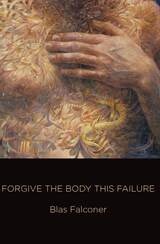
Forgive the Body This Failure
Blas Falconer
Four Way Books, 2018
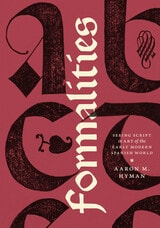
Formalities
Seeing Script in Art of the Early Modern Spanish WorldAaron M. Hyman
University of Chicago Press, 0
Examines the visual qualities of written words in works of art created from 1540 to 1700 across the transatlantic Spanish Empire.
Pieces of text are found across paintings produced in the early modern Spanish Empire, but their role as aesthetic elements has long been overlooked. With Formalities, Aaron M. Hyman argues that these words were important, not only because of their literal content but also because of their forms, which artists and their audiences across the Spanish world understood in terms of meanings beyond semantic content.
The widespread phenomenon of writing in or on works of art is one of the most distinctive features of art in the early modern Spanish world, yet it has received little art historical attention. Hyman focuses on this feature, demonstrating how artists mobilized particular scripts and carefully integrated the pictorial qualities of the written word. He explores how letterforms of the era were strictly codified, with different forms being particular to different genres and contexts. Chapters look at painted, embroidered, and incised words alongside texts in archival documents, books, and prints, showing how the visual arts drew on sources including calligraphy manuals, notarial documents, merchant account books, liturgical texts, and pictograms. Artists relied on their audiences’ understanding of the contexts in which such objects were used and connotations that texts thus produced, using visual languages to make meaning in addition to—or in spite of—what the words themselves actually said.
Fractures
Carlos Andrés Gómez
University of Wisconsin Press, 2020
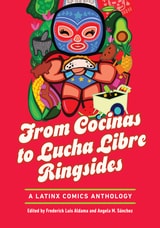
From Cocinas to Lucha Libre Ringsides
A Latinx Comics AnthologyEdited by Frederick Luis Aldama and Angela M. Sánchez
The Ohio State University Press, 2025
Contributors:
Aleasha Acevedo, José Alaniz, Frederick Luis Aldama, Julio Anta, Charlene Bowles, David Bowles, Adrian Carrillo, José Cabrera, Valerie Martinez Cabrera, Mauricio Alberto Cordero, Jaime Crespo, Celeste Cruz, Ernesto Cuevas Jr., Chris Escobar, Rolando Esquivel, Tim Fielder, Dustin Garcia, Eric J. García, Jorge Garza, Oscar Garza, Lucas Gattoni, Blas Goncalves-Borrego, Estella González, Carina Guevara, Aaron Guzman, Javier Hernandez, Sam Jimenez, Eric Kittelberger, Alberto Ledesma, Pablo Leon, Darren López, Patrick Lugo, Jarred A. Luján, Eliamaría Madrid, Miguel Martinez, Paloma Martínez-Cruz, Carlos Meyer, Marisol Meyer Driovínto, Paul Meyer, Rosie Murillo, Rafael Navarro, Daniel Parada, Stephanie Nina Pitsirilos, Jazmin Puente, Raúl the Third, Anna Maria Richardson, Hector Rodriguez III, Theresa Rojas, Rafael Rosado, Andrea Rosales, Justin Rueff, Irma Ruiz, Angela M. Sánchez, Serenity Serseción, Javier Solórzano, Josh Trujillo, Cayetano Valenzuela, Diana “Dianita” Vargas Sampieri, Andrés Vera Martínez
From This Wicked Patch of Dust
Sergio Troncoso
University of Arizona Press, 2011
Spanning four decades, this is a story of a family’s struggle to become American and yet not be pulled apart by a maelstrom of cultural forces. As a young adult, daughter Julieta is disenchanted with Catholicism and converts to Islam. Youngest son Ismael, always the bookworm, is accepted to Harvard but feels out of place in the Northeast where he meets and marries a Jewish woman. The other boys—Marcos and Francisco—toil in their father’s old apartment buildings, serving as the cheap labor to fuel the family’s rise to the middle class. Over time, Francisco isolates himself in El Paso while Marcos eventually leaves to become a teacher, but then returns, struggling with a deep bitterness about his work and marriage. Through it all, Pilar clings to the idea of her family and tries to hold it together as her husband’s health begins to fail.
This backdrop is then shaken to its core by the historic events of 2001 in New York City. The aftermath sends shockwaves through this newly American family. Bitter conflicts erupt between siblings and the physical and cultural spaces between them threaten to tear them apart. Will their shared history and once-common dreams be enough to hold together a family from Ysleta, this wicked patch of dust?
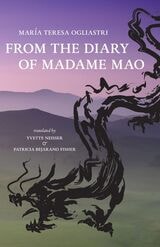
From the Diary of Madame Mao
María Teresa Ogliastri
Carnegie Mellon University Press, 2026
Fictionalized poems that embody the reality of life in twentieth-century China through the voice of Jiang Qing, the wife of Mao Zedong.
From the Diary of Madame Mao is a poetry collection of fictionalized diary entries in the voice of Jiang Qing, wife of Mao Zedong and a vilified leader of the “Gang of Four," a Maoist political faction which wielded unchecked and violent suppression of dissent during China’s Cultural Revolution (1966–76). The haunting voice in this collection recounts the events of twentieth-century China through the imagined inner thoughts of Jiang, a liberated woman in a male-dominated society who struggled to fend for herself but then, upon gaining totalitarian power, became “mentally ill.” Maria Teresa Ogliastri—who has lived under authoritarian regimes in Venezuela for more than two decades— “opts for compassion” in her portrayal of this infamous public figure, conveying the full complexity of human emotion and experience in her singular lyric voice.
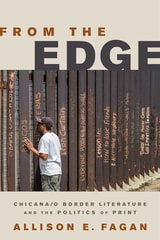
From the Edge
Chicana/o Border Literature and the Politics of PrintFagan, Allison E
Rutgers University Press, 2016
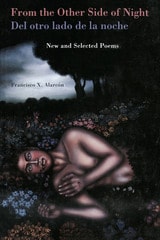
From the Other Side of Night/Del otro lado de la noche
New and Selected PoemsFrancisco X. Alarcón
University of Arizona Press, 2002
One of Chicano literature's premier poets, Alarcón has brought his luminous images to the page in such acclaimed volumes as Sonnets to Madness and Other Misfortunes and Snake Poems. Now he has assembled the best of his work from fifteen years, along with fourteen new poems, in a book that distills his magical sense of reality into a cup brimming with passion.
Raised in Guadalajara and now living in the San Francisco Bay area, Alarcón sees that " 'Mexican' / is not / a noun / or an / adjective / 'Mexican' / is a life / long / low-paying / job." Participating in a poetic tradition that goes back to the mystic Spanish poets of the sixteenth century, he brings us sonnets infused with romance and tenderness—and shorter poems that are direct and hard-hitting commentaries on American society, as he cries out for "a more godlike god," one "who spends nights / in houses / of ill repute / and gets up late / on Saturdays."
Alarcón invokes both the mysteries of Mesoamerica and the "otherness" of his gay identity. "My skin is dark / as the night / in this country / of noontime," he writes, "but my soul / is even darker / from all the light / I carry inside." In lyrical poems open to wide interpretation, he transcends ethnic concerns to address social, sexual, and historical issues of concern to all Americans. The fourteen new poems in From the Other Side of Night offer startling new commentaries on life and love, sex and AIDS.
Shifting effortlessly between English and Spanish—and even Nahuatl—Alarcón demonstrates the gift of language that has earned him both a wide readership and the admiration of fellow poets. With this book, he invites new readers to meet him where the darkness is palpable and the soul burns bright.
Full Foreground
Roberto Tejada
University of Arizona Press, 2012
Poet Roberto Tejada uses lyrical poems to explore and give a voice to the troubles of global citizenship, US–Mexico relations, Latino identity, and the political emotion of queer sexualities. His collection provides a holistic ground-level view of pivotal world events from the mid 1990s to a more recent present.
Tejada’s innovative work dramatically widens the scope of Latina/o literature, showing us exactly what it can accomplish. The poems move very much like a three-act play, in which the first act is one of origins; the second, a staging of desire; and the third, a symbiosis. These acts magnify one another when unified. Each poem within the collection positions itself within the avant-garde, in which the artful use of language aims to dazzle, surprise, and enliven. The poems dance by, preserving a tension between hurry and delay, momentum and stasis, and every line is like a newly launched firecracker, sending out startling patterns of spark and flare.
Tejada’s exuberant language stretches the limits of selfhood and the way it is represented in poetry. He illuminates the tangled webs that are woven when identities are linked to sexuality, nationality, privilege, and temporality. The concerns and obsessions voiced here turn the construction of desire on its head, forcing us to ask ourselves what is worthy of our attentions.