Results by title
12 books match the query 'Gesture'
From Gesture to Language in Hearing and Deaf Children
Virginia Volterra
Gallaudet University Press, 1994
Renowned scholars contributing to this volume include Ursula Bellugi, Judy Snitzer Reilly, Susan Goldwin-Meadow, Andrew Lock, M. Chiara Levorato, and many others.
Gestural Listening In and Beyond the Classroom
Laura Feibush
Utah State University Press, 2026
Attuned to the subtle choreographies of the classroom, Gestural Listening In and Beyond the Classroom investigates how students and instructors show that they are listening to each other—and, sometimes, that they are not. While rhetorical scholarship traditionally focuses on speaking and writing, listening can also be understood as a rhetorical force that makes things happen. Listening has the power to move, bring about, cause, and catalyze. This conductive aspect of listening is its embodied manifestation—termed “gestural listening.”
Laura Feibush first traces the roots of embodied listening through cultural and rhetorical history and then uses findings from a classroom study to inform an insightful discussion of respect, resistance, and self-regulation as the key dynamics that characterize listening in contemporary educational spaces. She reveals how the gestures of listening refract across identity categories in ways that have surprising effects on how classroom participants respond to one another. This accessibly written book attends to hands and faces, nodding and note-taking, and the presence of phones and laptops, as well as other forms of nonverbal backchanneling, such as where people sit, when they interrupt, and when they engage in impactful quietness.
The power of gestural listening is not limited to the classroom. Its quiet yet profound influence can elucidate many sites of interaction: in-person and virtual academic settings as well as those far beyond the educational space, such as scenes of protest, worship, and performance. Gestural Listening In and Beyond the Classroom shows how, when understood as possessing its own repertoire of impressive and expressive capacities, listening emerges as a fascinating site of study and offers exercises, activities, and other materials to help educators, counselors, and all those engaging in communicative work enact a new awareness of gestural listening as a rhetorical force.
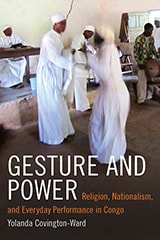
Gesture and Power
Religion, Nationalism, and Everyday Performance in CongoYolanda Covington-Ward
Duke University Press, 2016
Gesture and Thought
David McNeill
University of Chicago Press, 2005
Gesture and Thought expands on McNeill’s acclaimed classic Hand and Mind. While that earlier work demonstrated what gestures reveal about thought, here gestures are shown to be active participants in both speaking and thinking. Expanding on an approach introduced by Lev Vygotsky in the 1930s, McNeill posits that gestures are key ingredients in an “imagery-language dialectic” that fuels both speech and thought. Gestures are both the “imagery” and components of “language.” The smallest element of this dialectic is the “growth point,” a snapshot of an utterance at its beginning psychological stage. Utilizing several innovative experiments he created and administered with subjects spanning several different age, gender, and language groups, McNeill shows how growth points organize themselves into utterances and extend to discourse at the moment of speaking.
An ambitious project in the ongoing study of the relationship of human communication and thought, Gesture and Thought is a work of such consequence that it will influence all subsequent theory on the subject.
Gesture in Multiparty Interaction
Emily Shaw
Gallaudet University Press, 2018
Shaw filmed Deaf and hearing participants playing a gesture-based game as part of a social game night. Their interactions were then studied using discourse analysis to see whether and how Deaf and hearing people craft discourses through the use of their bodies. This volume examines gesture, not just for its iconic, imagistic qualities, but also as an interactive resource in signed and spoken discourse. In addition, Shaw addresses the key theoretical barriers that prevent a full accounting of gesture’s interface with signed and spoken language. Her study pushes further the notion that language is fundamentally embodied.

Gestures
Vilém Flusser
University of Minnesota Press, 2014
Throughout his career, the influential new media theorist Vilém Flusser kept the idea of gesture in mind: that people express their being in the world through a sweeping range of movements. He reconsiders familiar actions—from speaking and painting to smoking and telephoning—in terms of particular movement, opening a surprising new perspective on the ways we share and preserve meaning. A gesture may or may not be linked to specialized apparatus, though its form crucially affects the person who makes it.
These essays, published here as a collection in English for the first time, were written over roughly a half century and reflect both an eclectic array of interests and a durable commitment to phenomenological thought. Defining gesture as “a movement of the body or of a tool attached to the body for which there is no satisfactory causal explanation,” Flusser moves around the topic from diverse points of view, angles, and distances: at times he zooms in on a modest, ordinary movement such as taking a photograph, shaving, or listening to music; at others, he pulls back to look at something as vast and varied as human “making,” embracing everything from the fashioning of simple tools to mass manufacturing. But whatever the gesture, Flusser analyzes it as the expression of a particular form of consciousness, that is, as a particular relationship between the world and the one who gestures.
Gilbert Austin's "Chironomia" Revisited
Sympathy, Science, and the Representation of MovementSara Newman and Sigrid Streit
Southern Illinois University Press, 2020
Austin did not simply categorize gesture mechanically, separating delivery from rhetoric and the discipline’s overall goals, but instead he provided a theoretical framework of written descriptions and illustrations that positions delivery as central to effective rhetoric and civic interactions. Balancing the variable physical elements of human interactions as well as the demands of communication, Austin’s system fortuitously anticipated contemporary inquiries into embodied and nonverbal communication. Enlightenment rhetoricians, scientists, and physicians relied on sympathy and its attendant vivacious and lively ideas to convey feelings and facts to their varied audiences. During the seventeenth and eighteenth-centuries, as these disciplines formed increasingly distinct, specialized boundaries, they repurposed existing, shared communication conventions to new ends. While the emerging standards necessarily diverged, each was grounded in the subjective, embodied bedrock of the sympathetic, magical tradition.
Hand and Mind
What Gestures Reveal about ThoughtDavid McNeill
University of Chicago Press, 1992

Kinesis
The Ancient Depiction of Gesture, Motion, and EmotionChristina A. Clark, Edith Foster, and Judith P. Hallett, editors
University of Michigan Press, 2015

Original Signs
Gesture, Sign, and the Sources of LanguageDavid F. Armstrong
Gallaudet University Press, 2002
In the ongoing debate about evolution, scholars frequently argue either the perspective that humans stand as the end product of a deliberate process or that they derive from a series of random acts of natural selection. David F. Armstrong’s new book Original Signs embraces the Darwinian concept of natural selection and extends it to apply to the formation of language. While most current linguistic theory envisions language as a system for translating the contents of the mind into linear strings of arbitrary symbols, Armstrong asserts that this model does not characterize signed languages. He shows that language is inherently a multichannel activity, of which the two primary channels are auditory and visual.
Original Signs employs a more expansive notion of language that takes into account the full range of human communicative behavior. By making no strict separation between language and gesture, this thought-provoking work reveals that the use by deaf people of signs to create a fully formed language is also a natural facet of communication development for hearing people.
Armstrong explores the influences of Plato and Descartes on modern linguistics, and delineates the theories of earlier anthropological linguists Edward Sapir and Benjamin Lee Whorf, who thought of language as natural experiments connected to individual cultures. This exceptional work of scholarship methodically demonstrates that the intricacies of how languages develop, whether they depend upon words or signs, and that the complexity among languages that contact one another cannot be accounted for by the sequential hierarchical processes previously put forth by linguists and logicians. Original Signs will prove to be a fascinating, watershed work invaluable to linguists, anthropologists, and all other scholars and students engaged in the search for the origin of language.

Show of Hands
A Natural History of Sign LanguageDavid F. Armstrong
Gallaudet University Press, 2011
Most scholarly speculation on the origin of human language has centered around speech. However, the growing understanding of sign languages on human development has transformed the debate on language evolution. David F. Armstrong’s new book Show of Hands: A Natural History of Sign Language casts a wide net in history and geography to explain how these visible languages have enriched human culture in general and how their study has expanded knowledge of the human condition.
Armstrong addresses the major theories of language evolution, including Noam Chomsky’s thesis of an innate human “organ” for language and Steven Pinker’s contention that there is language and not-language without any gradations between gesture and language. This engrossing survey proceeds with William C. Stokoe’s revival of the early anthropological cognitive-linguistic model of gradual development through the iconicity of sign languages. Armstrong ranges far to reveal the nature of sign languages, from the anatomy of early human ancestors to telling passages by Shakespeare, Dickens, and Pound, to the astute observations of Socrates, Lucretius, and Abbé de l’Epée on sign communication among deaf people. Show of Hands illustrates the remarkable development of sign languages in isolated Bedouin communities and among Australian indigenous peoples. It also explores the ubiquitous benefits of “Deaf Gain” and visual communication as they dovetail with the Internet and its mushrooming potential for the future.

The Stony Dance
Unity and Gesture in Andrey Bely's PetersburgTimothy Langen
Northwestern University Press, 2005
Thoroughly versed in Russian and European modernism, in Bely's biography and writings, and in twentieth-century literary theory, Langen constructs an original analytic scheme for reading Petersburg. Guided by Bely's fertile but challenging notions of art and philosophy, he analyzes the novel first as an object embodying intentions and essences, then as a pattern of signification and events, and finally as a dance of gestures that coordinate body and meaning, regularity and surprise, self and other, and author, novel, and reader. The terms are derived from Bely's own writings, but they are nuanced with reference to Russian and European contexts and clarified with reference to philosophy and literary theory. Langen shows how Bely invariably challenges his own concepts and patterns, thereby creating an unusually demanding and dynamic text. In finding an approach to these enriching difficulties, this book at long last shows readers a welcoming way into Bely's thought, and his masterwork, and their place in the complex world of early twentieth-century literature.