Results by title
884 books match the query 'Historical' and 33 start with f

Faces in the Fire
The Women of Beowulf: Book OneDonnita L. Rogers
Arizona Center for Medieval and Renaissance Studies, 2013

Faith in Disguise
A NovellaMayra Santos-Febres; Translated from the Spanish by John A. Mundell
Vanderbilt University Press, 2026
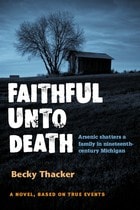
Faithful Unto Death
Becky Thacker
University of Michigan Press, 2011
Benzonia, Michigan, 1894: a sleepy Congregationalist community, dedicated to the education of hardworking and virtuous young people of both sexes and all races. Anna Spencer Thacker is the daughter of missionaries, a faithful wife, and mother of five, pious to a fault. She is suddenly stricken with a mysterious ailment that soon proves fatal. Was it truly an unfortunate illness? Or was it murder—or suicide?
Taking a true story of a murder in her own family, Becky Thacker has crafted a historical mystery novel whose cast of characters rapidly builds, including William Henry Thacker as deputy sheriff, deacon in his church, a kind man . . . but perhaps just a trifle too fond of the attractive young housekeeper; and Charlotte Spencer, the pretty missionary sister, almost saintly in her efforts to bring Jesus to the Armenians in the mountains of Turkey, though a bit prone to exaggeration. She could be a suspect—or the next target.
The children are Roy, 19: musical, a good student, but a little too wild for Benzonia; Ralph, 17: trying to shoulder the responsibilities of farm and family; and Lottie, 14: a talented young artist trying to take care of young Will and Josie. Faithful Unto Death provides a window into the daily lives of small-town Michiganders at the turn of the century wrapped up in a riveting whodunit.
Cover image by Hemera/Thinkstock
Fanning the Flames
The Women of Beowulf Book 2Donnita L. Rogers
Arizona Center for Medieval and Renaissance Studies, 2014
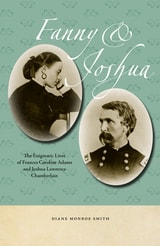
Fanny & Joshua
The Enigmatic Lives of Frances Caroline Adams and Joshua Lawrence ChamberlainDiane Monroe Smith
University Press of New England, 2013
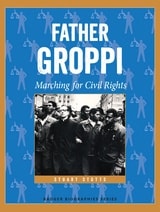
Father Groppi
Marching for Civil RightsStuart Stotts
Wisconsin Historical Society Press, 2013
Father Groppi Marched to Change Milwaukee
"Father Groppi: Marching for Civil Rights" tells the story of Father James Groppi, a Catholic priest from Milwaukee, Wis., who stood up for civil rights in the 1960s and 1970s.
This important new addition to the Badger Biographies series for young readers also tells about a turbulent time in Wisconsin history and sheds light on the civil rights movement and its place in the North.
Growing up on the south side of Milwaukee as the son of Italian immigrants, young James Groppi learned early on what it felt like to be made fun of just because of who you are, and he learned to respect people from other races and ethnic groups. Later, while studying to become a priest, he saw the discrimination African Americans faced. It made him angry, and he vowed to do whatever he could to fight racism.
Father Groppi marched with Dr. Martin Luther King Jr. and other leaders of the civil rights movement. But he knew there was work to be done in his own city. In Milwaukee, he teamed up with the NAACP and other organizations, protesting discrimination and segregation wherever they saw it. It wasn't always easy, and Father Groppi and the other civil rights workers faced great challenges.

Fatty
A NovelNatalie Rogers
Northwestern University Press, 2027
A poignant coming-of-age novel inspired by martial arts films and family lore about powerful ghost brides
Fatty Wong is a streetwise eleven-year-old in 1960s colonial Hong Kong who dreams of ruling the world. She fights daily for a better life, but in an era of great political turmoil, Fatty faces struggles in the streets of her working-class village—and inside her own home. As the city’s youth begins protesting British rule and local communists mimic the Cultural Revolution that has ignited chaos across mainland China, Fatty grapples with her own desire for freedom and spars with the neighborhood kids to discover her strength through kung fu. She takes a job at a convenience store to carve a space of her own, only to be sexually abused by the owner. Increasingly attuned to the spirit world, Fatty is visited by a neighbor boy who was shot and killed during a riot; his ghost offers to help her escape her anguish if she cares for his grieving mother. Now Fatty must embark on an adventure that will demand she discover her true identity—and raise a fist to anyone attempting to stifle her spirit.
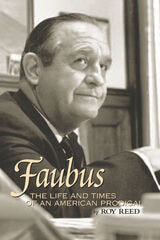
Faubus
The Life and Times of an American ProdigalRoy Reed
University of Arkansas Press, 1999
New York Times Book Review Notable Book for 1997
1998 Certificate of Commendation, American Association for State and Local History
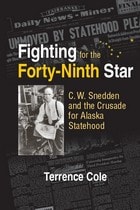
Fighting for the Forty-Ninth Star
C. W. Snedden and the Crusade for Alaska StatehoodTerrence Cole
University of Alaska Press, 2010
C.W. "Bill" Snedden, the publisher of America's farthest north daily newspaper, the Fairbanks Daily News-Miner, helped lead the battle of the Far North against the Deep South. Working behind the scenes with his protege, a young attorney named Ted Stevens, and a fellow Republican newspaperman, Secretary of Interior Fred Seaton, Snedden's "magnificent obsession" would open the door to development of the oil fields at Prudhoe Bay, inspire establishment of the Arctic Wildlife Range (now the Arctic National Wildlife Refuge), and add the forty-ninth star to the flag.
Fighting for the Forty-Ninth Star is the story of how the publisher of a little newspaper four thousand miles from Washington, D.C., helped convince Congress that Alaskans should be second-class citizens no more.
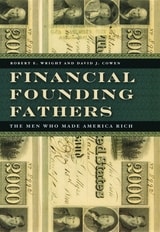
Financial Founding Fathers
The Men Who Made America RichRobert E. Wright and David J. Cowen
University of Chicago Press, 2006
Robert E. Wright and David J. Cowen here chronicle how a different group of founding fathers forged the wealth and institutions necessary to transform the American colonies from a diffuse alliance of contending business interests into one cohesive economic superpower. From Alexander Hamilton to Andrew Jackson, the authors focus on the lives of nine Americans in particular—some famous, some unknown, others misunderstood, but all among our nation’s financial founding fathers. Such men were instrumental in creating and nurturing a financial system that drove economic growth in the nascent United States because they were quick to realize that wealth was as crucial as the Constitution in securing the blessings of liberty and promoting the general welfare. The astonishing economic development made possible by our financial founding fathers was indispensable to the preservation of national unity and of support for a government that was then still a profoundly radical and delicate political experiment.
Grand in scope and vision, Financial Founding Fathers is an entertaining and inspiring history of the men who made America rich and steered her toward greatness.
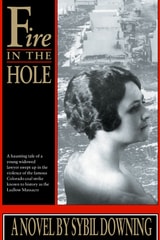
Fire in the Hole
Sybil Downing
University Press of Colorado, 1996

Fire on Water
Porgess and The AbyssArnost Lustig
Northwestern University Press, 2005
It occurred to me why I was able to forgive the Italians, but never the Germans. Was it because the Italians never slept on mattresses stuffed with the hair of Luster Leibling or Weltfeind Flusser?
In this pair of short novels, Arnošt Lustig continues his lifelong project of creating a universe-at once concrete and dreamlike-to examine the horrors of the Holocaust and the impossible burden of living as a survivor.
The Abyss is the fragmented memories of David Wiesenthal, aged twenty, tortured by what he has witnessed and by the knowledge that luck-not skill, not courage, certainly not goodness-separated the survivors from the doomed. He seeks solace remembering the women he's loved or desired, even the one who represents his death.
In Porgess, the narrator recounts the life of the title character, "the most handsome boy in Jewish Prague" who was paralyzed on the last day of World War II. The two discuss their mutual fascinations-women, jazz, the significance of numbers-in sometimes bitter, sometimes sardonic voices, but always with the specters of the dead and the guilt of survival close at hand.
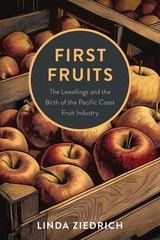
First Fruits
The Lewellings and the Birth of the Pacific Coast Fruit IndustryLinda Ziedrich
Oregon State University Press, 2025
2025 Choice Outstanding Academic Title
First Fruits offers a fascinating look at the lives of Pacific Coast horticulturists Henderson, Jonathan, and Seth Lewelling. Traveling across the Overland Trail—Henderson to Oregon in 1847, with a wagonload of fruit trees, and Seth and John to California three years later—the brothers would establish themselves as pioneers in the West’s growing fruit industry. By recounting how Henderson planted the first orchard of grafted fruit trees in Oregon, how Seth originated the Black Republican and Bing cherries, and how John led the development of the Napa Valley wine industry, First Fruits preserves the Lewellings’ place in history.
However, the Lewellings were not simply planters, grafters, and breeders. They were also adventurers, colonists, gold seekers, reformists, and explorers—experiencing firsthand the westward expansion of the nation. Their stories provide a unique glimpse into the social, economic, and political history of the day. From their Quaker upbringing in North Carolina and Indiana to Henderson’s attempt to start a utopian colony in Honduras, John’s efforts to grow the Grange in California, and Seth’s contribution to democratic reforms in Oregon, the Lewellings’ legacy extends far beyond their agricultural endeavors.
In the first biography to reclaim the brothers’ histories, Linda Ziedrich splendidly captures their dedicated support of one another and their communities, their contributions to the development of the modern fruit industry, and their lasting influence on the cultivation of fruits synonymous with the Pacific Coast region.
For the Good of Humanity
Ludwik Rajchman, Medical StatesmanMarta A. Balinska
Central European University Press, 1998

Ford Road
Amy Kenyon
University of Michigan Press, 2012
After the death of her mother, Kay Seger abandons her career as a historical consultant to a Los Angeles film company and returns to her childhood home in Michigan. There, she rekindles a teenage love affair with Joe Chase, now a Vietnam War veteran and Ford auto worker. Afflicted by grief and the mysterious symptoms of an unidentified ailment, Kay, at Joe's urging, begins an investigation of her family's past.
As Kay pores over the boxes of papers, letters, and photo albums her mother left behind, vivid recollections of a bygone Detroit, ragged and teeming at the start of the automotive age, come to life alongside snapshots of Michigan's rural western counties after the settlement of the frontier. In the midst of her searches, Kay comes across the long-forgotten medical history of nostalgia, and it is this new knowledge that helps her to recover the lost histories of her family and find a resolution to her troubled relationship with Joe.
An exploration of memory as both pathology and promise, Ford Roadoffers a moving examination of the injuries we inflict on the people closest to us, the worldly injuries that are often beyond our control, and our astonishing ability to act upon and inhabit our own stories. It is also a meditation on American car culture, the road, and the role of early Hollywood in the creation of America's vision of itself. Written in spare, evocative prose, historian Amy Kenyon's first novel is as heartbreaking as it is thought-provoking.
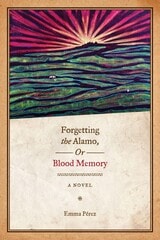
Forgetting the Alamo, Or, Blood Memory
A NovelBy Emma Pérez
University of Texas Press, 2009
Runner-up, Best Historical Fiction in English, Latino Book Awards Competition, 2010
This literary adventure takes place in nineteenth-century Texas and follows the story of a Tejana lesbian cowgirl after the fall of the Alamo. Micaela Campos, the central character, witnesses the violence against Mexicans, African Americans, and indigenous peoples after the infamous battles of the Alamo and of San Jacinto, both in 1836. Resisting an easy opposition between good versus evil and brown versus white characters, the novel also features Micaela's Mexican-Anglo cousin who assists and hinders her progress. Micaela's travels give us a new portrayal of the American West, populated by people of mixed races who are vexed by the collision of cultures and politics. Ultimately, Micaela's journey and her romance with a black/American Indian woman teach her that there are no easy solutions to the injustices that birthed the Texas Republic.
This novel is an intervention in queer history and fiction with its love story between two women of color in mid-nineteenth-century Texas. Pérez also shows how a colonial past still haunts our nation's imagination. The battles of the Alamo and San Jacinto offered freedom and liberty to Texans, but what is often erased from the story is that common people who were Mexican, Indian, and Black did not necessarily benefit from the influx of so many Anglo immigrants to Texas. The social themes and identity issues that Pérez explores—political climate, debates over immigration, and historical revision of the American West—are current today.
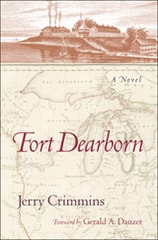
Fort Dearborn
A NovelJerry Crimmins
Northwestern University Press, 2008
In a story that brings to life the founding of one of the world's great cities, Fort Dearborn takes us back to Chicago's early struggle of fire and blood. Through the eyes of two young boys and their fathers—one father a sergeant with the United States First Infantry, the other a Potawatomi warrior—we see the events that lead up to the Fort Dearborn Massacre. Using scores of letters, historical documents and maps, and long-forgotten Native American speeches, Jerry Crimmins breathes life into the little known drama that took place in the vicinity of the fort that once occupied what is now downtown Chicago. A suspenseful narrative, Fort Dearborn is also a remarkable historical account, minutely observed and meticulously documented, preserving a key moment in American history.
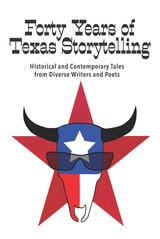
Forty Years of Texas Storytelling
Historical and Contemporary Tales from Diverse Writers and PoetsTed Parkhurst
Parkhurst Brothers, Inc., 2024

Four Days in Michigan
A NovelPhilip Zazove
Gallaudet University Press, 2012
As a young, deaf Jewish woman living in a small town in Michigan in 1942, Sandra Horowitz felt deeply frustrated by her limited prospects. Even though she had just graduated from junior college, she knew that she had two strikes against her in fulfilling her dream to become a veterinarian. Better to marry Jacob Winter, her parents urged her, a deaf Jewish man who made a good living. Then, Sandra met Rudy Townsend, a hearing soldier on leave before shipping out to the war in Europe.
In just four days, both Sandra and Rudy’s worlds were turned upside down. Sandra’s parents feared him for being hearing and a Gentile, while Rudy’s parents expressed openly their bias against her ethnic background and her deafness. Even so, Sandra and Rudy soon realized that they had fallen in love, deeply and passionately. As they shared the brief time they had together, they learned about each other’s dreams for the future — Sandra’s desire to be a vet and Rudy’s determination to serve in Congress. Then, Rudy had to leave for the war.
Philip Zazove’s novel Four Days in Michigan captures perfectly the power of irrepressible love between two individuals from opposite backgrounds. The struggles they encounter in an era when such differences were never more sharply drawn also reveal great detail about deaf and hearing life. Despite all, their triumph comes ultimately because of their long-lasting individual respect and love.
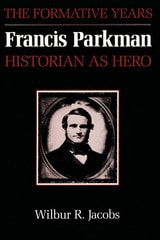
Francis Parkman, Historian as Hero
The Formative YearsBy Wilbur R. Jacobs
University of Texas Press, 1991
A historian who lived the kind of history he wrote, Francis Parkman is a major—and controversial—figure in American historiography. His narrative style, while popular with readers wanting a "good story," has raised many questions with professional historians. Was Parkman writing history or historical fiction? Did he color historical figures with his own heroic self-image? Was his objectivity compromised by his "unbending, conservative, Brahmin" values? These are some of the many issues that Wilbur Jacobs treats in this thought-provoking study.
Jacobs carefully considers the "apprenticeship" of Francis Parkman, first spent in facing the rigors of the Oregon Trail and later in struggling to write his histories despite a mysterious, frequently incapacitating illness. He shows how these events allowed Parkman to create a heroic self-image, which impelled his desire for fame as a historian and influenced his treatment of both the "noble" and the "savage" characters of his histories.
In addition to assessing the influence of Parkman's development and personality on his histories, Jacobs comments on Parkman's relationship to basic social and cultural issues of the nineteenth century. These include the slavery question, Native American issues, expansion of the suffrage to new groups, including women, and anti-Catholicism.
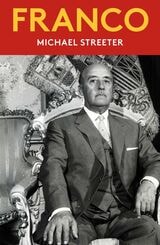
Franco
Michael Streeter
Haus Publishing, 2025
A narrative of the life of Francisco Franco, Spanish general and dictator.
Growing up in the wake of the Spanish military’s shattering defeat at the hands of the United States in 1898 over Cuba and having survived a bullet to the stomach while serving his country in Morocco, Francisco Franco’s fame and notoriety were eventually guaranteed by his ruthless pursuit of victory for the Nationalists in the Spanish Civil War.
Franco played a major role on the world stage until his death in 1975. At once intensely sentimental and affecting cool indifference at times of bad news, he emphasized the need to obey orders, the importance of individual bravery, absolute loyalty to the Fatherland, and the crucial role of the army. Franco was variously courted by the liberal democracies of Britain and France, the Fascist alliance of Hitler and Mussolini, and then by anti-communist administrations in Washington, but the memory of his successful policies, leading to rapid growth during a time of economic depression, is tempered by his government’s extreme repression of political opponents and perpetration of mass violence during the White Terror.
In this updated edition of Franco, featuring a new introduction by the author, Michael Streeter explores the Generalissimo’s legacy as the subject of a cult of personality in one of Europe’s longest-lasting modern dictatorships and considers his genesis, his successes (decades of relative stability and prosperity during a period of great European conflict), and the terrible cost at which they came.

Francois Vallé and His World
Upper Louisiana before Lewis and ClarkCarl J. Ekberg
University of Missouri Press, 2002
Winner of the Kemper & Leila Williams Prize in Louisiana History for excellence in historical scholarship for the year 2002, awarded by The Historic New Orleans Collection, The Louisiana Historical Association.
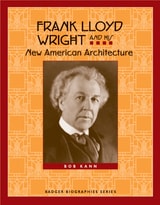
Frank Lloyd Wright and His New American Architecture
Bob Kann
Wisconsin Historical Society Press, 2010
From boyhood adventures to the creation of visionary buildings like the Guggenheim Museum, Frank Lloyd Wright and His New American Architecture chronicles the vibrant life of one of the world's most famous architects.
Wright's love of architecture was nurtured early on-from paintings of European cathedrals hung in his childhood room; to "Froebel Gifts" building blocks, which he crafted into crude structures; to long walks near the Wisconsin River, where his mother pointed out patterns and colors in nature. Wright also learned, from summers spent on his uncle's Spring Green farm, that adversity is part of life. And perhaps this helped him weather a life beset with both tragedy and triumph.
Wright's prolific career spanned more than 70 years, and he created more than 1,100 designs. Author Bob Kann brings readers into the eccentric stories behind some of Wright's landmark buildings. Find out about Wright's Oak Park home, known to locals as "the house with a tree growing through it;" the Robie House, which is shaped like a battleship; and Fallingwater, which is built on a waterfall. Learn how Wright successfully built the Imperial Hotel in Tokyo to withstand earthquakes, and how the Johnson Wax Building and Guggenheim Museum set new standards in institutional architecture.

Frederic Manning
An Unfinished LifeJonathan L. Marwil
Duke University Press, 1988
How did a classical and noncommercial author come to write a grittily realistic war novel? Manning fled from the attendant publicity, avoiding the limelight assiduously and successfully. Marwil's search for the answer to this riddle and for the details of his life (in some ways the search is as interesting and revealing as the results) and his account of Manning's life and work reveal a great deal of the intellectual and social world of Edwardian and Georgian England.
Freedom Train North
Stories of the Underground Railroad in WisconsinJulia Pferdehirt
Wisconsin Historical Society Press, 2011
People running from slavery made many hard journeys to find freedom—on steamboats and in carriages, across rivers and in hay-covered wagons. Some were shot at. Many were chased by slave catchers. Others hid in tunnels and secret rooms. But these troubles were worth it for the men, women, and children who eventually reached freedom. Freedom Train North tells the stories of fugitive slaves who found help in Wisconsin. Young readers (ages 7 to 12) will meet people like Joshua Glover, who was broken out of jail by a mob of freedom workers in Milwaukee, and Jacob Green, who escaped five times before he finally made it to freedom.
This compelling book also introduces stories of the strangers who hid fugitive slaves and helped them on their way, brave men and women who broke the law to do what was right. As both a historian and a storyteller, author Julia Pferdehirt shares these exciting and important stories of a dangerous time in Wisconsin’s past. Using manuscripts, letters, and artifacts from the period, as well as stories passed down from one generation to another, Pferdehirt takes us deep into our state’s past, challenging and inspiring us with accounts of courage and survival.
Freedom's Champion
Elijah LovejoyElijah Lovejoy. Revised by Paul Simon. Foreword by Clarence Page
Southern Illinois University Press, 1994
In this revised edition of his earlier biography, Paul Simon provides an inspiring account of the life and work of Elijah Lovejoy, an avid abolitionist in the 1830s and the first martyr to freedom of the press in the United States.
Lovejoy was a native New Englander, the son of a Congregational minister. He came to the Midwest in 1827 in pursuit of a teaching career and succeeded in running his own school for two years in St. Louis. Teaching failed to challenge Lovejoy, however, so he bought a half interest in the St. Louis Times and became its editor. In 1832, after experiencing a religious conversion, he returned east to study for the ministry at Princeton Theological Seminary. After his graduation, Lovejoy was called back to St. Louis by a group of Christian businessmen to serve as the editor of a new religious newspaper, the Observer, promoting religion, morality, and education. It was through this forum that Lovejoy took an ever stronger stance against slavery.
In the slave state of Missouri, such a view was not onlyunpopular, but in the eyes of many, criminal. As a result, Lovejoy and his family suffered repeated persecution and acts of violence from angry mobs. In July 1836, in hopes of finding a more tolerant community in a "free" state, he moved both his printing press and his family across the Mississippi River to Alton, Illinois.
The move to Alton was a fateful one. Lovejoy’s press was dismantled and thrown into the river by a mob on the night of its arrival. Lovejoy ordered a new printing press, and it, too, was destroyed eleven months later. A determined and dedicated man, Lovejoy ordered a third press, and city officials took special precautions to ensure its safety after delivery. Nevertheless, an organized and angry mob rolled this third press, still in its crate, into the river exactly one month after Lovejoy’s second press had been destroyed. A fourth press, housed in a large stone warehouse and guarded by Lovejoy and his supporters, met the same fate but only after a drunken mob had killed Lovejoy himself. He was buried two days later, 9 November 1837, on his thirty-fifth birthday. No one was ever convicted of his murder.
Rather than suppressing the abolitionist movement, Lovejoy’s death caused an eruption of antislavery activity throughout the nation. At a protest meeting in Ohio, John Brown dedicated his life to fighting slavery, and Wendell Phillips emerged from a Lovejoy protest meeting in Boston to become a leader in the antislavery fight.
Simon defines Lovejoy’s fight as a struggle for human dignity and the oppressed. He distinguishes Lovejoy as a courageous and admirable individual and his story as an important and enduring one for both the cause of freedom for the slaves and the cause of freedom of the press.
French Roots
Adventures along the New Madrid Fault Line, 1811-1812Norris Norman
Parkhurst Brothers, Inc., 2017
"Norris Norman has picked a very difficult subject for his book and has done wonders with it. There is probably no more obscure part of the history of Arkansas than the period in which this book is situated, namely, the second decade of the nineteenth century. Mr. Norman makes it come alive in a very convincing way. His main character, a French/Indian mixed-blood or metis, is carefully crafted and is ideally positioned to tell the tale of the New Madrid earthquake, the early White settlers of a newly-American Arkansas, and the daily lives of Indians and Europeans alike..."
-- Hon. Morris S. Arnold, author of Unequal Laws Unto a Savage Race: European Legal Traditions in Arkansas 1686-1836
Friedrichsburg
A NovelBy Friedrich Armand Strubberg
University of Texas Press, 2012
Summerfield G. Roberts Award for a Work of Creative Writing, Sons of the Texas Republic, 2013
First published in Germany in 1867, this fascinating autobiographical novel of German immigrants on the antebellum Texas frontier provides a trove of revelations about the myriad communities that once called the Hill Country home.
Founded in 1846, Fredericksburg, Texas, was established by German noblemen who enticed thousands of their compatriots to flee their overcrowded homeland with the prospect of free land in a place that was portrayed as a new Garden of Eden. Few of the settlers, however, were prepared for the harsh realities of the Texas frontier or for confrontation with the Comanche. In his 1867 novel Friedrichsburg, Friedrich Armand Strubberg, a.k.a. Dr. Schubbert, interwove his personal story with a fictional romance to capture the flavor of Fredericksburg, Texas, during its founding years when he served as the first colonial director.
Now available in a contemporary translation, Friedrichsburg brings to life the little-known aspects of life among these determined but often ill-equipped settlers who sought to make the transition to a new home and community on the Texas frontier. Opening just as a peace treaty is being negotiated between the German newcomers and the Comanches, the novel describes the unlikely survival of these fledgling homesteads and provides evidence that support from the Delaware Indians, as well as the nearby Mormon community of Zodiac, was key to the Germans’ success. Along the way, Strubberg also depicts the laying of the cornerstone to the Vereinskirche, the blazing of an important new road to Austin, exciting hunting scenes, and an admirable spirit of cultural cohesion and determined resilience. In so doing, he resurrects a fascinating lost world.
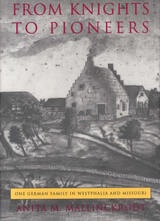
From Knights to Pioneers
One German Family in Westphalia and MissouriAnita M. Mallinckrodt
Southern Illinois University Press, 1994
Anita M. Mallinckrodt traces the 750-year history of the Mallinckrodt family from its earliest documented beginnings in thirteenth-century Westphalia (in the Dortmund area) through immigration to Missouri in 1831 and beyond.
In part 1, Mallinckrodt tells the story of some of her family’s leading personalities in order to explicate the history and society of medieval and early modern Germany: the life and times of knight Ludwig (c. 1241) and crusader Gerd (c. 1450–1504); the 1451 and 1492 adventures of the mercenary knight Hermann and his son Wilhelm; the 1594 feuding of the noble brothers Dietrich and Hermann, which led to a double murder; the liberal Dortmund publisher Arnold’s struggles in the early 1800s to establish freedom of the press and to free Westphalian farmers from serfdom; and the wealthy, aristocratic Sister Pauline (b. 1817), founder of the Sisters of Charity and recently beatified for her efforts on behalf of the poor and blind children of her day.
In parts 2 and 3, Mallinckrodt focuses on the first of her forebears to immigrate to the New World—Julius and Emil in 1831, followed by Conrad, Hermann, August, Helene, Sophie, and Luise in 1838—and their immediate families and descendants in Missouri. These early pioneers cleared the forests, built schools and churches, supported German-language periodicals, and founded social and cultural organizations that would benefit later waves of immigrants. In the 1860s, they participated in their adopted country’s Civil War and held strong views toward slavery and the Union. Mallinckrodt ends her family’s history with the deaths of the Dortmund pioneers in the 1890s.
But From Knights to Pioneers is much more than a single family’s history. The experiences Mallinckrodt relates reflect those of many German families who left their mark on centuries of history and of many midwestern families transplanted from the Old World. Especially interesting is the continuity between the old and new ways of life—entries on genealogical tables need not end with the comment "immigrated to the USA," for immigrants often wrote notable chapters of family history that deserve recognition in their old homelands. Similarly, knowledge of pre-immigration history is essential for those Americans whose traditions surely did not begin, as oral history often suggests, with the fact that "great-grandfather arrived in the Midwest from Germany in 1831." Thus the purpose of this book is to set a family’s immigration chapter against its European background, without passing judgment on the cultural influence of outstanding individuals in the United States or of German immigration per se.
Drawing on her extensive research in both Europe and the United States, Mallinckrodt presents an exceptionally detailed picture of the social and political contexts of each of her subjects. The richness of her exposition of both the Old World background and the lives of the immigrants to the New World offers important insights into aspects of European and American history.
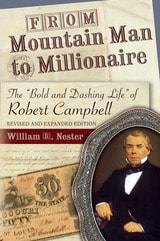
From Mountain Man to Millionaire
The "Bold and Dashing Life" of Robert Campbell, Revised and Expanded EditionWilliam R. Nester
University of Missouri Press, 2011
Campbell came to America from Ireland in 1822 and entered the fur trade soon after. He quickly rose from trapper to brigade leader to partner, all within a half dozen years, and this new edition includes an expanded narrative of his adventures in the Rocky Mountain fur trade. In the mid-1830s, having amassed considerable wealth, Campbell retired from the mountains and embarked on a new career. He returned to St. Louis and built up a business empire that embraced mercantile, steamboat, railroad, and banking interests, thus becoming a leading force behind the region’s economic development. A more extensive account of the cutthroat business world in which Campbell operated now enriches this portion of the book.
Nester masterfully depicts the “sterling character” for which Campbell was renowned. Campbell enjoyed deep and enduring friendships and strong familial ties, both in America and abroad. Although he was an outstanding businessman and philanthropist, his personal life was marred by tragedy. Ten of his thirteen children died prematurely. Despite those tragic losses, his faith in God never faltered. He believed that all worldly successes should honor God and once wrote that , “all worldly gain is but dross.” This edition elucidates the complex relations among his family and chronicles both tragic events and humorous incidents in more depth.
Exploring the letters, journals, and account books that Campbell left behind, Nester places him in the context of the times in which he lived, showing the economic, political, social, and cultural forces that provided the opportunities and challenges that shaped his life. Nester provides new insights into Campbell’s ownership of slaves, his attitudes toward slavery, and his behind-the-scenes political and economic activities during the Civil War. This comprehensive exploration of Robert Campbell’s life depicts a fascinating era in American history.

From the Blue Windows
Recollections of Life in Queenstown, Singapore, in the 1960s and 1970sTan Kok Yang
National University of Singapore Press, 2013
From the Blue Windows is a collection of Tan Kok Yang's memories of growing up in Queenstown back when the tallest residential building there was fourteen storeys, the Alexandra Canal flooded regularly, and wayang shows were a regular feature on Mei Ling Street. He stayed in Princess Estate, an area that was colloquially known as "the Blue Windows" because of its unique blue glass louvred windows.
With nostalgia and a sense of loss, this memoir is a personal tribute to and celebration of Queenstown and a simple but fulfilling way of life that has all but vanished from modern Singapore.

Frontier Swashbuckler
The Life and Legend of John Smith TDick Steward
University of Missouri Press, 2000
Few frontiersmen in the late eighteenth century and early nineteenth century epitomized the reckless energies of the West and the lust for adventure as did John Smith T—pioneer, gunfighter, entrepreneur, militia colonel, miner, judge, and folk hero. In this fascinating biography, Dick Steward traces the colorful Smith T's life from his early days in Virginia through his young adulthood. He then describes Smith T's remarkable career in the wilds of Missouri and his armed raids to gain land from Indians, Spaniards, and others.
Born into the fifth generation of Virginia gentry, young Smith first made his name on the Tennessee frontier. It was there that he added the "T" to his name to distinguish his land titles and other enterprises from those of the hosts of other John Smiths. By the late 1790s he owned or laid claim to more than a quarter million acres in Tennessee and northern Alabama.
In 1797, Smith T moved to Missouri, then a Spanish territory, and sought to gain control of its lead-mining district by displacing the most powerful American in the region, Moses Austin. He acquired such public positions as judge of the court of common pleas, commissioner of weights and levies, and lieutenant colonel of the militia, which enabled him to mount a spirited assault on Austin's virtual monopoly of the lead mines. Although neither side emerged a winner from that ten-year-old conflict, it was during this period that Smith T's fame as a gunfighter and duelist spread across the West. Known as the most dangerous man in Missouri, he was said to have killed fourteen men in duels.
Smith T was also recognized by many for his good works. He donated land for churches and schools and was generous to the poor and downtrodden. He epitomized the opening of the West, helping to build towns, roads, and canals and organizing trading expeditions.
Even though Smith T was one of the most notorious characters in Missouri history, by the late nineteenth century he had all but disappeared from the annals of western history. Frontier Swashbuckler seeks to rescue both the man and the legend from historical obscurity. At the same time, it provides valuable insights into the economic, political, and social dynamics of early Missouri frontier history.

Frozen
Mary Casanova
University of Minnesota Press, 2013
Sixteen-year-old Sadie Rose hasn’t said a word in eleven years—ever since the day she was found lying in a snowbank during a howling storm. Like her voice, her memories of her mother and what happened that night were frozen.
Set during the roaring 1920s in the beautiful, wild area on Rainy Lake where Minnesota meets Canada, Frozen tells the remarkable story of Sadie Rose, whose mother died under strange circumstances the same night that Sadie Rose was found, unable to speak, in a snowbank. Sadie Rose doesn’t know her last name and has only fleeting memories of her mother—and the conflicting knowledge that her mother had worked in a brothel. Taken in as a foster child by a corrupt senator, Sadie Rose spends every summer along the shores of Rainy Lake, where her silence is both a prison and a sanctuary.
One day, Sadie Rose stumbles on a half dozen faded, scandalous photographs—pictures, she realizes, of her mother. They release a flood of puzzling memories, and these wisps of the past send her at last into the heart of her own life’s great mystery: who was her mother, and how did she die? Why did her mother work in a brothel—did she have a choice? What really happened that night when a five-year-old girl was found shivering in a snowbank, her voice and identity abruptly shattered?
Sadie Rose’s search for her personal truth is laid against a swirling historical drama—a time of prohibition and women winning the right to vote, political corruption, and a fevered fight over the area’s wilderness between a charismatic, unyielding, powerful industrialist and a quiet man battling to save the wide, wild forests and waters of northernmost Minnesota. Frozen is a suspenseful, moving testimonial to the haves and the have-nots, to the power of family and memory, and to the extraordinary strength of a young woman who has lost her voice in nearly every way—but is utterly determined to find it again.