Results by title
125 books match the query 'Human-animal relationships' and 3 start with f
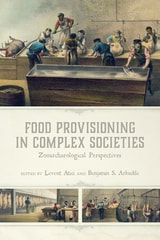
Food Provisioning in Complex Societies
Zooarchaeological PerspectivesLevent Atici
University Press of Colorado, 2022
Through creative combinations of ethnohistoric evidence, iconography, and contextual analysis of faunal remains, this work offers new insight into the mechanisms involved in food provisioning for complex societies. Contributors combine zooarchaeological and historical data from global case studies to analyze patterns in centralization and bureaucratic control, asymmetrical access and inequalities, and production-distribution-consumption dynamics of urban food provisioning and animal management.
Taking a global perspective and including both prehistoric and historic case studies, the chapters in the volume reflect some of the current best practices in the zooarchaeology of complex societies. Embedding faunal evidence within a broader anthropological explanatory framework and integrating archaeological contexts, historic texts, iconography, and ethnohistorical sources, the book discerns myriad ways that animals are key contributors to, and cocreators of, complex societies in all periods and all places. Chapters cover the diverse sociopolitical and economic roles wild animals played in Bronze Age Turkey; the production and consumption of animal products in medieval Ireland; the importance of belief systems, politics, and cosmologies in Shang Dynasty animal provisioning in the Yellow River Valley; the significance of external trade routes in the kingdom of Aksum (modern Sudan); hunting and animal husbandry at El Zotz; animal economies from two Mississippian period sites; and more.
Food Provisioning in Complex Societies provides an optimistic roadmap and heuristic tools to explore the diverse, resilient, and contingent processes involved in food provisioning. The book represents a novel and productive way forward for understanding the unique, yet predictably structured, provisioning systems that emerged in the context of complex societies in all parts of the world. It will be of interest to zooarchaeologists and archaeologists alike.
Contributors: Joaquin Arroyo-Cabrales, Fiona Beglane, Roderick Campbell, Kathryn Grossman, Patricia Martinez-Lira, Jacqueline S. Meier, Sarah E. Newman, Terry O'Connor, Tanya M. Peres, Gypsy C. Price, Elizabeth J. Reitz, Kim Shelton, Marcus Winter, Helina S. Woldekiros
Fragments for a History of a Vanishing Humanism
Edited by Myra Seaman and Eileen A. Joy
The Ohio State University Press, 2016
This volume, edited by Myra Seaman and Eileen A. Joy, insists on the always provisional and contingent formations of the human, and of various humanisms, over time, while also aiming to demonstrate the different ways these formations emerge (and also disappear) in different times and places, from the most ancient past to the most contemporary present. The essays are offered as “fragments” because the authors do not believe there can ever be a “total history” of either the human or the post/human as they play themselves out in differing historical contexts. At the same time, the volume as a whole argues that defining what “the human” (or “post/human”) is has always been an ongoing, never finished cultural project.
French Thinking about Animals
Louisa Mackenzie
Michigan State University Press, 2015