Results by title
57 books match the query 'Hunting' and 2 start with f

Farming, Hunting, and Fishing in the Olmec World
By Amber M. VanDerwarker
University of Texas Press, 2006
The Olmec who anciently inhabited Mexico's southern Gulf Coast organized their once-egalitarian society into chiefdoms during the Formative period (1400 BC to AD 300). This increase in political complexity coincided with the development of village agriculture, which has led scholars to theorize that agricultural surpluses gave aspiring Olmec leaders control over vital resources and thus a power base on which to build authority and exact tribute.
In this book, Amber VanDerwarker conducts the first multidisciplinary analysis of subsistence patterns at two Olmec settlements to offer a fuller understanding of how the development of political complexity was tied to both agricultural practices and environmental factors. She uses plant and animal remains, as well as isotopic data, to trace the intensification of maize agriculture during the Late Formative period. She also examines how volcanic eruptions in the region affected subsistence practices and settlement patterns. Through these multiple sets of data, VanDerwarker presents convincing evidence that Olmec and epi-Olmec lifeways of farming, hunting, and fishing were driven by both political and environmental pressures and that the rise of institutionalized leadership must be understood within the ecological context in which it occurred.
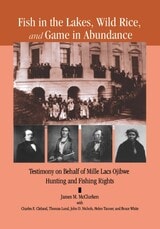
Fish in the Lakes, Wild Rice, and Game in Abundance
Testimony on Behalf of Mille Lacs Ojibwe Hunting and Fishing RightsEdited by James M. McClurken
Michigan State University Press, 2000
On 13 August 1990 members of the Mille Lacs Band of Ojibwe filed a lawsuit against the State of Minnesota for interfering with the hunting, fishing, and gathering rights that had been guaranteed to them in an 1837 treaty with the United States. In order to interpret the treaty the courts had to consider historical circumstances, the intentions of the parties, and the treaty's implementation. The Mille Lacs Band faced a mammoth challenge. How does one argue the Native side of the case when all historical documentation was written by non- Natives? The Mille Lacs selected six scholars to testify for them. Published here for the first time, Charles Cleland, James McClurken, Helen Tanner, John Nichols, Thomas Lund, and Bruce White discuss the circumstances under which the treaty was written, the personalities involved in the negotiations and the legal rhetoric of the times, as well as analyze related legal conflicts between Natives and non- Natives. Justice Sandra Day O'Connor delivered the 1999 Opinion of the [United States Supreme] Court.