Results by title
221 books match the query 'Imperialism' and 3 start with f
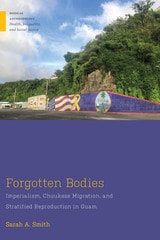
Forgotten Bodies
Imperialism, Chuukese Migration, and Stratified Reproduction in GuamSarah A. Smith
Rutgers University Press, 2024
Women from Chuuk, Federated States of Micronesia, who migrate to Guam, a U.S. territory, suffer disproportionately poor reproductive health outcomes. Though their access to the United States is unusually easy, through a unique migration agreement, it keeps them in a perpetual liminal state as nonimmigrants, who never fully belong as part of the United States Chuukese women move to Guam, sometimes with their families but sometimes alone, in search of a better life: for jobs, for the education system, or to access safe health care. Yet, the imperial system they encounter creates underlying conditions that greatly and disproportionately impact their ability to succeed and thrive, negatively impacting their reproductive health. Through clinical and community ethnography, Sarah A. Smith illuminates the way this system stratifies women’s reproduction at structural, social, and individual levels. Readers can visualize how U.S. imperialist policies of benign neglect control the body politic, change the social body, and render individual bodies vulnerable in the twenty-first century but also how people resist.
[more]
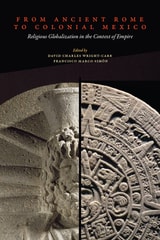
From Ancient Rome to Colonial Mexico
Religious Globalization in the Context of EmpireDavid Charles Wright-Carr
University Press of Colorado, 2023
From Ancient Rome to Colonial Mexico compares the Christianization of the Roman Empire with the evangelization of Mesoamerica, offering novel perspectives on the historical processes involved in the spread of Christianity. Combining concepts of empire and globalization with the notion of religion from a postcolonial perspective, the book proposes the method of analytical comparison as a point of departure to conceptualize historical affinities and differences between the ancient Roman Empire and colonial Mesoamerica.
An international team of specialists in classical scholarship and Mesoamerican studies engage in an interdisciplinary discussion involving ideas from history, anthropology, archaeology, art history, iconography, and philology. Key themes include the role of religion in processes of imperial domination; religion’s use as an instrument of resistance or the imposition, appropriation, incorporation, and adaptation of various elements of religious systems by hegemonic groups and subaltern peoples; the creative misunderstandings that can arise on the “middle ground”; and Christianity’s rejection of ritual violence and its use of this rejection as a pretext for inflicting other kinds of violence against peoples classified as “barbarian,” “pagan,” or “diabolical.”
From Ancient Rome to Colonial Mexico presents a sympathetic vantage point for discussing and attempting to decipher past processes of social communication in multicultural contexts of present-day realities. It will be significant for scholars and specialists in the history of religions, ethnohistory, classical antiquity, and Mesoamerican studies.
Publication supported, in part, by Spain’s Ministry of Economy and Competitiveness.
Contributors: Sergio Botta,Maria Celia Fontana Calvo, Martin Devecka, György Németh, Guilhem Olivier, Francisco Marco Simón, Paolo Taviani, Greg Woolf, David Charles Wright-Carr, Lorenzo Pérez Yarza
Translators: Emma Chesterman, Benjamin Adam Jerue, Layla Wright-Contreras
[more]
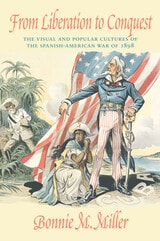
From Liberation to Conquest
The Visual and Popular Cultures of the Spanish-American War of 1898Bonnie M. Miller
University of Massachusetts Press, 2011
The American people overwhelmingly supported the nation's entry into the Spanish-American War of 1898, which led to U.S. imperial expansion into the Caribbean and Pacific. In this book, Bonnie M. Miller explores the basis of that support, showing how the nation's leading media makers—editorialists, cartoonists, filmmakers, photographers, and stage performers—captured the public's interest in the Cuban crisis with heart-rending depictions of Cuban civilians, particularly women, brutalized by bloodthirsty Spanish pirates.
Although media campaigns initially advocated for the United States to step in to rescue Cuba from the horrors of colonial oppression, the war ended just months later with the U.S. acquisition of Spain's remaining empire, including Cuba, Puerto Rico, Guam, and the Philippines. President William McKinley heeded the call for war, with the American people behind him, and then proceeded to use the conflict to further his foreign policy agenda of expanding U.S. interests in the Caribbean and Far East.
Miller examines the shifting media portrayals of U.S. actions for the duration of the conflict, from liberation to conquest. She shows how the media capitalized on the public's thirst for drama, action, and spectacle and adapted to emerging imperial possibilities. Growing resistance to American imperialism by the war's end unraveled the consensus in support of U.S policy abroad and produced a rich debate that found expression in American visual and popular culture.
[more]