Results by title
517 books match the query 'In literature' and 18 start with f
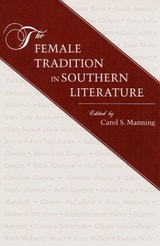
FEMALE TRADITION IN SOUTHERN LITERATURE
Carol S. Manning
University of Illinois Press, 1993
essays reclaim women's traditions which have been neglected by critics who ought to have known
better." -- Kathryn Lee Seidel, author of The Southern Belle in the American Novel
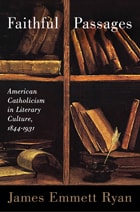
Faithful Passages
American Catholicism in Literary Culture, 1844–1931James Emmett Ryan
University of Wisconsin Press, 2013
Faithful Passages also reveals new dimensions in American religious literary culture by moving beyond the antebellum period to consider how the first important cohort of Catholic writers shaped their message for subsequent generations of readers in the late nineteenth and early twentieth centuries. Perhaps most strikingly, Ryan shows that by the early twentieth century, Roman Catholic themes and traditions in American literature would be advanced in complex ways by mainstream, non-Catholic modernist writers like Kate Chopin and Willa Cather.
Catholic literary culture in the United States took shape in a myriad of ways and at the hands of diverse participants. The process by which Roman Catholic ideas, themes, and moralities were shared and adapted by writers with highly differentiated beliefs, Ryan contends, illuminates a surprising fluidity of religious commitment and expression in early U.S. literary culture.
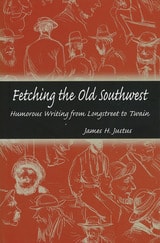
Fetching the Old Southwest
Humorous Writing from Longstreet to TwainJames H. Justus
University of Missouri Press, 2004
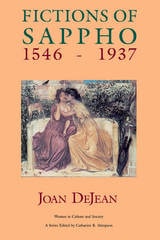
Fictions of Sappho, 1546-1937
Joan DeJean
University of Chicago Press, 1989
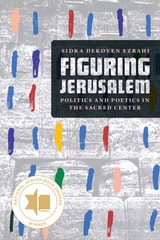
Figuring Jerusalem
Politics and Poetics in the Sacred CenterSidra DeKoven Ezrahi
University of Chicago Press, 2022
For two thousand years, Hebrew writers used their exile from the Holy Land as a license for invention. The question at the heart of Figuring Jerusalem is this: how did these writers bring their imagination “home” in the Zionist century? Sidra DeKoven Ezrahi finds that the same diasporic conventions that Hebrew writers practiced in exile were maintained throughout the first half of the twentieth century. And even after 1948, when the state of Israel was founded but East Jerusalem and its holy sites remained under Arab control, Jerusalem continued to figure in the Hebrew imagination as mediated space. It was only in the aftermath of the Six Day War that the temptations and dilemmas of proximity to the sacred would become acute in every area of Hebrew politics and culture.
Figuring Jerusalem ranges from classical texts, biblical and medieval, to the post-1967 writings of S. Y. Agnon and Yehuda Amichai. Ultimately, DeKoven Ezrahi shows that the wisdom Jews acquired through two thousand years of exile, as inscribed in their literary imagination, must be rediscovered if the diverse inhabitants of Jerusalem are to coexist.
First Books
The Printed Word and Cultural Formation in Early AlabamaPhilip D. Beidler
University of Alabama Press, 1999
Early 19th-century Alabama was a society still in the making. Now Philip Beidler tells how the first books written and published in the state influenced the formation of Alabama's literary and political culture. As Beidler shows, virtually overnight early Alabama found itself in possession of the social, political, and economic conditions required to jump start a traditional literary culture in the old Anglo-European model: property-based class relationships, large concentrations of personal wealth, and professional and merchant classes of similar social, political, educational, and literary views.
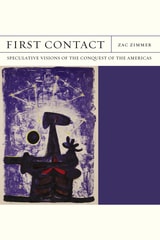
First Contact
Speculative Visions of the Conquest of the AmericasZac Zimmer
Northwestern University Press, 2025
Examining the power of speculative fiction to reimagine historical accounts of the conquest of the Americas
The historical conquest of the Americas resides at the core of all first-contact narratives, which stage colonization and resistance in the generic guise of speculative fiction. Starting from this axiom, First Contact: Speculative Visions of the Conquest of the Americas moves through a corpus of Mexican novels, Andean visual arts practices, and other cultural artifacts that have dramatized counterfactual narratives. Reimagining the early colonial period’s historiography from a south-to-north directionality while inventing parallel realities, these texts, which are concerned with limit cases, alterities, and alternative temporalities, refuse any reliance on the imperial ontologies of European expansion. Zac Zimmer examines these works to explore the slippage that exists between science fiction as the exemplary genre of the modern, colonial reality and literary speculation as an aesthetic tool that can be used to imagine other possible worlds. First Contact thus poses a foundational question: Can we understand the conquest as an originary world-historical event without eclipsing the other cosmologies that existed, and continue to exist, within the contact zone? Can we decolonize the speculative imagination itself?
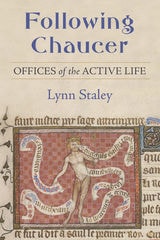
Following Chaucer
Offices of the Active LifeLynn Staley
University of Michigan Press, 2020
Following Chaucer: Offices of the Active Life explores three representative figures—the royal woman, the poet, and the merchant—in relation to the concept of “office,” which Cicero linked to the health of the republic, but Chaucer to that of the common good. Not usually conjoined to the term “office,” these three figures, situated in the active life, were not firmly mapped onto the body politic, which was used to figure a relational and ordered social body ruled by the king, the head. These figures are points of entry into a set of questions rooted in Chaucer’s understanding of his cultural and historical past and in his keen appraisal of the social dynamics of his own time that also reverberate in the centuries after Chaucer’s death.
Following Chaucer does not trace influence but uses Chaucer’s likely reading, circumstances, and literary and social affiliations as guides to understanding his poetry, within the context of late medieval English culture and the reshaping of the concept of these particular offices that suited the needs of a future whose dynamics he anticipated. His understanding of the importance of the Ciceronian concept of office within the active life, his profound cultural awareness, and his probing of the foundations of social change provide him with a keen sense of the persistent tensions and inconsistencies that are fundamental to his poetry.
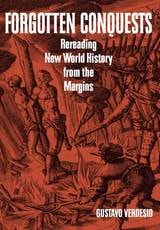
Forgotten Conquests
Rereading New World History from the MarginsGustavo Verdesio
Temple University Press, 2001
Verdesio read the key texts relating to the struggles for possession of River Plate's northern shore -- present-day Uruguay. He probes them for traces of conflicts in meaning and the agency of Amerindians, gauchos, Africans, and women -- the subjected peoples that the texts try to silence. The narrators, speaking for their culture, assume the role of knowing subject, repressing all other voices, epistemologies, and acts of resistance. Verdesio's tasks are to listen for those that the Europeans represented as an unintelligible Other, to draw them into the foreground, and to decolonize their histories.
By unpacking these texts, Verdesio shows that from the European point of view, the colonial encounter draws the New World into historical time and ushers in a new concept of knowledge. For the first time, the historian's role is to discover, to interpret eyewitness testimonies and first-hand experience, to write 'a new history of admirable things.' Even in this reconstruction of historical truth, Old World ideology drives the narratives, whose chief purpose is to justify conquest. Forgotten Conquests lays bare the discursive strategies that generated the founding texts of Latin American history and engulfed its subjected peoples in silence for 500 years.
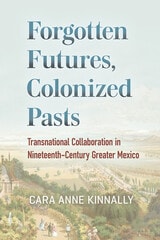
Forgotten Futures, Colonized Pasts
Transnational Collaboration in Nineteenth-Century Greater MexicoCara Anne Kinnally
Bucknell University Press, 2019
Published by Bucknell University Press. Distributed worldwide by Rutgers University Press.
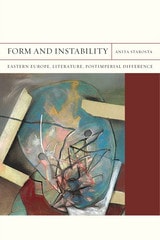
Form and Instability
Eastern Europe, Literature, Postimperial DifferenceAnita Starosta
Northwestern University Press, 2015
Located at the intersection of comparative literature, area studies, and literary theory, this interdisciplinary study has a twofold commitment: to Eastern Europe on the one hand and to literature on the other. It aims to intervene in the way we conceive of Eastern Europe by seeking to develop a more equitable way of thinking, one that avoids subordinating it to Eurocentric narratives of progress. At the same time, it marshals literature as both object and method of this rethinking, in order to extend existing conceptions of the usefulness and of the proper organization of literary studies. The three terms in the title of this book mark a passage—via literature—from “Eastern Europe” as an inadequate and obsolescent category to “post-imperial difference” as a more accurate, if provisional, account of the region. By way of original readings of particular texts, and by attending to literature as a critical

Forms of Nationhood
The Elizabethan Writing of EnglandRichard Helgerson
University of Chicago Press, 1992
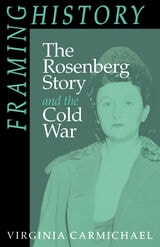
Framing History
The Rosenberg Story and the Cold WarVirginia Carmichael
University of Minnesota Press, 1993
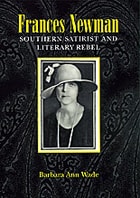
Frances Newman
Southern Satirist and Literary RebelBarbara Ann Wade
University of Alabama Press, 1998
This first biographical and literary assessment of Frances Newman highlights one of the most experimental writers of the Southern Renaissance
Frances Newman was born into a prominent Atlanta family and was educated at private schools in the South and the Northeast. Her first novel, The Hard-Boiled Virgin, was hailed by James Branch Cabell as “the most brilliant, the most candid, the most civilized, and the most profound yet written by any American woman.” Cabell and H. L. Mencken became Newman’s literary mentors and loyally supported her satire of southern culture, which revealed the racism, class prejudice, and religious intolerance that reinforced the idealized image of the white southern lady. Writing within a nearly forgotten feminist tradition of southern women’s fiction, Newman portrayed the widely acclaimed social change in the early part of the century in the South as superficial rather than substantial, with its continued restrictive roles for women in courtship and marriage and limited educational and career opportunities.
Barbara Wade explores Newman’s place in the feminist literary tradition by comparing her novels with those of her contemporaries Ellen Glasgow, Mary Johnston, and Isa Glenn. Wade draws from Newman’s personal correspondence and newspaper articles to reveal a vibrant, independent woman who simultaneously defied and was influenced by the traditional southern society she satirized in her writing.

Frank Waters
Man and MysticVine Deloria Jr.
Ohio University Press, 1993
“In addition to his accomplishments as a talented novelist, a thorough historian, and an excellent essayist, Frank Waters is that rare breed of man who has merged heart and mind early in his life and moved forward to confront ultimate questions. This dilemma of faith and heritage, religion and identity, and commitment and comfort has never been resolved intellectually. Even with profound faith and rigorous discipline of self, mystics have found it difficult to resolve through action and prayer…I look at the life and writing of Frank Waters…and find…a remarkable journey of inquiry spanning nearly a century and illuminating questions which I did not think possible to formulate.”
—Vine Deloria, Jr., editor
Contributors to this volume are Alvin M. Josephy, Jr., Bobby Bridger, Steven Wall, Will Wright, William Eastlake, Larry Evers, David Jongeward, Max Evans, Win Blevins, Barbara Waters, Rudolfo Anaya, Thomas J. Lyon, Joe Gordon, Robert Kostka, Charles Adams, Father Peter J. Powell, Quay Grigg, Alexander Blackburn, and T. N. Luther.
From Villain to Hero
Odysseus in Ancient ThoughtSilvia Montiglio
University of Michigan Press, 2011
Praise for Silvia Montiglio
"[A] brilliant and important book. . . . "
---Journal of Religion, on Silence in the Land of Logos
"[A]n invigorating reevaluation of both the ancient symbolic landscape and our preconceptions of it."
---American Journal of Philology, on Wandering in Ancient Greek Culture
Best known for his adventures during his homeward journey as narrated in Homer's Odyssey, Odysseus remained a major figure and a source of inspiration in later literature, from Greek tragedy to Dante's Inferno to Joyce's Ulysses. Less commonly known, but equally interesting, are Odysseus' "wanderings" in ancient philosophy: Odysseus becomes a model of wisdom for Socrates and his followers, Cynics and Stoics, as well as for later Platonic thinkers. From Villain to Hero: Odysseus in Ancient Thought follows these wanderings in the world of ancient Greek and Roman philosophy, retracing the steps that led the cunning hero of Homeric epic and the villain of Attic tragedy to become a paradigm of the wise man.
From Villain to Hero explores the reception of Odysseus in philosophy, a subject that so far has been treated only in tangential or limited ways. Diverging from previous studies, Montiglio outlines the philosophers' Odysseus across the spectrum, from the Socratics to the Middle Platonists. By the early centuries CE, Odysseus' credentials as a wise man are firmly established, and the start of Odysseus' rehabilitation by philosophers challenges current perceptions of him as a villain. More than merely a study in ancient philosophy, From Villain to Hero seeks to understand the articulations between philosophical readings of Odysseus and nonphilosophical ones, with an eye to the larger cultural contexts of both. While this book is the work of a classicist, it will also be of interest to students of philosophy, comparative literature, and reception studies.
From Viracocha to the Virgin of Copacabana
Representation of the Sacred at Lake TiticacaBy Verónica Salles-Reese
University of Texas Press, 1997
Surrounded by the peaks of the Andean cordillera, the deep blue waters of Lake Titicaca have long provided refreshment and nourishment to the people who live along its shores. From prehistoric times, the Andean peoples have held Titicaca to be a sacred place, the source from which all life originated and the site where the divine manifests its presence.
In this interdisciplinary study, Verónica Salles-Reese explores how Andean myths of cosmic and ethnic origins centered on Lake Titicaca evolved from pre-Inca times to the enthronement of the Virgin of Copacabana in 1583. She begins by describing the myths of the Kolla (pre-Inca) people and shows how their Inca conquerors attempted to establish legitimacy by reconciling their myths of cosmic and ethnic origin with the Kolla myths. She also shows how a similar pattern occurred when the Inca were conquered in turn by the Spanish.
This research explains why Lake Titicaca continues to occupy a central place in Andean thought despite the major cultural disruptions that have characterized the region's history. This book will be a touchstone in the field of Colonial literature and an important reference for Andean religious and intellectual history.
From Warm Center to Ragged Edge
The Erosion of Midwestern Literary and Historical Regionalism, 1920-1965Jon K. Lauck
University of Iowa Press, 2017
This book explains the factors that triggered the demise of the Midwest’s regionalist energies, from anti-midwestern machinations in the literary world and the inability of midwestern writers to break through the cultural politics of the era to the growing dominance of a coastal, urban culture. These developments paved the way for the proliferation of images of the Midwest as flyover country, the Rust Belt, a staid and decaying region. Yet Lauck urges readers to recognize persisting and evolving forms of midwestern identity and to resist the forces that squelch the nation’s interior voices.