Results by title
102 books match the query 'Indians' and 3 start with f

French and Indians in the Heart of North America, 1630-1815
Robert Englebert
Michigan State University Press, 2013
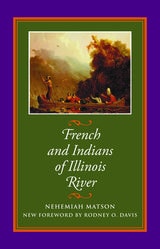
French and Indians of Illinois River
Nehemiah Matson. Foreword by Rodney O. Davis
Southern Illinois University Press, 2001
Complex and paradoxical, Nehemiah Matson (1816–1873) celebrated the occupation of the Middle West by European pioneers even as he labored to preserve the memory of the natives these pioneers replaced. He perpetuated the memory of the Indians who were driven out of the territory, but he nevertheless accumulated wealth selling their land to the pioneers. Rodney O. Davis notes in his new foreword to this book that Matson combined the attributes of a scholar with those of a salesman and promoter.
Matson settled in Princeton, Illinois, in 1836. He left behind a library partially endowed by him, named for him, and finally completed in 1913. According to Davis, however, Matson’s other legacy, “of equal significance in his own eyes, consisted of the five books he authored on northern Illinois and Illinois River history and cartography, volumes based not only on conscientious scholarship but also on both Indian and white reminiscence and on local folklore.”
Matson’s historical writings are valuable even when he deals with well-known events because his personal perspective makes his observations unique. Without the stories and reminiscences he collected, much valuable information would have been lost, especially since many of his informants, both Indian and European, were illiterate. Because his informants often told conflicting stories, Matson admitted that “harmonizing all conflicting accounts . . . has not been a success.”
Although Matson’s sources may not always have agreed, and sometimes his heart may have overruled his head and colored his accounts, he was a conscientious and committed author. “Obviously,” Davis explains, “this book must be evaluated as what it is, a piece of colorful local history, romantically anchored in legend yet rooted also in invaluable research and produced by a dedicated amateur whose standards were high. . . . French and Indians of Illinois River is a model of its type, indeed a minor classic.”
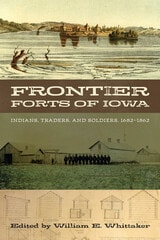
Frontier Forts of Iowa
Indians, Traders, and Soldiers, 1682-1862William E. Whittaker
University of Iowa Press, 2009
At least fifty-six frontier forts once stood in, or within view of, what is now the state of Iowa. The earliest date to the 1680s, while the latest date to the Dakota uprising of 1862. Some were vast compounds housing hundreds of soldiers; others consisted of a few sheds built by a trader along a riverbank. Regardless of their size and function—William Whittaker and his contributors include any compound that was historically called a fort, whether stockaded or not, as well as all military installations—all sought to control and manipulate Indians to the advantage of European and American traders, governments, and settlers. Frontier Forts of Iowa draws extensively upon the archaeological and historical records to document this era of transformation from the seventeenth-century fur trade until almost all Indians had been removed from the region.
The earliest European-constructed forts along the Mississippi, Des Moines, and Missouri rivers fostered a complex relationship between Indians and early traders. After the Louisiana Purchase of 1804, American military forts emerged in the Upper Midwest, defending the newly claimed territories from foreign armies, foreign traders, and foreign-supported Indians. After the War of 1812, new forts were built to control Indians until they could be moved out of the way of American settlers; forts of this period, which made extensive use of roads and trails, teamed a military presence with an Indian agent who negotiated treaties and regulated trade. The final phase of fort construction in Iowa occurred in response to the Spirit Lake massacre and the Dakota uprising; the complete removal of the Dakota in 1863 marked the end of frontier forts in a state now almost completely settled by Euro-Americans.
By focusing on the archaeological evidence produced by many years of excavations and by supporting their words with a wealth of maps and illustrations, the authors uncover the past and connect it with the real history of real places. In so doing they illuminate the complicated and dramatic history of the Upper Midwest in a time of enormous change. Past is linked to present in the form of a section on visiting original and reconstructed forts today.
Gayle F. Carlson
Jeffrey T. Carr
Lance M. Foster
Kathryn E. M. Gourley
Marshall B. McKusick
Cindy L. Nagel
David J. Nolan
Cynthia L. Peterson
Leah D. Rogers
Regena Jo Schantz
Christopher M. Schoen
Vicki L. Twinde-Javner
William E. Whittaker