Results by title
55 books match the query 'Individual Architects & Firms' and 6 start with f
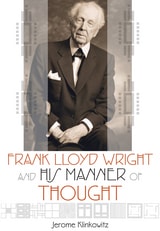
Frank Lloyd Wright and His Manner of Thought
Jerome Klinkowitz
University of Wisconsin Press, 2014
Klinkowitz presents a critical biography driven by the architect's own work and intellectual growth, focusing on the evolution of Wright's thinking and writings from his first public addresses in 1894 to his last essay in 1959. Did Wright reject all of Victorian thinking about the home, or do his attentions to a minister's sermon on "the house beautiful" deserve closer attention? Was Wright echoing the Transcendentalism of Ralph Waldo Emerson, or was he more in step with the philosophy of William James? Did he reject the Arts and Crafts movement, or repurpose its beliefs and practices for new times? And, what can be said of his deep dissatisfaction with architectural concepts of his own era, the dominant modernism that became the International Style? Even the strongest advocates of Frank Lloyd Wright have been puzzled by his objections to so much that characterized the twentieth century, from ideas for building to styles of living.
In Frank Lloyd Wright and His Manner of Thought, Klinkowitz, a widely published authority on twentieth-century literature, thought, and culture, examines the full extent of Wright's books, essays, and lectures to show how he emerged from the nineteenth century to anticipate the twenty-first.
Outstanding Book, selected by the American Association of School Librarians
Best Books for General Audiences, selected by the Public Library Reviewers
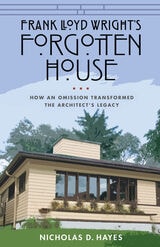
Frank Lloyd Wright's Forgotten House
How an Omission Transformed the Architect's LegacyNicholas D. Hayes
University of Wisconsin Press, 2021
When Nicholas and Angela Hayes became stewards of the unassuming Elizabeth Murphy House near Milwaukee, they began to unearth evidence that ultimately revealed a one-hundred-year-old fiasco fueled by competing ambitions and conflicting visions of America. The couple’s forensic pursuit of the truth untangled the ways Wright’s ASBH experiment led to the architect’s most productive, creative period. Frank Lloyd Wright’s Forgotten House includes a wealth of drawings and photographs, many of which have never been previously published. Historians, architecture buffs, and Wrightophiles alike will be fascinated by this untold history that fills a crucial gap in the architect’s oeuvre.
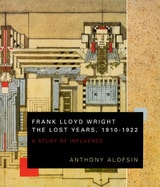
Frank Lloyd Wright--the Lost Years, 1910-1922
A Study of InfluenceAnthony Alofsin
University of Chicago Press, 1993
"Alofsin has set out to explain the impact of European culture on Wright by integrating its artistic influence with the tumultuous events in his private life. . . . [He] succeeds in this ambitious goal."—Kevin Nute, Architects' Journal
"A convincing and well-documented case that these were in fact crucial and fruitful years in Wright's development as an architect. . . . Absorbing."—Catherine Maclay, San Jose Mercury News
"One of the best."—Robert Fulford, Toronto Globe and Mail
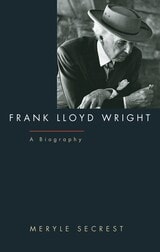
Frank Lloyd Wright
A BiographyMeryle Secrest
University of Chicago Press, 1998
The result is the most engaging and thorough account ever of Wright's life, work, and professional and personal circle, a gripping account of a complicated, challenging genius.
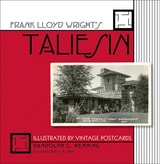
Frank Lloyd Wright’s Taliesin
Illustrated by Vintage PostcardsRandolph C. Henning
University of Wisconsin Press, 2011
The Wisconsin-born Frank Lloyd Wright (1867–1959) is recognized worldwide as an iconic architectural genius. In 1911 he designed Taliesin to use as his personal residence, architectural studio, and working farm. A century later Randolph C. Henning has assembled a splendid collection of rare vintage postcards, some never before published, that provides a revealing and visually unique journey through Wright’s work at Taliesin. Included are intimate images of Taliesin at various stages and views of the building just after the tragic 1914 fire. The postcards also depict nearby buildings designed by Wright, including the Romeo and Juliet windmill and two buildings for the Hillside Home School. Henning provides useful explanations that highlight relevant details and accompany each image. Frank Lloyd Wright’s Taliesin documents and celebrates Wright’s 100-year-old masterpiece.
Best Books for General Audiences, selected by the American Association of School Librarians
Best Books for General Audiences, selected by the Public Library Reviewers
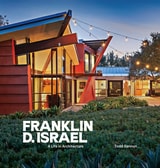
Franklin D. Israel
A Life in ArchitectureTodd Gannon
J. Paul Getty Trust, The, 2024
Acclaimed Los Angeles architect Franklin D. Israel (1945–1996) created innovative residential projects and office interiors that made him one of the most talked-about designers of his generation. In this vivid account, architectural historian Todd Gannon draws on archival resources, analyses of Israel’s buildings, and recent interviews with the architect’s colleagues, clients, and contemporaries, including Frank Gehry, Thom Mayne, and Robert A. M. Stern. Gannon traces Israel’s development from his early years and career on the East Coast to his formative world travels and residence at the American Academy in Rome. The author guides readers through the Los Angeles architectural context, Israel’s influential teaching at UCLA, his dalliance with Hollywood, and the personal motivations behind his architecture and design work—all aspects of an influential career that was cut short by his death from AIDS-related complications at the age of fifty.
Franklin D. Israel is a compelling work of architectural history and biography, chronicling one gay man’s engagement with the largely heteronormative world of American architectural culture. It explores the achievement of this central figure in the still largely unstudied history of late twentieth-century avant-garde Los Angeles architecture.