Results by title
412 books match the query 'Japan' and 10 start with f
Faking Liberties
Religious Freedom in American-Occupied JapanJolyon Baraka Thomas
University of Chicago Press, 2019
Through a fresh analysis of pre-war Japanese law, Jolyon Baraka Thomas demonstrates that the occupiers’ triumphant narrative obscured salient Japanese political debates about religious freedom. Indeed, Thomas reveals that American occupiers also vehemently disagreed about the topic. By reconstructing these vibrant debates, Faking Liberties unsettles any notion of American authorship and imposition of religious freedom. Instead, Thomas shows that, during the Occupation, a dialogue about freedom of religion ensued that constructed a new global set of political norms that continue to form policies today.
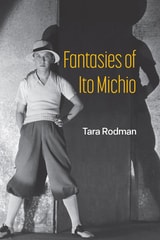
Fantasies of Ito Michio
Tara Rodman
University of Michigan Press, 2024
Winner of the 2025 Dance Studies Association Oscar Brockett Book Prize
Born in Japan and trained in Germany, dancer and choreographer Ito Michio (1893–1961) achieved prominence in London before moving to the U.S. in 1916 and building a career as an internationally acclaimed artist. During World War II, Ito was interned for two years, and then repatriated to Japan, where he contributed to imperial war efforts by creating propaganda performances and performing revues for the occupying Allied Forces in Tokyo. Throughout, Ito continually invented stories of voyages made, artists befriended, performances seen, and political activities carried out—stories later dismissed as false.
Fantasies of Ito Michio argues that these invented stories, unrealized projects, and questionable political affiliations are as fundamental to Ito’s career as his ‘real’ activities, helping us understand how he sustained himself across experiences of racialization, imperialism, war, and internment. Tara Rodman reveals a narrative of Ito’s life that foregrounds the fabricated and overlooked to highlight his involvement with Japanese artists, such as Yamada Kosaku and Ishii Baku, and global modernist movements. Rodman offers “fantasy” as a rubric for understanding how individuals such as Ito sustain themselves in periods of violent disruption and as a scholarly methodology for engaging the past.
Feeling Media
Potentiality and the Afterlife of ArtMiryam Sas
Duke University Press, 2022
Fertility Change in Contemporary Japan
Robert W. Hodge and Naohiro Ogawa
University of Chicago Press, 1992

Film's Ghosts
Tatsumi Hijikata's Butoh and the Transmutation of 1960s JapanStephen Barber
Diaphanes, 2019

Finding Mars
Ned Rozell
University of Alaska Press, 2011
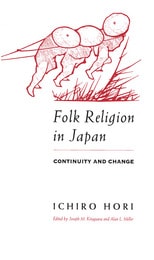
Folk Religion in Japan
Continuity and ChangeIchiro Hori
University of Chicago Press, 1968
Folk religion, transmitted by the common people from generation to generation, has greatly conditioned the political, economic, and cultural development of Japan and continues to satisfy the emotional and religious needs of the people. Hori examines the organic relationship between the Japanese social structure—the family kinship system, village and community organizations—and folk religion. A glossary with Japanese characters is included in the index.
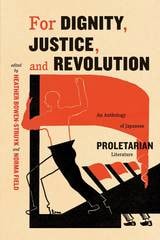
For Dignity, Justice, and Revolution
An Anthology of Japanese Proletarian LiteratureEdited by Heather Bowen-Struyk and Norma Field
University of Chicago Press, 2015
Contextualized by introductory essays, forty expertly translated stories touch on topics like perilous factories, predatory bosses, ethnic discrimination, and the myriad indignities of poverty. Together, they show how even intensely personal issues form a pattern of oppression. Fostering labor consciousness as part of an international leftist arts movement, these writers, lovers of literature, were also challenging the institution of modern literature itself. This anthology demonstrates the vitality of the “red decade” long buried in modern Japanese literary history.
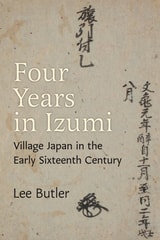
Four Years in Izumi
Village Japan in the Early Sixteenth CenturyLee Butler
University of Michigan Press, 2026
Four Years in Izumi takes an in-depth and critical approach to understanding Japanese village life through analysis of the diary of Kujō Masamoto, the former chancellor of the imperial court who resided briefly in one of his provincial estates from 1501 to 1504. For a high ranking courtier to travel to the countryside and manage a family estate was unheard of during the era of Sengoku, the “country at war.” The diary Masamoto kept offers a remarkably rich and vivid portrait of village Japan, which has seen no significant study in English-language scholarship.
Through extensive examination of the diary and close and critical reading of it and complementary sources, Lee Butler provides a window into the inner workings of late-medieval village life that challenges typical portrayals of the period. In Four Years in Izumi, we see the complexity of relations between commoners and elites in action. We also see the ways in which an estate functioned in practice at the heart of the medieval economy and local social structure.
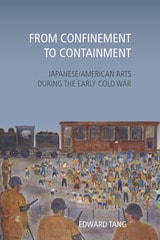
From Confinement to Containment
Japanese/American Arts during the Early Cold WarEdward Tang
Temple University Press, 2019
During the early part of the Cold War, Japan emerged as a model ally, and Japanese Americans were seen as a model minority. From Confinement to Containment examines the work of four Japanese and Japanese/American artists and writers during this period: the novelist Hanama Tasaki, the actor Yamaguchi Yoshiko, the painter Henry Sugimoto, and the children’s author Yoshiko Uchida. The backgrounds of the four figures reveal a mixing of nationalities, a borrowing of cultures, and a combination of domestic and overseas interests.
Edward Tang shows how the film, art, and literature made by these artists revealed to the American public the linked processes of U.S. actions at home and abroad. Their work played into—but also challenged—the postwar rehabilitated images of Japan and Japanese Americans as it focused on the history of transpacific relations such as Japanese immigration to the United States, the Asia-Pacific War, U.S. and Japanese imperialism, and the wartime confinement of Japanese Americans. From Confinement to Containment shows the relationships between larger global forces as well as how the artists and writers responded to them in both critical and compromised ways.