Results by title
82 books match the query 'Japanese Americans' and 6 start with f
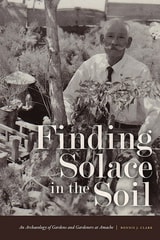
Finding Solace in the Soil
An Archaeology of Gardens and Gardeners at AmacheBonnie J. Clark
University Press of Colorado, 2022
Before incarceration, many at Amache had been farmers, gardeners, or nursery workers. Between 1942 and 1945, they applied their horticultural expertise to the difficult high plains landscape of southeastern Colorado. At Amache they worked to form microclimates, reduce blowing sand, grow better food, and achieve stability and preserve community at a time of dehumanizing dispossession. In this book archaeologist Bonnie J. Clark examines botanical data like seeds, garden-related artifacts, and other material evidence found at Amache, as well as oral histories from survivors and archival data including personal letters and government records, to recount how the prisoners of Amache transformed the harsh military setting of the camp into something resembling a town. She discusses the varieties of gardens found at the site, their place within Japanese and Japanese American horticultural traditions, and innovations brought about by the creative use of limited camp resources.
The gardens were regarded by the incarcerees as a gift to themselves and to each other. And they were also, it turns out, a gift to the future as repositories of generational knowledge where a philosophical stance toward nature was made manifest through innovation and horticultural skill. Framing the gardens and gardeners of Amache within the larger context of the incarceration of Japanese Americans and of recent scholarship on displacement and confinement, Finding Solace in the Soil will be of interest to gardeners, historical archaeologists, landscape archaeologists, cultural anthropologists, and scholars of Japanese American history and horticultural history.
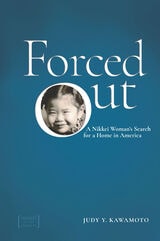
Forced Out
A Nikkei Woman's Search for a Home in AmericaJudy Y. Kawamoto
University Press of Colorado, 2020
Forced Out: A Nikkei Woman’s Search for a Home in America offers insight into “voluntary evacuation,” a little-known Japanese American experience during World War II, and the lasting effects of cultural trauma. Of the roughly 120,000 people forced from their homes by Executive Order 9066, around 5,000 were able to escape incarceration beforehand by fleeing inland. In a series of beautifully written essays, Judy Kawamoto recounts her family’s flight from their home in Washington to Wyoming, their later moves to Montana and Colorado, and the influence of those experiences on the rest of her life. Hers is a story shared by the many families who lost everything and had to start over in often suspicious and hostile environments.
Kawamoto vividly illustrates the details of her family’s daily life, the discrimination and financial hardship they experienced, and the isolation that came from experiencing the horrors of the 1940s very differently than many other Japanese Americans. Chapters address her personal and often unconscious reactions to her parents’ trauma, as well as her own subsequent travels around much of the world, exploring, learning, enjoying, but also unconsciously acting out a continual search for a home.
Showing how the impacts of traumatic events are collective and generational, Kawamoto draws
interconnections between her family’s displacement and later aspects of her life and juxtaposes the impact of her early experiences and questions of identity, culture, and assimilation. Forced Out will be of great interest to the general reader as well as students and scholars of ethnic studies, Asian American studies, history, education, and mental health.
2022 Asian/Pacific American Award for Literature, Honor Title, Adult Non-Fiction Literature
2022 Evans Handcart Award Winner
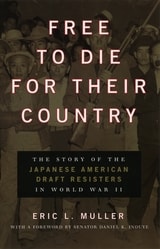
Free to Die for Their Country
The Story of the Japanese American Draft Resisters in World War IIEric L. Muller
University of Chicago Press, 2001
In the spring of 1942, the federal government forced West Coast Japanese Americans into detainment camps on suspicion of disloyalty. Two years later, the government demanded even more, drafting them into the same military that had been guarding them as subversives. Most of these Americans complied, but Free to Die for Their Country is the first book to tell the powerful story of those who refused. Based on years of research and personal interviews, Eric L. Muller re-creates the emotions and events that followed the arrival of those draft notices, revealing a dark and complex chapter of America's history.
From Chinese Exclusion to Guantánamo Bay
Plenary Power and the Prerogative StateNatsu Taylor Saito
University Press of Colorado, 2007
From Chinese Exclusion to Guantánamo Bay also provides a larger context for understanding problems resulting from the exercise of plenary power. Saito explains how the rights of individuals and groups deemed Other by virtue of race or national origin have been violated under both the Constitution and international law. The differing treatment of José Padilla and John Walker Lindh - both Americans accused of terrorism - provides an example of such disparate approaches. Such executive actions and their sanction by Congress and the judiciary, Saito argues, undermine not just individual rights but the very foundations of our national security - democracy and the rule of law.
From Chinese Exclusion to Guantánamo Bay will interest readers concerned with the historical background of constitutional protection in times of war and peace and will provide fascinating new material for scholars, teachers, and students of law, history, and ethnic studies
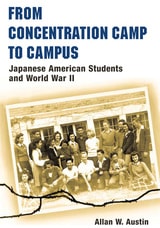
From Concentration Camp to Campus
Japanese American Students and World War IIAllan W. Austin
University of Illinois Press, 2003
Austin argues that the resettled students transformed the attempts at assimilation to create their own meanings and suit their own purposes, and succeeded in reintegrating themselves into the wider American society without sacrificing their connections to community and their Japanese cultural heritage.
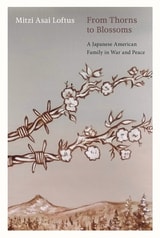
From Thorns to Blossoms
A Japanese American Family in War and PeaceMitzi Asai Loftus
Oregon State University Press, 2024
Mitsuko “Mitzi” Asai was not yet ten years old in the spring of 1942 when President Roosevelt’s Executive Order 9066 sent 120,000 people of Japanese ancestry—about two-thirds of them US citizens—from their homes on the West Coast to inland prison camps. They included Mitzi and most of her family, who owned a fruit orchard in Hood River, Oregon. The Asais spent much of World War II in the camps while two of the older sons served in the Pacific in the US Army. Three years later, when the camps began to close, the family returned to Hood River to find an altered community. Shop owners refused to serve neighbors they had known for decades; racism and hostility were open and largely unchecked. Humiliation and shame drove teenaged Mitzi to reject her Japanese heritage, including her birth name. More than a decade later, her life took another turn when a Fulbright grant sent her to teach in Japan, where she reconnected with her roots.
In From Thorns to Blossoms, Mitzi recounts her rich and varied life, from a childhood surrounded by barbed wire and hatred to a successful career as a high school English teacher and college instructor in English as a Second Language. Today, Asai descendants continue to tend the Hood River farm while the town confronts its shameful history. Originally published in 1990 as Made in Japan and Settled in Oregon, this revised and expanded edition describes the positive influence Mitzi’s immigrant parents had on their children, provides additional context for her story, and illuminates the personal side of a dark chapter in US history. It’s the remarkable story of a transformation from thorns into blossoms, pain into healing.