Results by title
622 books match the query 'Language Study' and 18 start with f
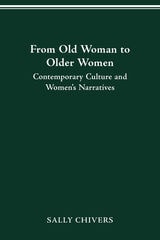
FROM OLD WOMAN TO OLDER WOMEN
Contemporary Culture and Women’s NarrativesSally Chivers
The Ohio State University Press, 2003
Sally Chivers provides a fascinating look at and challenge to how North American popular culture has portrayed old age as a time of disease, decline, and death. Within contemporary Canadian literary and film production, a tradition of articulate central elderly female characters challenges what the aging body has come to signify in a broader cultural context. Rather than seek positive images of aging, which can do their own prescriptive damage, the author focuses on constructive depictions that provide a basis on which to create new stories and readings of growing old. This type of humanities approach to the study of aging promises neither to fixate on nor avoid consideration of the role of the body in the much broader process of getting older. The progression implied in the title from the solitary symbol of The Old Woman toward a community of older women, indicates not a move toward euphemism, but rather an increasing and necessary awareness of the social and cultural dimensions of aging.

Fasciculus Moralitatis
Omelie Morales de Infantia SaluatorisCaesarius of Heisterbach
Karolinum Press, 2023
Primarily known as the author of the Dialogus miraculorum—a collection of exemplary stories that secured his reputation as the master of Cistercian storytelling—Caesarius of Heisterbach was also the author of several sermons and homilies. Although they are not as well known today, his Homilies on Jesus’ Childhood are exceptional in many ways. Readers will immediately notice Caesarius’s versatility as he employs an impressive array of persuasive techniques: quoting scholarly works, interpreting Hebrew names and letters, delving into etymology and numerology, and including numerous examples to instruct both the learned and the common person.
Filipino Tapestry Audio Supplement
To accompany Filipino Tapestry, Tagalog Language through CultureRhodalyne Gallo-Crail and Michael Hawkins
University of Wisconsin Press, 2012
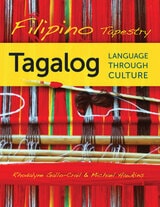
Filipino Tapestry
Tagalog Language through CultureRhodalyne Gallo-Crail
University of Wisconsin Press, 2012
An official language of the Philippines, Filipino is based on Tagalog, with elements of Spanish, English, and Chinese mixed in. The result is a rich, expressive language spoken in the Philippines and throughout the far-reaching Filipino diaspora.
Filipino Tapestry offers an innovative approach to learning language by emphasizing the critical intersection of language and culture. It provides activities and exercises that immerse beginning and intermediate students of Filipino in a variety of authentic situations to simulate an in-country experience. Starting with chapters on such topics as family, friends, and home, it then expands the student’s world in chapters prompting conversation about food, shopping, parties, and pastimes. Its later chapters push learners to discuss city and country life, cultural traditions, religion, history, and politics.
Features include:
• background chapters on phonology, sentence construction, and common expressions
• photos and cultural notes about chapter themes
• grammar, reading, listening, and speaking exercises
• glossaries of words and additional expressions
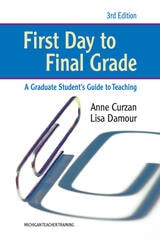
First Day to Final Grade, Third Edition
A Graduate Student's Guide to TeachingAnne Curzan and Lisa Damour
University of Michigan Press, 2011
This new edition incorporates newer teaching and learning pedagogy. The book has been updated to reflect the role of technology both inside and outside the classroom. In addition, a new chapter has been added that discusses successfully transitioning from being a teaching assistant to being hired as a full-time instructor.

First Day to Final Grade
A Graduate Student's Guide to Teaching, Fourth EditionAnne Curzan, Lisa Damour, and Whitney Peoples
University of Michigan Press, 2027
Every year, tens of thousands of graduate students walk into a college classroom for the first time with deep subject-matter expertise but little or no formal preparation for teaching. First Day to Final Grade has guided those instructors through three successful editions, offering clear, honest, and immediately usable advice for every stage of a course—from writing a syllabus and preparing a first lecture to running discussions, grading fairly, and handling difficult moments in the classroom. This fourth edition brings that trusted guidance fully up to date with new material on creating classrooms where all students can succeed and teaching with today’s technology. Whether read cover to cover before a first assignment or consulted in the middle of a challenging semester, this book is the practical companion new college teachers need.
In this new edition of First Day to Final Grade, readers will find:
- Equity-focused and inclusive pedagogy woven throughout the text;
- New material on transparency as a core inclusive and equity-focused practice, including explicit attention to surfacing the “hidden curriculum” for first-generation students;
- Advice on AI and generative tools, including designing writing assignments that account for AI, and a section on academic integrity, plagiarism, and inappropriate use of generative AI;
- New syllabus guidance on contemporary classroom management issues, including students requesting to record class sessions;
- Updated and consolidated recommended readings that address AI in teaching, equity-based pedagogy, student belonging, student mental health, teaching writing, and teaching when English is not one’s first language;
- Prescriptive guidance that explains the reasoning behind specific recommendations to help readers understand how particular practices benefit the learning environment and the instructor-student relationship.
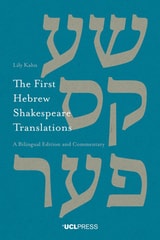
First Hebrew Shakespeare Translations
A Bilingual Edition and CommentaryLily Kahn
University College London, 2017
Flipping the Classroom
What Every ESL Teacher Should KnowRobyn Brinks Lockwood
University of Michigan Press, 2018
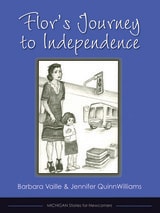
Flor's Journey to Independence
Barbara Vaille and Jennifer QuinnWilliams
University of Michigan Press, 2005
A modified version of this story is also available on our website, www.press.umich.edu/esl/stories.
The MICHIGAN Stories for Newcomers are original fiction written for adult English learners who wish to improve their reading and English skills

Florentine Codex
Book 1: Book 1: The GodsBernardino de Sahagun
University of Utah Press, 1981
Two of the world’s leading scholars of the Aztec language and culture have translated Sahagún’s monumental and encyclopedic study of native life in Mexico at the time of the Spanish Conquest. This immense undertaking is the first complete translation into any language of Sahagún’s Nahuatl text, and represents one of the most distinguished contributions in the fields of anthropology, ethnography, and linguistics.
Written between 1540 and 1585, the Florentine Codex (so named because the manuscript has been part of the Laurentian Library’s collections since at least 1791) is the most authoritative statement we have of the Aztecs’ lifeways and traditions—a rich and intimate yet panoramic view of a doomed people.
The Florentine Codex is divided by subject area into twelve books and includes over 2,000 illustrations drawn by Nahua artists in the sixteenth century.
Book One describes in detail the gods of the Aztec people, including Uitzilopochtli, Tlatoc, and Quetzalcoatl. This colorful and clear translation brings to life characteristics of each god, describing such items as clothing or adornment worn by individual gods, as well as specific personality traits.
Four Point Listening and Speaking 2, Second Ed., Supplemental Audiofiles
Audio DownloadBetsy Parrish
University of Michigan Press, 2014
This audio download product is NOT an audio reproduction of all the content in the accompanying textbook (Four Point: Listening & Speaking 2, Second Edition).
The Four Point series is designed for English language learners whose primary goal is to succeed in an academic setting.The series covers the four academic skills of reading, writing, listening, and speaking while providing reinforcement and systematic recycling of key vocabulary and further exposure to grammar issues. In order to participate in academic settings, English learners need focused activities to develop and then maintain their use of vocabulary and grammar. Each book in the series focuses heavily on vocabulary in particular, highlighting between 125-150 key vocabulary items including individual words, compound words, phrasal verbs, short phrases, idioms, metaphors, collocations, and longer set lexical phrases.
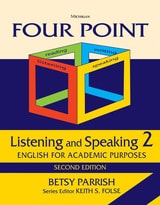
Four Point Listening and Speaking 2, Second Edition (No Audio)
English for Academic PurposesBetsy Parrish
University of Michigan Press, 2018
This version has the same content as 978-0-472-03535-9; it just is not packaged with the audio. The audio (MP3) files, available for download, must be purchased separately: 978-0-472-00362-4.
This product replaces 978-0-472-03535-9.
The Four Point series is designed for English language learners whose primary goal is to succeed in an academic setting.The series covers the four academic skills of reading, writing, listening, and speaking while providing reinforcement and systematic recycling of key vocabulary and further exposure to grammar issues. In order to participate in academic settings, English learners need focused activities to develop and then maintain their use of vocabulary and grammar. Each book in the series focuses heavily on vocabulary in particular, highlighting between 125-150 key vocabulary items including individual words, compound words, phrasal verbs, short phrases, idioms, metaphors, collocations, and longer set lexical phrases.
The 2nd Edition of Listening-Speaking 2 contains six lectures on the topic within a field of academic study: applied linguistics, geology, economics, history, health sciences, and engineering. The lectures range in length from 11 to 16 minutes in length. Audio files are sold separately. The exercises practice an array of important academic listening and speaking skills, including making presentations, and also reinforce vocabulary and reading and writing skills. Each unit includes activities based on the in-class interactions students will encounter in academic settings—including making impromptu and prepared presentations, debating, participating in group discussions. Toward this end, video scenes (available on the companion website) for each unit model student behavior when working in groups and incorporate key words and phrases typically used when working in groups. By addressing the breadth and depth of listening and speaking tasks required in academic settings, students will grow confident in areas that build the fluencies needed to succeed in their academic endeavors.
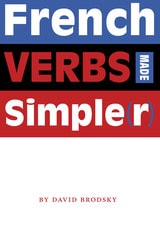
French Verbs Made Simple(r)
By David Brodsky
University of Texas Press, 2006
It's time for a new approach to learning French verbs. Unlike popular verb guides that require the rote memorization of hundreds of verb forms, this book clearly explains the rules that govern the conjugation of all classes of French verbs—especially the irregular ones that give second-language learners the most trouble. These straightforward, easy-to-understand rules for conjugating French verbs are effective learning tools for both beginning students and more advanced speakers who want to perfect their usage of French verb forms.
French Verbs Made Simple(r) has many helpful features that you won't find in any other verb guide:
- Clear explanations of all verb tenses and forms.
- The simple patterns and rules that govern the conjugation of all verbs—including those verbs whose irregularities follow patterns that can be easily learned.
- A detailed discussion of how each verb form is used, with numerous examples.
- A full explanation of whether a verb should be conjugated with avoir or être, and the conditions under which the past participle is variable—two of the thorniest problems for students of French.
- An extended treatment of the subjunctive that will help you understand why it is used in some situations but not others.
- Complete conjugations for 57 basic model verbs (along with 27 "variants") and a comprehensive listing of some 6,200 verbs that indicates which of the models each verb follows.
Going well beyond any other guide in the clarity and detail of its explanations—as well as the innovative manner in which individual verbs are linked to model conjugations—French Verbs Made Simple(r) is the only guide to French verbs a learner needs.
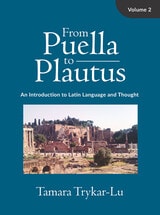
From Puella to Platus
An Introduction to Latin Language and Thought, Volume 2Tamara Trykar-Lu
Catholic University of America Press, 2019
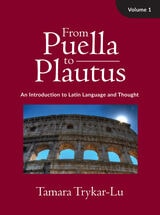
From Puella to Plautus
An Introduction to Latin Language and Thought, Volume 1Tamara Trykar-Lu
Catholic University of America Press, 2019

From Pushkin to Tolstoy
An Advanced Russian ReaderKonstantin Reichardt
University of Minnesota Press, 1944
Fulfulde (Maasina) - English - French Lexicon
A Root-Based Compilation Drawn from Extant SourcesDonald W. Osborn
Michigan State University Press, 1993
The Lexicon brings together lexical material from a wide range of published and non-published sources to create an extensive compilation of the vocabulary of Fulfulde as it is spoken in that part of central Mali known as Masina (in Fulfulde, Maasina). The Lexicon is intended primarily for non-Fulfulde speakers who are learning the language at the intermediate or advanced levels and who need access to a comprehensive reference source on Fulfulde vocabulary. Scholars, development workers, and others whose research or fieldwork involves use of the Fulfulde of Masina may find it helpful as well in clarifying nuances of meaning and standardized spelling for the less familiar terms they might encounter. It is also intended that the present work, beyond the matter of organizing vocabulary, will contribute significantly to the expanding lexicographical and linguistic investigations of Fulfulde.
Fundamentals of Curriculum Planning, Development, Implementation, and Evaluation in English Language Teaching
Eman Elturki
University of Michigan Press, 2026
This book offers a systematic guide to navigating the different phases of the curriculum, from its inception to its evaluation. Part I explores the conceptual and theoretical foundations that shape curriculum and instruction. Part II provides practical knowledge and guidelines that programs and individual teachers can adopt or adapt to their specific educational contexts with the goal is to optimize the teaching and learning experience. Elturki draws largely on knowledge from the field of education, particularly curriculum studies, to complement what we know about L2 teaching and learning from Applied Linguistics, Second Language Acquisition, and English Language Teaching. Each chapter begins with pre-reading questions to stimulate thinking and concludes with post-reading questions for reflection, encouraging readers to connect the material to their own context.