Results by title
276 books match the query 'Legal History' and 4 start with f
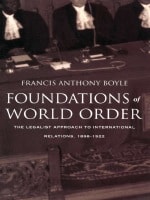
Foundations of World Order
The Legalist Approach to International Relations, 1898–1922Francis Anthony Boyle
Duke University Press, 1999
Although both the League of Nations and the Permanent Court of International Justice were rejected by the U.S. Senate, Boyle shows how the early governance of these institutions—precursors, respectively, to the United Nations and the International Court of Justice—informed later efforts to reduce and regulate transnational threats and the use of military force. Delving into such topics as the United States and its initial stance of neutrality in World War I and its imperial policy toward Latin America and the Caribbean, Boyle offers detailed readings of the relevant treaties, tribunals, and conferences, and assesses the political actors involved. Taking up the legalist point of view, he discusses the codification of customary international law, the obligatory arbitration of international disputes, and the creation of a new regime for the settlement of such disputes.
Boyle has provided in Foundations of World Order a compelling portrait of the relationship between political power and law, and of the impact of these forces on U.S. diplomacy. This volume will serve as a valuable resource to students, scholars, and practitioners of international law; it will also be of great interest to historians and political scientists engaged with issues of U.S. foreign policy and diplomatic history.
Free Speech, The People's Darling Privilege
Struggles for Freedom of Expression in American HistoryMichael Kent Curtis
Duke University Press, 2000
Curtis analyzes three crucial political struggles: the controversy that surrounded the 1798 Sedition Act, which raised the question of whether criticism of elected officials would be protected speech; the battle against slavery, which raised the question of whether Americans would be free to criticize a great moral, social, and political evil; and the controversy over anti-war speech during the Civil War. Many speech issues raised by these controversies were ultimately decided outside the judicial arena—in Congress, in state legislatures, and, perhaps most importantly, in public discussion and debate. Curtis maintains that modern proposals for changing free speech doctrine can usefully be examined in the light of this often ignored history. This broader history shows the crucial effect that politicians, activists, ordinary citizens—and later the courts—have had on the American understanding of free speech.
Filling a gap in legal history, this enlightening, richly researched historical investigation will be valuable for students and scholars of law, U.S. history, and political science, as well as for general readers interested in civil liberties and free speech.
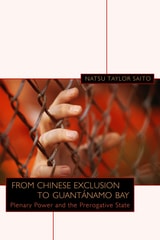
From Chinese Exclusion to Guantánamo Bay
Plenary Power and the Prerogative StateNatsu Taylor Saito
University Press of Colorado, 2007
From Chinese Exclusion to Guantánamo Bay also provides a larger context for understanding problems resulting from the exercise of plenary power. Saito explains how the rights of individuals and groups deemed Other by virtue of race or national origin have been violated under both the Constitution and international law. The differing treatment of José Padilla and John Walker Lindh - both Americans accused of terrorism - provides an example of such disparate approaches. Such executive actions and their sanction by Congress and the judiciary, Saito argues, undermine not just individual rights but the very foundations of our national security - democracy and the rule of law.
From Chinese Exclusion to Guantánamo Bay will interest readers concerned with the historical background of constitutional protection in times of war and peace and will provide fascinating new material for scholars, teachers, and students of law, history, and ethnic studies
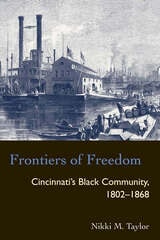
Frontiers of Freedom
Cincinnati’s Black Community 1802–1868Nikki M. Taylor
Ohio University Press, 2004