Results by title
1228 books match the query 'Library & Information Science' and 65 start with f

FRBR, Before and After
A Look at Our Bibliographic ModelsKaren Coyle
American Library Association, 2015
FRBR
A Guide for the PerplexedRobert L. Maxwell
American Library Association, 2008
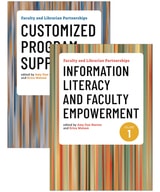
Faculty and Librarian Partnerships (2-Volume Set)
edited by Amy Dye-Reeves and Erica Watson
Assoc of College & Research Libraries, 2026
Academic librarians and disciplinary faculty have many partnership opportunities that can contribute greatly to student learning and experience and the academic community as a whole. Planning and scoping these collaborations, and beginning them with a clear understanding of each other’s roles and responsibilities, can help make them as rewarding and beneficial as possible.
Faculty and Librarian Partnerships is packed with practical insights, real-world examples, and inspiration for the many types of faculty collaboration—from instruction to technology to outreach to collection development. Volume 1, Information Literacy and Faculty Empowerment, contains ideas, lesson plans, and sample documents for collaborating with faculty on instruction and research. Volume 2, Customized Program Support, provides information on discipline-specific projects, leveraging liaison roles, and maximizing the use of special collections. Both volumes contain detailed descriptions of different kinds of collaborations from all types of institutions: one-on-one partnerships, larger team efforts, on campus and with the wider community, virtual collaborations, and strategic organizational alliances.
Whether you’re teaching one-shots or courses, are part of the student success team, or are just navigating the complex world of faculty engagement, Faculty and Librarian Partnerships can provide easy-to-implement strategies, relatable stories, and innovative ideas to inspire and guide your work.
Faculty and Librarian Partnerships, Volume 1
Information Literacy and Faculty EmpowermentEdited by Amy Dye-Reeves and Erica Watson
Assoc of College & Research Libraries, 2026
Academic librarians and disciplinary faculty have many partnership opportunities that can contribute greatly to student learning and experience and the academic community as a whole. Planning and scoping these collaborations, and beginning them with a clear understanding of each other’s roles and responsibilities, can help make them as rewarding and beneficial as possible.
Faculty and Librarian Partnerships is packed with practical insights, real-world examples, and inspiration for the many types of faculty collaboration—from instruction to technology to outreach to collection development. Volume 1, Information Literacy and Faculty Empowerment, contains ideas, lesson plans, and sample documents for collaborating with faculty on instruction and research. Volume 2, Customized Program Support, provides information on discipline-specific projects, leveraging liaison roles, and maximizing the use of special collections. Both volumes contain detailed descriptions of different kinds of collaborations from all types of institutions: one-on-one partnerships, larger team efforts, on campus and with the wider community, virtual collaborations, and strategic organizational alliances.
Whether you’re teaching one-shots or courses, are part of the student success team, or are just navigating the complex world of faculty engagement, Faculty and Librarian Partnerships can provide easy-to-implement strategies, relatable stories, and innovative ideas to inspire and guide your work.
Faculty and Librarian Partnerships, Volume 2
Customized Program SupportEdited by Amy Dye-Reeves and Erica Watson
Assoc of College & Research Libraries, 2026
Academic librarians and disciplinary faculty have many partnership opportunities that can contribute greatly to student learning and experience and the academic community as a whole. Planning and scoping these collaborations, and beginning them with a clear understanding of each other’s roles and responsibilities, can help make them as rewarding and beneficial as possible.
Faculty and Librarian Partnerships is packed with practical insights, real-world examples, and inspiration for the many types of faculty collaboration—from instruction to technology to outreach to collection development. Volume 1, Information Literacy and Faculty Empowerment, contains ideas, lesson plans, and sample documents for collaborating with faculty on instruction and research. Volume 2, Customized Program Support, provides information on discipline-specific projects, leveraging liaison roles, and maximizing the use of special collections. Both volumes contain detailed descriptions of different kinds of collaborations from all types of institutions: one-on-one partnerships, larger team efforts, on campus and with the wider community, virtual collaborations, and strategic organizational alliances.
Whether you’re teaching one-shots or courses, are part of the student success team, or are just navigating the complex world of faculty engagement, Faculty and Librarian Partnerships can provide easy-to-implement strategies, relatable stories, and innovative ideas to inspire and guide your work.

Faculty-Librarian Collaborations
Michael Stöpel
Assoc of College & Research Libraries, 2020
Fairy Tale Fun!
American Library Association, 2012
Fake News and Alternative Facts
Information Literacy in a Post-Truth EraNicole A. Cooke
American Library Association, 2018
Family Literacy Storytimes
Readymade Storytimes Suitable for the Whole FamilyAmerican Library Association, 2009
Family Storytime
24 Creative Programs for All AgesAmerican Library Association, 1999
Family-Centered Library Handbook
American Library Association, 2007
Fang-tastic Fiction
Patricia American Library Association
American Library Association, 2011
Film Preservation
Competing Definitions of Value, Use, and PracticeKaren F. Gracy
American Library Association, 2009
Film Programming for Public Libraries
Kati Irons
American Library Association, 2014
Financial Management In Academic Libraries
Data-DrivenRobert E. Dugan
Assoc of College & Research Libraries, 2018
Financial Management for Libraries
William W. Sannwald
American Library Association, 2018
Presenting financial management principles and best practices applicable to both public and academic libraries, this comprehensive text elucidates a broad array of issues crucial for those entering a managerial position. Both thorough and straightforward, Sannwald's treatment
- gives readers a solid grounding in the basics of accounting and finance, with an emphasis on applicability to library management and operations;
- ties budgets and strategic planning to library vision, mission, goals, and objectives;
- discusses the roles of stakeholders such as boards, governmental/municipal bodies, the university, and the community;
- looks at a variety of funding sources, from tax revenue to gifts and donations, and presents sound strategies for including them when projecting income and expenses;
- articulates and discusses the pros and cons of various budget strategies;
- includes sample budgets and forms that can be customized as needed;
- offers expert guidance on modifying budgets for windfalls and shortfalls;
- explains operating ratios, fiscal benchmarking, and metrics, demonstrating how to use these to effectively create and manage a budget and assess the fiscal health of the library; and
- advises on how to effectively prepare and present a budget and annual financial statements to a library's governing agency.
Finding a Public Voice
Barbara Fister as a Case StudyDanielle Theiss
Assoc of College & Research Libraries, 2013
Finding a Public Voice
Barbara Fister as a Case StudyDanielle Theiss
Assoc of College & Research Libraries, 2013
Finding the Answers to Legal Questions
Virginia M. Tucker
American Library Association, 2017
Finding the Answers to Legal Questions
A How-To-Do-It ManualAmerican Library Association, 2011
First Have Something to Say
Writing for the Library ProfessionAmerican Library Association, 2003
Five Steps of Outcome-Based Planning & Evaluation for Youth Services
Melissa Gross, Cindy Mediavilla, and Virginia A. Walter
American Library Association, 2022
Outcome-based planning and evaluation (OBPE), with its straightforward approach built on a flexible framework, is the perfect model to enable youth services professionals to deliver effective services regardless of uncertainties. An outcome-based approach can help youth services stay grounded in producing desired outcomes with and for youth through responsive programs, services, and processes that can adapt to changing conditions. Clarifying the relationship between planning, program development, and evaluation, the five simple steps outlined in this book will help youth services staff conduct solid community assessments and integrate OBPE into their work. Inside its pages you will learn
- a short history of OBPE and its evolution;
- why it is crucially important to involve youth in all stages of program development, with guidance on navigating challenges;
- how to think about planning as the need to react quickly, whether due to natural or human-made disasters, changing demographics, or economic swings;
- the five steps of OBPE, from gathering information about your community and determining the outcomes that will serve your community to crafting accurate outcome statements, developing an evaluation plan, and maximizing the results of successful outcome-based programs;
- how to visualize the steps needed to successfully plan, implement, and evaluate an outcome-based program, using the template included in the book;
- ways to share your data to let people know the library’s important role in the community; and
- additional useful tools to bolster your work, including environmental scan forms and ideas for creating relevant family storytimes.
Five Steps of Outcome-Based Planning and Evaluation for Public Libraries
Melissa Gross, Cindy Mediavilla, Virginia A. Walter
American Library Association, 2016
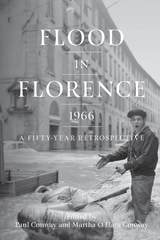
Flood in Florence, 1966
A Fifty-Year RetrospectivePaul Conway and Martha O’Hara Conway
Michigan Publishing Services, 2018
Folktales Aloud
Practical Advice for Playful StorytellingJanice M. Del Negro
American Library Association, 2013
Forging the Future of Special Collections
Arnold Hirshon
American Library Association, 2016
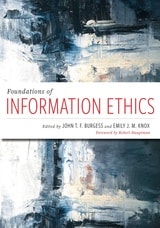
Foundations of Information Ethics
John T. F. Burgess
American Library Association, 2019
As discussions about the roles played by information in economic, political, and social arenas continue to evolve, the need for an intellectual primer on information ethics that also functions as a solid working casebook for LIS students and professionals has never been more urgent. This text, written by a stellar group of ethics scholars and contributors from around the globe, expertly fills that need. Organized into twelve chapters, making it ideal for use by instructors, this volume from editors Burgess and Knox
- thoroughly covers principles and concepts in information ethics, as well as the history of ethics in the information professions;
- examines human rights, information access, privacy, discourse, intellectual property, censorship, data and cybersecurity ethics, intercultural information ethics, and global digital citizenship and responsibility;
- synthesizes the philosophical underpinnings of these key subjects with abundant primary source material to provide historical context along with timely and relevant case studies;
- features contributions from John M. Budd, Paul T. Jaeger, Rachel Fischer, Margaret Zimmerman, Kathrine A. Henderson, Peter Darch, Michael Zimmer, and Masooda Bashir, among others; and
- offers a special concluding chapter by Amelia Gibson that explores emerging issues in information ethics, including discussions ranging from the ethics of social media and social movements to AI decision making.
This important survey will be a key text for LIS students and an essential reference work for practitioners
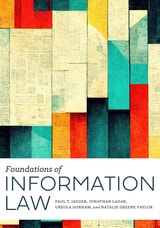
Foundations of Information Law
Paul T. Jaeger, Jonathan Lazar, Ursula Gorham, and Natalie Greene Taylor
American Library Association, 2023
- discusses information law as part of a continuum of interrelated issues rather than an assortment of discrete topics;
- examines information law in the context of different types of libraries;
- delves into the manifold legal issues raised when interacting with patrons and communities, from intellectual freedom topics like censorship and public activities in the library to the legal issues surrounding materials and information access;
- elucidates operational and management legal issues, including library security, interacting with law enforcement, advocacy, lobbying, funding, human resources, and liability;
- promotes literacy of the law, its structures, and its terminology as a professional skill;
- gives readers the tools to find and understand different sources of legal authority and demonstrates how to interpret them when they conflict; and
- explores information law as a national and cross-national issue.
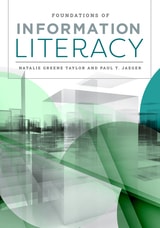
Foundations of Information Literacy
Natalie Greene Taylor
American Library Association, 2021
It’s not hyperbole to conclude that in today’s world, information literacy is essential for survival and success; and also that, if left unchecked, the social consequences of widespread misinformation and information illiteracy will only continue to grow more dire. Thus its study must be at the core of every education. But while many books have been written on information literacy, this text is the first to examine information literacy from a cross-national, cross-cultural, and cross-institutional perspective. From this book, readers will
- learn about information literacy in a wide variety of contexts, including academic and school libraries, public libraries, special libraries, and archives, through research and literature that has previously been siloed in specialized publications;
- come to understand why information literacy is not just an issue of information and technology, but also a broader community and societal issue;
- get an historical overview of advertising, propaganda, disinformation, misinformation, and illiteracy;
- gain knowledge of both applied strategies for working with individuals and for addressing the issues in community contexts;
- find methods for combating urgent societal ills caused and exacerbated by misinformation; and
- get tools and techniques for advocacy, activism, and self-reflection throughout one’s career.
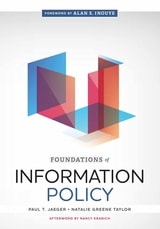
Foundations of Information Policy
Paul T. Jaeger
American Library Association, 2019
Foreword by Alan S. Inouye; Afterword by Nancy Kranich
The first of its kind, this important new text provides a much-needed introduction to the myriad information policy issues that impact information professionals, information institutions, and the patrons and communities served by those institutions. In this key textbook for LIS students and reference text for practitioners, noted scholars Jaeger and Taylor
- draw from current, authoritative sources to familiarize readers with the history of information policy;
- discuss the broader societal issues shaped by policy, including access to infrastructure, digital literacy and inclusion, accessibility, and security;
- elucidate the specific laws, regulations, and policies that impact information, including net neutrality, filtering, privacy, openness, and much more;
- use case studies from a range of institutions to examine the issues, bolstered by discussion questions that encourage readers to delve more deeply;
- explore the intersections of information policy with human rights, civil rights, and professional ethics; and
- prepare readers to turn their growing understanding of information policy into action, through activism, advocacy, and education.
Foundations of Intellectual Freedom
Emily J. M. Knox
American Library Association, 2022
- the historical and legal roots of intellectual freedom, with an in-depth examination of John Stuart Mill’s “On Liberty” and Article 19 of the U.N Declaration of Human Rights, and its central concepts and principles;
- the intersection of intellectual freedom, freedom of expression, and social justice;
- professional values, codes of ethics, ALA’s Library Bill of Rights, and Freedom to Read/View Statements;
- pro- and anti- censorship arguments and their use in impeding and facilitating access to information;
- book banning and internet filtering;
- privacy and its relationship to information services;
- U.S. case law and precedents;
- the basics of U.S. copyright law, including fair use, and how it differs from international copyright law; and
- emerging global issues and their impact on future intellectual freedom.
Foundations of Library and Information Science
Richard E. Rubin
American Library Association, 2020
Richard E. Rubin’s book has served as the authoritative introductory text for generations of library and information science practitioners, with each new edition taking in its stride the myriad societal, technological, political, and economic changes affecting our users and institutions and transforming our discipline. Rubin teams up with his daughter, Rachel G. Rubin, a rising star in the library field in her own right, for the fifth edition. Spanning all types of libraries, from public to academic, school, and special, it illuminates the major facets of LIS for students as well as current professionals. Continuing its tradition of excellence, this text addresses
- the history and mission of libraries from past to present, including the history of service to African Americans;
- critical contemporary social issues such as services to marginalized communities, tribal libraries, and immigrants;
- the rise of e-government and the crucial role of political advocacy;
- digital devices, social networking, digital publishing, e-books, virtual reality, and other technology;
- forces shaping the future of libraries, including Future Ready libraries, and sustainability as a core value of librarianship;
- the values and ethics of the profession, with new coverage of civic engagement, combatting fake news, the importance of social justice, and the role of critical librarianship;
- knowledge infrastructure and organization, including Resource Description and Access (RDA), linked data, and the Library Research Model;
- the significance of the digital divide and policy issues related to broadband access and net neutrality;
- intellectual freedom, legal issues, and copyright-related topics;
- contemporary issues in LIS education such as the ongoing tensions between information science and library science; and
- the changing character of collections and services including the role of digital libraries, preservation, and the digital humanities.
In its newest edition, Foundations of Library and Information Science remains the field’s essential resource.
Foundations of Library and Information Science
Richard E. Rubin
American Library Association, 2016
Framing Information Literacy (PIL#73) Volume Five
Scholarship as ConversationJanna L. Mattson
American Library Association, 0
Framing Information Literacy (PIL#73) Volume Four
Information Creation as a ProcessJanna L. Mattson
American Library Association, 0
Framing Information Literacy (PIL#73) Volume One
Research as InquiryJanna L. Mattson
American Library Association, 0
Framing Information Literacy (PIL#73) Volume Six
Authority is Constructed and ContextualJanna L. Mattson
American Library Association, 0
Framing Information Literacy (PIL#73) Volume Three
Searching as Strategic ExplorationJanna L. Mattson
American Library Association, 0
Framing Information Literacy (PIL#73) Volume Two
Information Has ValueJanna L. Mattson
American Library Association, 2018
Framing Information Literacy 6-Volume Set
Mary K. Oberlies
American Library Association, 2018
Framing Library Instruction
John Budd
Assoc of College & Research Libraries, 2011
Framing Library Instruction
John Budd
Assoc of College & Research Libraries, 2011
From A to Zine
Julie Bartel
American Library Association, 0
From A to Zine
Building a Winning Zine Collection in Your LibraryJulie Bartel
American Library Association, 2004
From Children's Literature to Readers Theatre
Elizabeth A. Poe
American Library Association, 2013
From Interrogation to Integration
Centering Social Justice in Special Collections, Archives, and PreservationKim Hoffman
Assoc of College & Research Libraries, 2025
From Interrogation to Integration: Centering Social Justice in Special Collections, Archives, and Preservation collects case studies, research projects, lesson plans, stories, practical strategies, color illustrations, and accessible, low-cost solutions from authors who have grappled directly with the legacy of harm present in their own institutions. The volume is organized into five themes:
- Research
- Description
- Preservation and Access
- Outreach
- Instruction
Fundamentals for the Academic Liaison
Richard Moniz
American Library Association, 2014
Fundamentals of Children's Services
Michael Sullivan
American Library Association, 2013
Fundamentals of Children's Services
Michael Sullivan
American Library Association, 2005
Fundamentals of Collection Development and Management
Peggy Johnson
American Library Association, 2018
Technical Services Quarterly declared that the third edition “must now be considered the essential textbook for collection development and management … the first place to go for reliable and informative advice." For the fourth edition expert instructor and librarian Johnson has revised and freshened this resource to ensure its timeliness and continued excellence. Each chapter offers complete coverage of one aspect of collection development and management, including numerous suggestions for further reading and narrative case studies exploring the issues. Thorough consideration is given to
- traditional management topics such as organization of the collection, weeding, staffing, and policymaking;
- cooperative collection development and management;
- licenses, negotiation, contracts, maintaining productive relationships with vendors and publishers, and other important purchasing and budgeting topics;
- important issues such as the ways that changes in information delivery and access technologies continue to reshape the discipline, the evolving needs and expectations of library users, and new roles for subject specialists, all illustrated using updated examples and data; and
- marketing, liaison activities, and outreach.
As a comprehensive introduction for LIS students, a primer for experienced librarians with new collection development and management responsibilities, and a handy reference resource for practitioners as they go about their day-to-day work, the value and usefulness of this book remain unequaled.