100 books match the query 'London' and 5 start with f
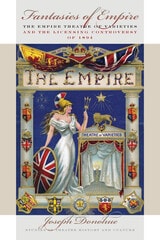
cover of Fantasies of Empire: The Empire Theatre of Varieties and the Licensing Controversy of 1894

Fantasies of Empire

The Empire Theatre of Varieties and the Licensing Controversy of 1894

Joseph Donohue

University of Iowa Press, 2005

In the London summer of 1894, members of the National Vigilance Society, led by the well-known social reformer Laura Ormiston Chant, confronted the Empire Theatre of Varieties, Leicester Square, and its brilliant manager George Edwardes as he applied for a routine license renewal. On grounds that the Empire’s promenade was the nightly resort of prostitutes, that the costumes in the theatre’s ballets were grossly indecent, and that the moral health of the nation was imperiled, Chant demanded that the London County Council either deny the theatre its license or require radical changes in the Empire’s entertainment and clientele before granting renewal. The resulting license restriction and the tremendous public controversy that ensued raised important issues—social, cultural, intellectual, and moral—still pertinent today.

Fantasies of Empire is the first book to recount in full the story of the Empire licensing controversy in all its captivating detail. Contemporaneous accounts are interwoven with Donohue’s identification and analysis of the larger issues raised: What the controversy reveals about contemporary sexual and social relations, what light it sheds on opposing views regarding the place of art and entertainment in modern society, and what it says about the pervasive effect of British imperialism on society’s behavior in the later years of Queen Victoria’s reign. Donohue connects the controversy to one of the most interesting developments in the history of modern theatre, the simultaneous emergence of a more sophisticated, varied, and moneyed audience and a municipal government insistent on its right to control and regulate that audience’s social and cultural character and even its moral behavior.

Rich in illustrations and entertainingly written, Fantasies of Empire will appeal to theatre, dance, and social historians and to students of popular entertainment, the Victorian period, urban studies, gender studies, leisure studies, and the social history of architecture.
[more]
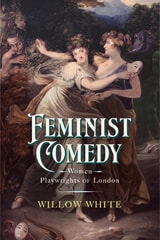
cover of Feminist Comedy: Women Playwrights of London

Feminist Comedy

Women Playwrights of London

Willow White

University of Delaware Press, 2024
Feminist Comedy: Women Playwrights of London identifies the eighteenth-century comedic stage as a key site of feminist critique, practice, and experimentation. While the history of feminism and comedy is undeniably vexed, by focusing on five women playwrights of the latter half of the eighteenth century--Catherine Clive, Frances Brooke, Frances Burney, Hannah Cowley, and Elizabeth Inchbald--this book demonstrates that stage comedy was crucial to these women’s professional success in a male-dominated industry and reveals a unifying thread of feminist critique that connects their works. Though male detractors denied women’s comic ability throughout the era, eighteenth-century women playwrights were on the cutting edge of comedy and their work had important feminist influence that can be traced to today’s stages and screens.
[more]
cover of Filth: Dirt, Digust, and Modern Life

Filth

Dirt, Digust, and Modern Life

William A. Cohen

University of Minnesota Press, 2004
From floating barges of urban refuse to dung-encrusted works of art, from toxic landfills to dirty movies, filth has become a major presence and a point of volatile contention in modern life. This book explores the question of what filth has to do with culture: what critical role the lost, the rejected, the abject, and the dirty play in social management and identity formation. It suggests the ongoing power of culturally mandated categories of exclusion and repression.Focusing on filth in literary and cultural materials from London, Paris, and their colonial outposts in the nineteenth and early twentieth centuries, the essays in Filth, all but one previously unpublished, range over topics as diverse as the building of sewers in nineteenth-century European metropolises, the link between interior design and bourgeois sanitary phobias, fictional representations of laboring women and foreigners as polluting, and relations among disease, disorder, and sexual-racial disharmony. Filth provides the first sustained consideration, both theoretical and historical, of a subject whose power to horrify, fascinate, and repel is as old as civilization itself.Contributors: David S. Barnes, U of Pennsylvania; Neil Blackadder, Knox College; Joseph Bristow, U of California, Los Angeles; Joseph W. Childers, U of California, Riverside; Eileen Cleere, Southwestern U; Natalka Freeland, U of California, Irvine; Pamela K. Gilbert, U of Florida; Christopher Hamlin, U of Notre Dame; William Kupinse, U of Puget Sound; Benjamin Lazier, U of Chicago; David L. Pike, American U; David Trotter, U of Cambridge.William A. Cohen is associate professor of English at the University of Maryland and the author of Sex Scandal: The Private Parts of Victorian Fiction.Ryan Johnson is completing his Ph.D. in the Department of English at Stanford University, where he has served as general editor of the Stanford Humanities Review.
[more]
cover of Fragments and Assemblages: Forming Compilations of Medieval London

Fragments and Assemblages

Forming Compilations of Medieval London

Arthur Bahr

University of Chicago Press, 2013
In Fragments and Assemblages, Arthur Bahr expands the ways in which we interpret medieval manuscripts, examining the formal characteristics of both physical manuscripts and literary works. Specifically, Bahr argues that manuscript compilations from fourteenth-century London reward interpretation as both assemblages and fragments: as meaningfully constructed objects whose forms and textual contents shed light on the city’s literary, social, and political cultures, but also as artifacts whose physical fragmentation invites forms of literary criticism that were unintended by their medieval makers. Such compilations are not simply repositories of data to be used for the reconstruction of the distant past; their physical forms reward literary and aesthetic analysis in their own right. The compilations analyzed reflect the full vibrancy of fourteenth-century London’s literary cultures: the multilingual codices of Edwardian civil servant Andrew Horn and Ricardian poet John Gower, the famous Auchinleck manuscript of texts in Middle English, and Chaucer’s Canterbury Tales. By reading these compilations as both formal shapes and historical occurrences, Bahr uncovers neglected literary histories specific to the time and place of their production. The book offers a less empiricist way of interpreting the relationship between textual and physical form that will be of interest to a wide range of literary critics and manuscript scholars.
[more]
cover of Freud's Couch, Scott's Buttocks, Brontë's Grave

Freud's Couch, Scott's Buttocks, Brontë's Grave

Simon Goldhill

University of Chicago Press, 2011

The Victorian era was the high point of literary tourism. Writers such as Charles Dickens, George Eliot, and Sir Walter Scott became celebrities, and readers trekked far and wide for a glimpse of the places where their heroes wrote and thought, walked and talked. Even Shakespeare was roped in, as Victorian entrepreneurs transformed quiet Stratford-upon-Avon into a combination shrine and tourist trap.

Stratford continues to lure the tourists today, as do many other sites of literary pilgrimage throughout Britain. And our modern age could have no better guide to such places than Simon Goldhill. In Freud's Couch, Scott’s Buttocks, Brontë's Grave, Goldhill makes a pilgrimage to Sir Walter Scott's baronial mansion, Wordsworth's cottage in the Lake District, the Bront ë parsonage, Shakespeare's birthplace, and Freud's office in Hampstead. Traveling, as much as possible, by methods available to Victorians—and gamely negotiating distractions ranging from broken bicycles to a flock of giggling Japanese schoolgirls—he tries to discern what our forebears were looking for at these sites, as well as what they have to say to the modern mind. What does it matter that Emily Brontë’s hidden passions burned in this specific room? What does it mean, especially now that his fame has faded, that Scott self-consciously built an extravagant castle suitable for Ivanhoe—and star-struck tourists visited it while he was still living there? Or that Freud's meticulous recreation of his Vienna office is now a meticulously preserved museum of itself? Or that Shakespeare’s birthplace features student actors declaiming snippets of his plays . . . in the garden of a house where he almost certainly never wrote a single line?

Goldhill brings to these inquiries his trademark wry humor and a lifetime's engagement with literature. The result is a travel book like no other, a reminder that even today, the writing life still has the power to inspire.

[more]