Results by title
273 books match the query 'Memoir' and 10 start with f
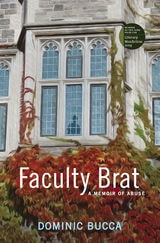
Faculty Brat
A Memoir of AbuseDominic Bucca
University of Iowa Press, 2020
At the most prestigious preparatory schools in the United States, the children of educators are referred to as “faculty brats.” Though generally lacking the privilege of the institution’s wealthy students, faculty brats enjoy access to the school’s extensive grounds and facilities and are part of everyday campus life.
Dominic Bucca’s art teacher mother married his music teacher stepfather twice, and the young boy wondered if the union might be twice as strong as a result. Instead, this faculty brat quickly discovered that the marriage was twice as flawed. When Dominic was nine years old, his stepfather began sexually abusing him in the faculty housing attached to the boys’ dorm his parents oversaw. Years later, he found escape by reaching out to his biological father, and learned to split his life between two realities.
For nearly twenty-five years, Bucca hid the secret of his stepfather’s abuse from his mother and sisters. When he decided to tell, hoping to prevent his stepfather from continuing to teach young boys, Bucca discovered the limits of both his family and the legal system.
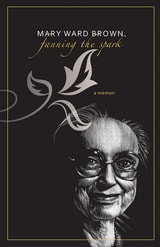
Fanning the Spark
A MemoirMary Ward Brown
University of Alabama Press, 2009
Where ordinary lives kindle extraordinary reckonings.
In 1986, after years of publishing stories in literary magazines and periodicals, Mary Ward Brown published her first book, the story collection Tongues of Flame. It soon received regional and national attention, and the following year won the PEN/Hemingway Award for fiction. Mary Ward Brown was sixty-nine years old. Though she would go on to write and publish many more stories and a well-received second collection, It Wasn’t All Dancing, Mary Ward Brown’s late acclaim hardly hints at the rich and varied life that prepared the way for her success.
Fanning the Spark is the story of her life as a writer—her upbringing in rural Alabama; the joys of college, marriage, and motherhood; the sorrows of becoming a widow; and a lifelong devotion to writing, writers, and literature, and the company of those who shared those loves, nurturing and feeding her interior life in the face of many challenges, losses, and obstacles, both emotional and material.
Here, in prose every bit as eloquent, evocative, and incisive as her stories, are her remembrances of loved ones; her letters fraught with worry to her son in Vietnam; periods of emotional isolation and unbidden silence; her invaluable friendships with renowned writers, editors, and agents; her love of community and place; and immeasurable delight with every award, speech, and public reading, the many recognitions she has garnered late in life. Above all, it is the story of the competing demands of art and of life, the constant struggle between her need to write and the practicalities of family, duty, and day to day living.

Fatherless
A MemoirKeith Maillard
West Virginia University Press, 2019
This story begins with a phone call out of the blue: a lawyer tells a writer that his ninety-six-year-old father, with whom he has had no contact since the age of three and whom he has twice tried to find without success, has just died, leaving him nothing. Half-reluctant, half-fascinated, both angry and curious, Keith Maillard begins to research his father’s life. The result is a suspenseful work of historical reconstruction—a social history often reading like a detective story—as well as a psychologically acute portrait of the impact of a father’s absence. Walking a tightrope between the known and the unknown, and following a trail that takes him from Vancouver to Montreal to his native Wheeling, West Virginia, Keith Maillard has pulled off a book that only a novelist of his stature could write.

Felon for Peace
The Memoir of a Vietnam-Era Draft ResisterJerry Elmer
Vanderbilt University Press, 2005
This book is a blend of personal memoir, contemporary history, and astute political analysis. Elmer draws on a variety of sources, including never-before-released FBI files, and argues passionately for the practice of nonviolence. He describes the range of actions he took—from draft card burning to organizing draft board raids with Father Phil Berrigan; from vigils on the Capitol steps inside "tiger cages" used to torture Vietnamese political prisoners to jail time for protesting nuclear power plants; from a tour of the killing fields of Cambodia to meetings with Corazon Aquino in the Philippines.
A Vietnamese-language edition of Felon for Peace has also been published.

For You, Lili Marlene
A Memoir Of World War IIRobert Peters
University of Wisconsin Press, 1996
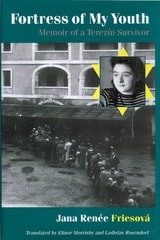
Fortress of My Youth
Memoir of a Terezín SurvivorJana Renée Friesová
University of Wisconsin Press, 2011
Jana Renée Friesová was fifteen when she was imprisoned by the Nazis in the Czech ghetto town of Terezín. Her memoir tells the poignantly familiar story of a young girl who, even under the most abominable circumstances, engages in intense adolescent friendships, worries with her companions over her looks, and falls in love.
Anne Frank’s diary ends with deportation to a concentration camp; Fortress of My Youth, in contrast, takes the reader deep into the horrors of daily life in a camp that were faced by a young girl and her family. But Friesová also tells of love, joy, sacrifice, and the people who shared in the most profound experiences of her life.
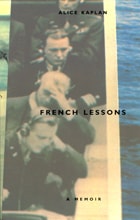
French Lessons
A MemoirAlice Kaplan
University of Chicago Press, 1993
The daughter of a Jewish lawyer who prosecuted Nazi war criminals at Nuremburg, Kaplan grew up in the 1960s in the Midwest. After her father's death when she was seven, French became her way of "leaving home" and finding herself in another language and culture. In spare, midwestern prose, by turns intimate and wry, Kaplan describes how, as a student in a Swiss boarding school and later in a junior year abroad in Bordeaux, she passionately sought the French "r," attentively honed her accent, and learned the idioms of her French lover.
When, as a graduate student, her passion for French culture turned to the elegance and sophistication of its intellectual life, she found herself drawn to the language and style of the novelist Louis-Ferdinand Celine. At the same time she was repulsed by his anti-Semitism. At Yale in the late 70s, during the heyday of deconstruction she chose to transgress its apolitical purity and work on a subject "that made history impossible to ignore:" French fascist intellectuals. Kaplan's discussion of the "de Man affair" — the discovery that her brilliant and charismatic Yale professor had written compromising articles for the pro-Nazi Belgian press—and her personal account of the paradoxes of deconstruction are among the most compelling available on this subject.
French Lessons belongs in the company of Sartre's Words and the memoirs of Nathalie Sarraute, Annie Ernaux, and Eva Hoffman. No book so engrossingly conveys both the excitement of learning and the moral dilemmas of the intellectual life.
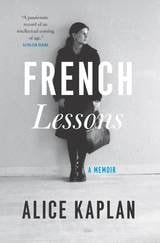
French Lessons
A MemoirAlice Kaplan
University of Chicago Press, 2018
The daughter of a Jewish lawyer who prosecuted Nazi war criminals at Nuremburg, Kaplan grew up in the 1960s in the Midwest. After her father's death when she was seven, French became her way of "leaving home" and finding herself in another language and culture. In spare, midwestern prose, by turns intimate and wry, Kaplan describes how, as a student in a Swiss boarding school and later in a junior year abroad in Bordeaux, she passionately sought the French "r," attentively honed her accent, and learned the idioms of her French lover.
When, as a graduate student, her passion for French culture turned to the elegance and sophistication of its intellectual life, she found herself drawn to the language and style of the novelist Louis-Ferdinand Celine. At the same time she was repulsed by his anti-Semitism. At Yale in the late 70s, during the heyday of deconstruction she chose to transgress its apolitical purity and work on a subject "that made history impossible to ignore:" French fascist intellectuals. Kaplan's discussion of the "de Man affair" — the discovery that her brilliant and charismatic Yale professor had written compromising articles for the pro-Nazi Belgian press—and her personal account of the paradoxes of deconstruction are among the most compelling available on this subject.
French Lessons belongs in the company of Sartre's Words and the memoirs of Nathalie Sarraute, Annie Ernaux, and Eva Hoffman. No book so engrossingly conveys both the excitement of learning and the moral dilemmas of the intellectual life.

From Southern Wrongs to Civil Rights
The Memoir of a White Civil Rights ActivistSara Mitchell Parsons
University of Alabama Press, 2009
This first-hand account tells the story of turbulent civil rights era Atlanta through the eyes of a white upper-class woman who became an outspoken advocate for integration and racial equality
As a privileged white woman who grew up in segregated Atlanta, Sara Mitchell Parsons was an unlikely candidate to become a civil rights agitator. After all, her only contacts with blacks were with those who helped raise her and those who later helped raise her children. As a young woman, she followed the conventional path expected of her, becoming the dutiful wife of a conservative husband, going to the country club, and playing bridge. But unlike many of her peers, Parsons harbored an increasing uneasiness about racial segregation.In a memoir that includes candid diary excerpts, Parsons chronicles her moral awakening. With little support from her husband, she runs for the Atlanta Board of Education on a quietly integrationist platform and, once elected, becomes increasingly outspoken about inequitable school conditions and the slow pace of integration. Her activities bring her into contact with such civil rights leaders as Martin Luther King, Jr., and his wife, Coretta Scott King. For a time, she leads a dual existence, sometimes traveling the great psychic distance from an NAACP meeting on Auburn Avenue to an all-white party in upscale Buckhead. She eventually drops her ladies' clubs, and her deepening involvement in the civil rights movement costs Parsons many friends as well as her first marriage.

From that Place and Time
A Memoir, 1938-1947Dawidowicz, Lucy
Rutgers University Press, 2008
Nancy Sinkoff's new introduction explores the historical forces, particularly the dynamic world of secular Yiddish culture, which shaped Dawidowicz's decision to journey to Poland and her reassessment of those forces in the last years of her life.