Results by title
105 books match the query 'Mind' and 4 start with f

Frames of Mind
A Post-Jungian Look at Cinema, Television and TechnologyLuke Hockley
Intellect Books, 2007
In this illuminating psychoanalysis of our media environment, Luke Hockley probes questions such as why we have genuine emotional responses to film events we know to be fictional, why we are compulsively driven to watch television, and how advertisers use unconscious motifs to persuade viewers.
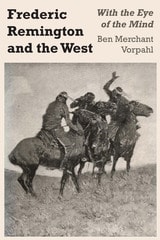
Frederic Remington and the West
With the Eye of the MindBy Ben Merchant Vorpahl
University of Texas Press, 1978
Frederic Remington and the West sheds new light on the remarkably complicated and much misunderstood career of Frederic Remington. This study of the complex relationship between Remington and the American West focuses on the artist’s imagination and how it expressed itself. Ben Merchant Vorpahl takes into account all the dimensions of Remington’s extensive work—from journalism to fiction, sculpture, and painting. He traces the events of Remington’s life and makes extensive use of literary and art criticism and nineteenth-century American social cultural and military history in interpreting his work.
Vorpahl reveals Remington as a talented, sensitive, and sometimes neurotic American whose work reflects with peculiar force the excitement and distress of the period between the Civil War and the Spanish-American War. Remington was not a “western” artist in the conventional sense; neither was he a historian: he lacked the historian’s breadth of vision and discipline, expressing himself not through analysis but through synthesis. Vorpahl shows that, even while Remington catered to the sometimes maudlin, sometimes jingoistic tastes of his public and his editors, his resourceful imagination was at work devising a far more demanding and worthwhile design—a composite work, executed in prose, pictures, and bronze. This body of work, as the author demonstrates, demands to be regarded as an interrelated whole. Here guilt, shame, and personal failure are honestly articulated, and death itself is confronted as the artist’s chief subject.
Because Remington was so prolific a painter, sculptor, illustrator, and writer, and because his subjects, techniques, and media were so apparently diverse, the deeper continuity of his work had not previously been recognized. This study is a major contribution to our understanding of an important American artist. In addition, Vorpahl illuminates the interplay between history, artistic consciousness, and the development of America’s sense of itself during Remington’s lifetime.
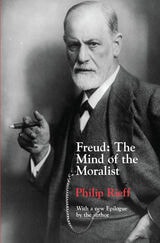
Freud
The Mind of the MoralistPhilip Rieff
University of Chicago Press, 1979
"This remarkably subtle and substantial book, with its nicely ordered sequences of skilled dissections and refined appraisals, is one of those rare products of profound analytic thought. . . . The author weighs each major article of the psychoanalytic canon in the scales of his sensitive understanding, then gives a superbly balanced judgement."—Henry A. Murray, American Sociological Review
"Rieff's tremendous scholarship and rich reflections fill his pages with memorable treasures."—Robert W. White, Scientific American
"Philip Rieff's book is a brilliant and beautifully reasoned example of what Freud's influence has really been: an increasing intellectual vigilance about human nature. . . . What the analyst does for the patient—present the terms for his new choices as a human being—Mr. Rieff does in respect to the cultural significance of Freudianism. His style has the same closeness, the same undertone of hypertense alertness. Again and again he makes brilliant points."—Alfred Kazin, The Reporter
From the Nature of the Mind to Personal Dignity
The Significance of Rosmini's PhilosophyJuan F. Franck
Catholic University of America Press, 2006