Results by title
968 books match the query 'Movements' and 23 start with f

Fantasies of Precision
American Modern Art, 1908-1947Ashley Lazevnick
University of Minnesota Press, 2023
Redefining the artistic movement that helped shape American modernism
In the early decades of the twentieth century, a loose contingent of artists working in and around New York City gave rise to the aesthetic movement known as precisionism, primarily remembered for its exacting depictions of skyscrapers, factories, machine parts, and other symbols of a burgeoning modernity. Although often regarded as a singular group, these artists were remarkably varied in their subject matter and stylistic traits. Fantasies of Precision excavates the surprising ties that connected them, exploring notions of precision across philosophy, technology, medicine, and many other fields.
Bookended by discussions of the landmark First Biennial Exhibition of Painting at the Whitney Museum in 1932, this study weaves together a series of interconnected chapters illuminating the careers of Charles Sheeler, Georgia O’Keeffe, and Charles Demuth. Built on a theoretical framework of the writing of modernist poets Marianne Moore and William Carlos Williams, Fantasies of Precision outlines an “ethos of precision” that runs through the diverse practices of these artists, articulating how the broad range of enigmatic imagery they produced was underpinned by shared strategies of restraint, humility, and slowness.
Questioning straightforward modes of art historical classification, Ashley Lazevnick redefines the concept that designated the precisionist movement. Through its cross-disciplinary approach and unique blend of historiography and fantasy, Fantasies of Precision offers a comprehensive reevaluation of one of the defining movements of artistic modernism.
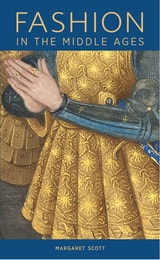
Fashion in the Middle Ages
Margaret Scott
J. Paul Getty Trust, The, 2018
From the costly velvets and furs worn by kings to the undyed wools and rough linens of the peasantry, the clothing worn by the various classes in the Middle Ages played an integral role in medieval society. In addition to providing clues to status, profession, and/or geographic origin, textiles were a crucial element in the economies of many countries and cities.
Much of what is known about medieval fashion is gleaned from the pages of manuscripts, which serve as a rich source of imagery. This volume provides a detailed look at both the actual fabrics and composition of medieval clothing as well as the period’s attitude toward fashion through an exploration of illuminated manuscripts in the collection of the J. Paul Getty Museum. The last portion of the book is dedicated to the depiction of clothing in biblical times and the ancient world as seen through a medieval lens. Throughout, excerpts from literary sources of the period help shed light on the perceived role and function of fashion in daily life.
Feminism, Capitalism, and Ecology
Johanna Oksala
Northwestern University Press, 2023
In the face of ecological catastrophe, neither feminists nor environmentalists have the option of merely supporting an environmental politics that would preserve an imagined nature somewhere outside capitalism. As Johanna Oksala contends, the political goal must be more radical: to challenge the capitalist economic system itself and the mechanisms by which it expropriates life on the planet.
Feminism, Capitalism, and Ecology lays the critical groundwork for this political project. It develops a new way of bringing feminist and ecological responses to capitalism together into a cohesive framework. By exposing the systemic logic by which environmental destruction and gender oppression are jointly rooted in capitalism, Oksala establishes the theoretical foundations for an effective political alliance. The traditions of materialist ecofeminism and Marxist feminism are critical starting points. But the rapid rise of biotechnology and the steady increase of precarity necessitate a model of resistance that responds to the distinctive challenges of contemporary biocapitalism. Timely and urgent, this book articulates a theoretically sophisticated response and maps out our real-world options in this existential struggle.
Feminist Experiences
Foucauldian and Phenomenological InvestigationsJohanna Oksala
Northwestern University Press, 2016
Drawing on conceptual tools from the thought of Michel Foucault, but also from the tradition of phenomenology, she explores the role of experience in feminist philosophy and its relationship to language and linguistic meaning. Oksala concludes by sketching a feminist ontology of the present through a critical investigation of neoliberalism and the challenges it presents to feminist theory and politics.
Feminist Making, Doing, and Sensing
Experiments in PhilosophyLauren Guilmette and Ada S. Jaarsma, editors
Duke University Press, 2026
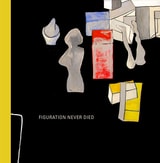
Figuration Never Died
New York Painterly Painting, 1950–1970Karen Wilkin
The Artist Book Foundation, 2020
By 1950, forward-looking New York painting was seen as synonymous with abstraction, especially charged, gestural Abstract Expressionism. But there was also a strong group of dissenters; artists, all born in the 1920s and many of them students of Hans Hofmann, who never lost their enthusiasm for recognizable imagery, without rejecting Abstract Expressionism's love of malleable oil paint. Although most of them began as abstract artists, they all evolved into painters working from observation, using a fluid, urgent touch to translate their perceptions into eloquent, highly individualized visual languages, almost always informed by the hand; that is, unlike the Color Field and Minimalist artists, these artists remained, for the most part, "painterly" painters. In light of their important contributions to twentieth-century American art, The Artist Book Foundation presents the cataloge for the Brattleboro Museum & Art Center's eponymous 2020 exhibition, Figuration Never Died: New York Painterly Painting, 1950–1970.
These rebellious artists include Lois Dodd, Jane Freilicher, Paul Georges, Grace Hartigan, Wolf Kahn, Alex Katz, Albert Kresch, Robert de Niro Sr., Paul Resika, and Anne Tabachnick. The compelling figurative work they made between about 1950 and 1970, in contrast to the prevailing Abstract Expressionism of the time, constitutes a significat chapter in the history of recent American Modernism. Their work not only greatly expands our conception of the story of New York painting, but it also presages and contextualizes today's multiplicity of artistic concepts and processes. Given both the aesthetic diversity of today's New York art world and the dependence of many younger artists on digital media or the appearance of digital media, it seems an appropriate moment to reconsider the work of these daring pioneers, as both precursor and opposition to current norms.

Film and Everyday Resistance
Marguerite La Caze
Northwestern University Press, 2024
A philosophical exploration of how modern global cinema represents everyday means of resisting authoritarianism and totalitarianism
Václav Havel’s concept of “living within the truth” in an authoritarian regime frames Marguerite La Caze’s readings of international cinema, highlighting forms of resistance in which seemingly pre- or nonpolitical aspects of life—such as professional labor, exile, and truth telling—can be recognized as political when seen against a backdrop of general acquiescence. La Caze’s case studies cross genres, historical eras, and national contexts: the apartheid regime in South Africa, in A Dry White Season; post-Suharto Indonesia, in The Look of Silence; 1980s East Germany, in Barbara; the Chilean military dictatorship, in No; contemporary Iran, in A Separation; and current-day Saudi Arabia, in Wadjda. This book explores the films’ use of image, sound, narrative, and character in dialogue with the work of Simone de Beauvoir, Aimé Cesaire, Hannah Arendt, Sara Ahmed, and W. E. B. Du Bois to reveal how cinema depicts ordinary people enacting their own philosophies of defiance.
Five Manifestos for the Beautiful World
The Alchemy LecturePhoebe Boswell, Saidiya Hartman, Janaina Oliveira, Joseph M. Pierce, and Cristina Rivera Garza
Duke University Press, 2025
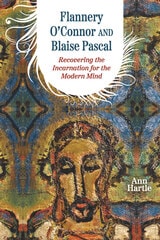
Flannery O'Connor and Blaise Pascal
Recovering the Incarnation for the Modern MindAnn Hartle
Catholic University of America Press, 2025
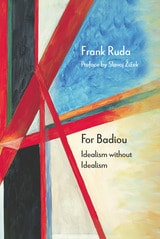
For Badiou
Idealism without IdealismFrank Ruda; Preface by Slavoj Zizek
Northwestern University Press, 2015
For Badiou serves both as an introduction to the influential French philosopher Alain Badiou’s thought and as an in-depth examination of his work. Ruda begins with a thorough and clear outline of the sometimes difficult main tenets of Badiou’s philosophy. He then traces the philosophers throughout Western thought who have influenced Badiou’s project—especially Plato, Descartes, Hegel, and Marx—and on whose work Badiou has developed his provocative philosophy. Ruda draws from Badiou’s oeuvre a series of directives with regard to renewing philosophy for the twenty-first century. For Badiou continues the interrogations of its subject and raises new materialistic and dialectical questions for the next generation of engaged philosophers.
Force, Drive, Desire
A Philosophy of PsychoanalysisRudolf Bernet, Translated from the French by Sarah Allen
Northwestern University Press, 2019
Rereading the long history of metaphysics (or at least a few of its key moments) in light of psychoanalytic inquiries into the nature and function of drive and desire also allows for a rewriting of the history of philosophy. Specifically, it allows Bernet to bring to light a different history of metaphysics, one centered less on Aristotelian substance (ousia) and more on the concept of dunamis—a power or potentiality for a realization toward which it strives with all its might. Relating human drives to metaphysical forces also bears fruit for a renewed philosophy of life and subjectivity.
Formerly God
Rethinking God after GodRick Benjamins
Amsterdam University Press, 2026
This book begins with the controversial work of Dutch theologian Harry Kuitert, who bid farewell to old representations of God but got stuck finding new ones. It turns back to the important and indispensable insights of Hegel and Heidegger. It presents contemporary post-theistic thinking about God, using German, French, and American thinkers, distinguishing interpretive theologians, deconstructionists, and constructive theologians, finally formulating a new position.
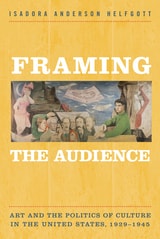
Framing the Audience
Art and the Politics of Culture in the United States, 1929-1945Isadora Helfgott
Temple University Press, 2015
Framing the Audience explores the cultural politics of the Great Depression and World War II through the prism of art appreciation. Isadora Helfgott interrogates the ideological and political motivations for breaking down barriers between fine art and popular culture. She charts the impact that changes in art appreciation had on the broader political, social, cultural, and artistic landscape.
Framing the Audience argues that efforts to expand the social basis of art became intertwined with—and helped shape—broader debates about national identity and the future of American political economy. Helfgott chronicles artists’ efforts toinfluence the conditions of artistic production and display. She highlights the influence of the Federal Art Project, the impact of the Museum of Modern Art as an institutional home for modernism in America and as an organizer of traveling exhibitions, and the efforts by LIFE and Fortune magazines to integrate art education into their visual record of modern life. In doing so, Helfgott makes critical observations about the changing relationship between art and the American public.
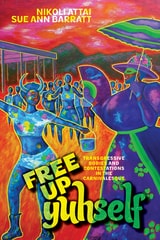
Free Up Yuhself
Transgressive Bodies and Contestations in the CarnivalesqueNikoli A. Attai
Rutgers University Press, 2025
Free Up Yuhself explores and theorizes what it means to embody and be empowered by the chaos of transgression, evaluating the implications for people who destabilize the Caribbean region’s dominant gender and sexuality politics within the Caribbean and the Caribbean diaspora. This book examines how people actively utilize the carnivalesque—spaces of festivity and places of excitement, the extraordinary, the ritualistic—to confront, negotiate, disrupt, and transgress normative trends, boundaries, and perspectives in the Caribbean and Caribbean diaspora communities. This book is particularly concerned with the ways that Caribbean people contest sexual and gendered expectations through their bodily performances across regional and diasporic festival spaces. Through illustrative, analytical, evaluative, and reflective chapters, the collection contemplates the themes of freedom, belonging, acceptance, and recognition as these affect the experience of people’s sense of being. The authors reflect on “freeing up” as a contentious politics, understanding that people have the capacity to enact their freedom through transgressive movements and performances that persistently grapple with notions of respectability, agency, empowerment, disruption, and the meanings and consequences of their varied social and political locations.
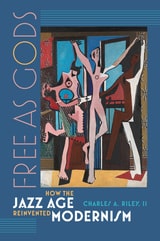
Free as Gods
How the Jazz Age Reinvented ModernismCharles A. Riley
University Press of New England, 2017
Freedom and Nature
The Voluntary and the InvoluntaryPaul Ricoeur
Northwestern University Press, 1966
Freedom and Nature
The Voluntary and the InvoluntaryPaul Ricoeur
Northwestern University Press, 2007
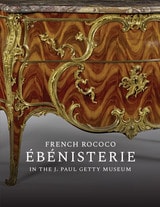
French Rococo Ébénisterie in the J. Paul Getty Museum
Gillian Wilson
J. Paul Getty Trust, The, 2021
The first comprehensive catalogue of the Getty Museum’s significant collection of French Rococo ébénisterie furniture.
This catalogue focuses on French ébénisterie furniture in the Rococo style dating from 1735 to 1760. These splendid objects directly reflect the tastes of the Museum’s founder, J. Paul Getty, who started collecting in this area in 1938 and continued until his death in 1976.
The Museum’s collection is particularly rich in examples created by the most talented cabinet masters then active in Paris, including Bernard van Risenburgh II (after 1696–ca. 1766), Jacques Dubois (1694–1763), and Jean-François Oeben (1721–1763). Working for members of the French royal family and aristocracy, these craftsmen excelled at producing veneered and marquetried pieces of furniture (tables, cabinets, and chests of drawers) fashionable for their lavish surfaces, refined gilt-bronze mounts, and elaborate design. These objects were renowned throughout Europe at a time when Paris was considered the capital of good taste.
The entry on each work comprises both a curatorial section, with description and commentary, and a conservation report, with construction diagrams. An introduction by Anne-Lise Desmas traces the collection’s acquisition history, and two technical essays by Arlen Heginbotham present methodologies and findings on the analysis of gilt-bronze mounts and lacquer.
The free online edition of this open-access publication is available at www.getty.edu/publications/rococo/ and includes zoomable, high-resolution photography. Also available are free PDF, EPUB, and Kindle/MOBI downloads of the book, and JPG downloads of the main catalogue images.
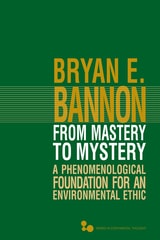
From Mastery to Mystery
A Phenomenological Foundation for an Environmental EthicBryan E. Bannon
Ohio University Press, 2014
From Mastery to Mystery is an original and provocative contribution to the burgeoningfield of ecophenomenology. Informed by current debates in environmental philosophy, Bannon critiques the conception of nature as u200a“substance” that he finds tacitly assumed by the major environmental theorists. Instead, this book reconsiders the basic goals of an environmental ethic by questioning the most basic presupposition that most environmentalists accept: that nature is in need of preservation.
Beginning with Bruno Latour’s idea that continuing to speak of nature in the way we popularly conceive of it is ethically and politically disastrous, this book describes a way in which the concept of nature can retain its importance in our discussion of the contemporary state of the environment. Based upon insights from the phenomenological tradition, specifically the work of Martin Heidegger and Maurice Merleau-Ponty, the concept of nature developed in the book preserves the best antihumanistic intuitions of environmentalists without relying on either a reductionistic understanding of nature and the sciences or dualistic metaphysical constructions.
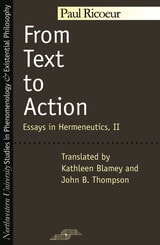
From Text to Action
Essays in Hermeneutics, IIPaul Ricoeur
Northwestern University Press, 1991
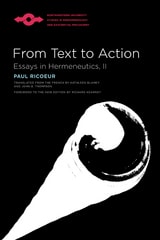
From Text to Action
Essays in Hermeneutics, IIPaul Ricoeur, Translated from the French by Kathleen Blamey and John B. Thompson, Foreword to the new edition by Richard Kearney
Northwestern University Press, 2007
From Text to Action is an essential companion to the classic The Conflict of Interpretations. Here, Ricoeur continues and extends his project of constructing a general theory of interpretation, positioning his work in relation to its philosophical background: Hegel, Husserl, Gadamer, and Weber. He also responds to contemporary figures like K. O. Apel and Jürgen Habermas, connecting his own theorization of ideology to their critique of ideology.
This new edition includes a foreword by Richard Kearney. It and other new editions of Ricoeur's texts published by Northwestern University Press have joined the canon of contemporary continental philosophy and continue to contribute to emergent discussions in the twenty-first century.
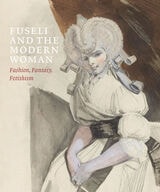
Fuseli and the Modern Woman
Fashion, Fantasy, FetishismEdited by David Solkin
Paul Holberton Publishing, 2022
Best known for his notoriously provocative painting The Nightmare, Anglo-Swiss painter Henry Fuseli (1741–1825) cultivated a reputation for eccentricity, with vividly stylized images of supernatural creatures, muscle-bound heroes, and damsels in distress. While these convinced some viewers of the greatness of his genius, others dismissed him as a charlatan, or as completely mad.
By bringing together more than fifty of his works, this volume offers unprecedented access to see one of the finest draftsmen of the Romantic period at his most innovative and exciting. Visitors to the show and readers of the lavishly illustrated catalog will further be invited to consider how Fuseli’s drawings of women, as products of the turbulent aftermath of the American and French Revolutions, speak to concerns about gender and sexuality that have never been more relevant than they are today.
The exhibition showcases drawings brought together from international collections, including the Kunsthaus Zürich, the Auckland Art Gallery in New Zealand, and other European and North American institutions.
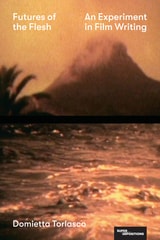
Futures of the Flesh
An Experiment in Film WritingDomietta Torlasco
Northwestern University Press, 2026
Exploring alternative possibilities of viewpoint through cinematic experimentation
In this boldly multidimensional work, Domietta Torlasco alternates between theoretical writings, film essays, and fragmented excerpts from an original screenplay to construct a temporal as well as spatial architecture for her critical intervention. Futures of the Flesh posits that cinematic experimentation holds the strongest potential to reimagine life—its forms, rhythms, and affects—beyond the division between subject and object, human and animal, animate and inanimate. Such potential cannot be clearly located in either space or time but, on the contrary, requires that we think according to momentum, diffraction, and difference.
As a novel notion and the formative medium of both subject and object, the flesh affirms the openness and indefinite generativity of being, allowing for the appearance of new perceptual relations and forms of kinship. Torlasco stages a dialogue between thinkers including Hortense Spillers and Maurice Merleau-Ponty and turns to canonical films, including Blade Runner and Solaris, classic sci-fi literature, such as Octavia Butler’s Kindred, and contemporary video art to elucidate how these media imaginatively rework the distinction between categories of being. This book endeavors to redefine the relation between theory and practice, analysis and creation, to name the primary relations that, under specific techno-aesthetic conditions, enable the emergence of porous, un-bordered forms of life.