Results by title
166 books match the query 'Native American' and 4 start with f
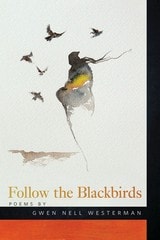
Follow the Blackbirds
Poems by Gwen Nell Westerman
Michigan State University Press, 2013
In language as perceptive as it is poignant, poet Gwen Nell Westerman builds a world in words that reflects the past, present, and future of the Dakota people. An intricate balance between the singularity of personal experience and the unity of collective longing, Follow the Blackbirds speaks to the affection and appreciation a contemporary poet feels for her family, community, and environment. With touches of humor and the occasional sharp cultural criticism, the voice that emerges from these poems is that of a Dakota woman rooted in her world and her words. In this moving collection, Westerman reflects on history and family from a unique perspective, one that connects the painful past and the hard-fought future of her Dakota homeland. Grounded in vivid story and memory, Westerman draws on both English and the Dakota language to celebrate the long journey along sunflower-lined highways of the tallgrass prairies of the Great Plains that returns her to a place filled with “more than history.” An intense homage to the power of place, this book tells a masterful story of cultural survival and the power of language.
[more]

Footprints of Hopi History
Hopihiniwtiput Kukveni'atEdited by Leigh J. Kuwanwisiwma, T. J. Ferguson, and Chip Colwell
University of Arizona Press, 2018
Kukveni—footprints—are a powerful historical metaphor that the Hopi people use to comprehend their tangible heritage. Hopis say that the deity Máasaw instructed their ancestors to leave footprints during their migrations from their origin place to their home today as evidence that they had fulfilled a spiritual pact to serve as stewards of his land. Today’s Hopis understand these footprints to be the archaeological remains of former settlements—pottery sherds, stone tools, petroglyphs, and other physical evidence of past use and occupation of the land.
The fourteen chapters in Footprints of Hopi History: Hopihiniwtiput Kukveni’at focus on these Hopi footprints as they are understood through a variety of research techniques, including archaeology, ethnography, documentary history, plant genetics, and educational outreach. The editors and contributors offer fresh and innovative perspectives on Hopi archaeology and history, and demonstrate how one tribe has significantly advanced knowledge about its past through collaboration with archaeologists and cultural anthropologists.
The book features managerial uses of research, cultural landscape theory, use of GIS in research, archaeological interpretations of social identity and immigration, analysis of corn genetics, heritage education of youth, and research of oral traditions and documentary history. Footprints of Hopi History highlights the Hopi tribe’s leadership in sustained efforts to create bridges between tribal goals and anthropology, forging a path for others to follow.
Contributors
E. Charles Adams
Wesley Bernardini
Joëlle Clark
Chip Colwell
T. J. Ferguson
Dennis Gilpin
Kelley Hays-Gilpin
George Gumerman IV
Saul L. Hedquist
Maren P. Hopkins
Stewart B. Koyiyumptewa
Leigh J. Kuwanwisiwma
Lee Wayne Lomayestewa
Patrick D. Lyons
Shirley Powell
Gregson Schachner
Thomas E. Sheridan
Mark D. Varien
Laurie D. Webster
Peter M. Whiteley
Michael Yeatts
[more]

From the Belly of My Beauty
Esther G. Belin
University of Arizona Press, 1999
If it can be said that Native culture is hidden behind the facade of mainstream America, there is a facet of that culture hidden even to many Native Americans. One of today's generation of outstanding Native writers, Esther Belin is an urban Indian. Raised in the city, she speaks with an entirely different voice from that of her reservation kindred as she expresses herself on subjects of urban alienation, racism, sexism, substance abuse, and cultural estrangement.
In this bold new collection of poems, Belin presents a startling vision of urban California—particularly Los Angeles—contrasted with Navajo life in the Four Corners region. She presents aspects of Diné life and history not normally seen by readers accustomed to accounts written by Navajos brought up on the reservation.
Her work reveals a difference in experience but a similarity in outlook. Belin's poems put familiar cultural forms in a new context, as Coyote "struts down east 14th / feeling good / looking good / feeling the brown." Her character Ruby dramatizes the gritty reality of a Native woman's life ("I laugh / sit / smoke a Virginia Slim / and talk to the spirits"). Her use of Diné language and poignant descriptions of family life will remind some of Joy Harjo's work, but with every turn of the page, readers will know that Belin is making her own mark on Native American literature.
From the Belly of My Beauty is also a ceremony of affirmation and renewal for those Native Americans affected by the Federal Indian Relocation Program of the 1950s and '60s, with its attempts to "assimilate" them into the American mainstream. They have survived by remembering who they were and where they came from. And they have survived so that they might bear witness, as Esther Belin so powerfully does. Belin holds American culture accountable for failing to treat its indigenous peoples with respect, but speaks for the ability of Native culture to survive and provide hope, even for mixed-blood or urban Indians. She is living proof that Native culture thrives wherever its people are found.
[more]

from Sand Creek
Simon J. Ortiz
University of Arizona Press, 2000
The massacre of Cheyenne and Arapaho women and children by U.S. soldiers at Sand Creek in 1864 was a shameful episode in American history, and its battlefield was proposed as a National Historic Site in 1998 to pay homage to those innocent victims. Poet Simon Ortiz had honored those people seventeen years earlier in his own way. That book, from Sand Creek, is now back in print.
Originally published in a small-press edition, from Sand Creek makes a large statement about injustices done to Native peoples in the name of Manifest Destiny. It also makes poignant reference to the spread of that ambition in other parts of the world—notably in Vietnam—as Ortiz asks himself what it is to be an American, a U.S. citizen, and an Indian. Indian people have often felt they have had no part in history, Ortiz observes, and through his work he shows how they can come to terms with this feeling. He invites Indian people to examine the process they have experienced as victims, subjects, and expendable resources—and asks people of European heritage to consider the motives that drive their own history and create their own form of victimization.
Through the pages of this sobering work, Ortiz offers a new perspective on history and on America. Perhaps more important, he offers a breath of hope that our peoples might learn from each other:
This America
has been a burden
of steel and mad
death,
but, look now,
there are flowers
and new grass
and a spring wind
rising
from Sand Creek.
[more]