Results by title
126 books match the query 'New England' and 5 start with f

Female Piety and the Invention of American Puritanism
Bryce Traister
The Ohio State University Press, 2016
Female Piety and the Invention of American Puritanism reconsiders the standard critical view that women’s religious experiences were either silent consent or hostile response to mainstream Puritan institutions. In this groundbreaking new approach to American Puritanism, Bryce Traister asks how gendered understandings of authentic religious experience contributed to the development of seventeenth-century religious culture and to the “post-religious” historiography of Puritanism in secular modernity. He argues that women were neither marginal nor hostile to the theological and cultural ambitions of seventeenth-century New England religious culture and, indeed, that radicalized female piety was in certain key respects the driving force of New England Puritan culture.
Uncovering the feminine interiority of New England Protestantism, Female Piety and the Invention of American Puritanism positions itself against prevalent historical arguments about the rise of secularism in the modern West. Traister demonstrates that female spirituality became a principal vehicle through which Puritan identity became both absorbed within and foundational for pre-national secular culture. Engaging broadly with debates about religion and secularization, national origins and transnational unsettlements, and gender and cultural authority, this is a foundational reconsideration both of American Puritanism itself and of “American Puritanism” as it has been understood in relation to secular modernity.
Uncovering the feminine interiority of New England Protestantism, Female Piety and the Invention of American Puritanism positions itself against prevalent historical arguments about the rise of secularism in the modern West. Traister demonstrates that female spirituality became a principal vehicle through which Puritan identity became both absorbed within and foundational for pre-national secular culture. Engaging broadly with debates about religion and secularization, national origins and transnational unsettlements, and gender and cultural authority, this is a foundational reconsideration both of American Puritanism itself and of “American Puritanism” as it has been understood in relation to secular modernity.
[more]

Field Guide to New England Barns and Farm Buildings
Thomas Durant Visser
University Press of New England, 1997
The quintessential New England barn–photogenic, full of character, and framed by flaming autumn foliage–is an endangered species. Of some 30,000 barns in Vermont alone, nearly a thousand a year are lost to fire, collapse, or bulldozers. Thomas Durant Visser’s field guide to the barns, silos, sugar houses, granaries, tobacco barns, and potato houses of New England is an attempt to document not just their structure but their traditions and innovations before the surviving architectural evidence of this rich rural heritage is lost forever. A recognized authority on historic barn preservation, Visser has combed the six-state region for representative barns and outbuildings, and 200 of his photographs are reproduced here. The text, which includes accounts from 18th– and 19th–century observers, describes key architectural characteristics, historic uses, and geographic distribution as well as specific features like timbers and frames, sheathings, doors, and cupolas. From English barns to bank barns, from ice houses to outhouses, these irreplaceable assets, Visser writes, “linger as vulnerable survivors of the past. Yet before these buildings vanish, each has a story to tell.” Travelers, residents, and scholars alike will find Visser’s text invaluable in uncovering, understanding, and appreciating the stories inherent in these dwindling cultural artifacts.
[more]

First Founders
American Puritans and Puritanism in an Atlantic WorldFrancis J. Bremer
University of New Hampshire Press, 2012
Francis J. Bremer has spent his entire career broadening our understanding of America’s colonial founders. Now, in this eminently readable collection of biographies, Bremer brings us a surprisingly varied and dynamic group of characters who continue to guide and influence America today. With its cast of magistrates, women, clergy, merchants, and Native Americans, First Founders underscores the breadth of early American experience and the profound transatlantic roots of our country’s forebears. Bremer succeeds in bringing little-known figures out of the shadows, while allowing us to appreciate better known figures in an entirely new light.
This is a truly fascinating look at the Puritans with keenly drawn portraits and the insight that only a lifetime of scholarship can achieve. It should become the standard introduction to the field. Written in the mold of Joseph Ellis’s Founding Brothers and Gordon Wood’s Revolutionary Characters, the book will appeal to general readers, students, and scholars alike.
This is a truly fascinating look at the Puritans with keenly drawn portraits and the insight that only a lifetime of scholarship can achieve. It should become the standard introduction to the field. Written in the mold of Joseph Ellis’s Founding Brothers and Gordon Wood’s Revolutionary Characters, the book will appeal to general readers, students, and scholars alike.
[more]
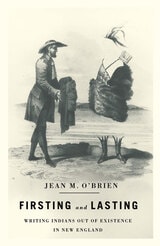
Firsting and Lasting
Writing Indians out of Existence in New EnglandJean M. O’Brien
University of Minnesota Press, 2010
Across nineteenth-century New England, antiquarians and community leaders wrote hundreds of local histories about the founding and growth of their cities and towns. Ranging from pamphlets to multivolume treatments, these narratives shared a preoccupation with establishing the region as the cradle of an Anglo-Saxon nation and the center of a modern American culture. They also insisted, often in mournful tones, that New England’s original inhabitants, the Indians, had become extinct, even though many Indians still lived in the very towns being chronicled.
In Firsting and Lasting, Jean M. O’Brien argues that local histories became a primary means by which European Americans asserted their own modernity while denying it to Indian peoples. Erasing and then memorializing Indian peoples also served a more pragmatic colonial goal: refuting Indian claims to land and rights. Drawing on more than six hundred local histories from Massachusetts, Connecticut, and Rhode Island written between 1820 and 1880, as well as censuses, monuments, and accounts of historical pageants and commemorations, O’Brien explores how these narratives inculcated the myth of Indian extinction, a myth that has stubbornly remained in the American consciousness.
In order to convince themselves that the Indians had vanished despite their continued presence, O’Brien finds that local historians and their readers embraced notions of racial purity rooted in the century’s scientific racism and saw living Indians as “mixed” and therefore no longer truly Indian. Adaptation to modern life on the part of Indian peoples was used as further evidence of their demise. Indians did not—and have not—accepted this effacement, and O’Brien details how Indians have resisted their erasure through narratives of their own. These debates and the rich and surprising history uncovered in O’Brien’s work continue to have a profound influence on discourses about race and indigenous rights.
[more]
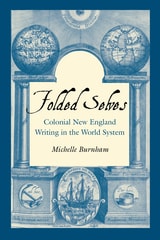
Folded Selves
Colonial New England Writing in the World SystemMichelle Burnham
Dartmouth College Press, 2014
Folded Selves radically refigures traditional portraits of seventeenth-century New England literature and culture by situating colonial writing within the spatial, transnational, and economic contexts that characterized the early-modern “world system” theorized by Immanuel Wallerstein and others. Michelle Burnham rethinks American literary history and the politics of colonial dissent, and her book breaks new ground in making the economic relations of investment, credit, and trade central to this new framework for early American literary and cultural study. Transcontinental colonialism and mercantile capitalism underwrote not just the emerging world system but New World writing—suggesting that early modern literary aesthetics and the early modern economy helped to sponsor each other. Burnham locates in New England’s literature of dissent—from Ma-re Mount to the Salem witchcraft trials – a persistent use of economic language, as well as competing economies of style. The brilliance of Burnham’s study is that it exposes the transoceanic material and commercial concerns of colonial America’s literature and culture of dissent.
[more]