Results by title
152 books match the query 'New York (N.Y.)' and 3 start with f
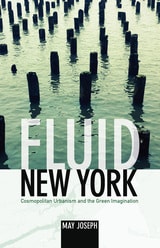
Fluid New York
Cosmopolitan Urbanism and the Green ImaginationMay Joseph
Duke University Press, 2013
Hurricane Sandy was a fierce demonstration of the ecological vulnerability of New York, a city of islands. Yet the storm also revealed the resilience of a metropolis that has started during the past decade to reckon with its aqueous topography. In Fluid New York, May Joseph describes the many ways that New York, and New Yorkers, have begun to incorporate the city's archipelago ecology into plans for a livable and sustainable future. For instance, by cleaning its tidal marshes, the municipality has turned a previously dilapidated waterfront into a space for public leisure and rejuvenation.
Joseph considers New York's relation to the water that surrounds and defines it. Her reflections reach back to the city's heyday as a world-class port—a past embodied in a Dutch East India Company cannon recently unearthed from the rubble at the World Trade Center site—and they encompass the devastation caused by Hurricane Sandy in 2012. They suggest that New York's future lies in the reclamation of its great water resources—for artistic creativity, civic engagement, and ecological sustainability.
[more]
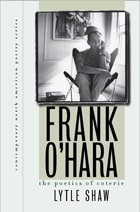
Frank O'Hara
The Poetics of CoterieLytle Shaw
University of Iowa Press, 2006
In this stimulating and innovative synthesis of New York's artistic and literary worlds, Lytle Shaw uses the social and philosophical problems involved in “reading” a coterie to propose a new language for understanding the poet, art critic, and Museum of Modern Art curator Frank O'Hara (1926-1966). O'Hara's poems are famously filled with proper names---from those of his immediate friends and colleagues in the New York writing and art worlds (John Ashbery, Kenneth Koch, Grace Hartigan, Willem de Kooning, and many musicians, dancers, and filmmakers) to a broad range of popular cultural and literary heroes (Apollinaire to Jackie O). But rather than understand O'Hara's most commonly referenced names as a fixed and insular audience, Shaw argues that he uses the ambiguities of reference associated with the names to invent a fluid and shifting kinship structure---one that opened up radical possibilities for a gay writer operating outside the structure of the family. As Shaw demonstrates, this commitment to an experimental model of association also guides O'Hara's art writing. Like his poetry, O'Hara's art writing too has been condemned as insular, coterie writing. In fact, though, he was alone among 1950s critics in his willingness to consider abstract expressionism not only within the dominant languages of existentialism and formalism but also within the cold war political and popular cultural frameworks that anticipate many of the concerns of contemporary art historians. Situating O'Hara within a range of debates about art's possible relations to its audience, Shaw demonstrates that his interest in coterie is less a symptomatic offshoot of his biography than a radical literary and artistic invention.
[more]
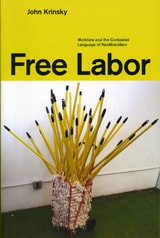
Free Labor
Workfare and the Contested Language of NeoliberalismJohn Krinsky
University of Chicago Press, 2008
One of former New York City Mayor Rudolph Giuliani’s proudest accomplishments is his expansion of the Work Experience Program, which uses welfare recipients to do routine work once done by unionized city workers. The fact that WEP workers are denied the legal status of employees and make far less money and enjoy fewer rights than do city workers has sparked fierce opposition. For antipoverty activists, legal advocates, unions, and other critics of the program this double standard begs a troubling question: are workfare participants workers or welfare recipients?
At times the fight over workfare unfolded as an argument over who had the authority to define these terms, and in Free Labor, John Krinsky focuses on changes in the language and organization of the political coalitions on either side of the debate. Krinsky’s broadly interdisciplinary analysis draws from interviews, official documents, and media reports to pursue new directions in the study of the cultural and cognitive aspects of political activism. Free Labor will instigate a lively dialogue among students of culture, labor and social movements, welfare policy, and urban political economy.
At times the fight over workfare unfolded as an argument over who had the authority to define these terms, and in Free Labor, John Krinsky focuses on changes in the language and organization of the political coalitions on either side of the debate. Krinsky’s broadly interdisciplinary analysis draws from interviews, official documents, and media reports to pursue new directions in the study of the cultural and cognitive aspects of political activism. Free Labor will instigate a lively dialogue among students of culture, labor and social movements, welfare policy, and urban political economy.
[more]