Results by title
137 books match the query 'Patients' and 9 start with f
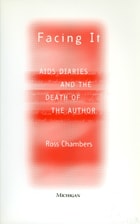
Facing It
AIDS Diaries and the Death of the AuthorRoss Chambers
University of Michigan Press, 2001
"Groundbreaking in its approach and potentially wide in its appeal. . . . The rigor of the ideas, their dramatic nature, and the political drive of the rhetoric all should win Facing It a large readership that could extend far beyond students of narrative or queer theory." --David Bergman, Towson University, editor of Camp Grounds: Style and Homosexuality
Ross Chambers is Distinguished University Professor of French and Comparative Literature, University of Michigan, and author of Room for Maneuver: Reading (the) Oppositional (in) Narrative and Story and Situation: Narrative Seduction and the Power of Fiction.
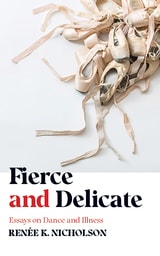
Fierce and Delicate
Essays on Dance and IllnessRenée K. Nicholson
West Virginia University Press, 2021
Renée Nicholson’s professional training in ballet had both moments of magnificence and moments of torment, from fittings of elaborate platter tutus to strange language barriers and unrealistic expectations of the body. In Fierce and Delicate, she looks back on the often confused and driven self she had been shaped into—always away from home, with friends who were also rivals, influenced by teachers in ways sometimes productive and at other times bordering on sadistic—and finds beauty in the small roles she performed. When, inevitably, Nicholson moved on from dancing, severed from her first love by illness, she discovered that she retained the lyricism and narrative of ballet itself as she negotiated life with rheumatoid arthritis.
An intentionally fractured memoir-in-essays, Fierce and Delicate navigates the traditional geographies of South Florida, northern Michigan, New York City, Milwaukee, West Virginia, and also geographies of the body—long, supple limbs; knee replacements; remembered bodies and actual. It is a book about the world of professional dance and also about living with chronic disease, about being shattered yet realizing the power to assemble oneself again, in a new way.
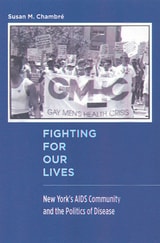
Fighting For Our Lives
New York's AIDS Community and the Politics of DiseaseChambré, Susan M
Rutgers University Press, 2006
In the first decade of the AIDS epidemic, New York City was struck like no other. By the early nineties, it was struggling with more known cases than the next forty most infected cities, including San Francisco, combined.
Fighting for Our Lives is the first comprehensive social history of New York's AIDS community-a diverse array of people that included not only gay men, but also African Americans, Haitians, Latinos, intravenous drug users, substance abuse professionals, elite supporters, and researchers. Looking back over twenty-five years, Susan Chambré focuses on the ways that these disparate groups formed networks of people and organizations that-both together and separately-supported persons with AIDS, reduced transmission, funded research, and in the process, gave a face to an epidemic that for many years, whether because of indifference, homophobia, or inefficiency, received little attention from government or health care professionals.
Beyond the limits of New York City, and even AIDS, this case study also shows how any epidemic provides a context for observing how societies respond to events that expose the inadequacies of their existing social and institutional arrangements. By drawing attention to the major faults of New York's (and America's) response to a major social and health crisis at the end of the twentieth century, the book urges more effective and sensitive actions-both governmental and civil-in the future.
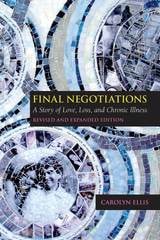
Final Negotiations
A Story of Love, Loss, and Chronic IllnessCarolyn Ellis
Temple University Press, 2018
Taking an autoethnographic perspective, Ellis focuses on her feeling and thinking self in relationships, narrating particular lived experiences that offer a gateway into understanding interpersonal and cultural life. In her new epilogue, “From New Endings to New Beginnings,” Ellis describes her changed identity and how Final Negotiations informs her life and her understanding of how she and her current partner grow older together. She hopes her book provides companionship and comfort to readers who also will suffer loss in their lives.
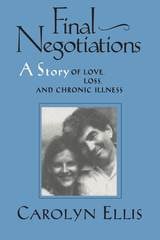
Final Negotiations
A Story of Love, and Chronic IllnessCarolyn Ellis
Temple University Press, 1995
When Carolyn Ellis, a graduate student, and Gene Weinstein, her Professor, fell in love, he was experiencing the first stages of emphysema. As he became increasingly disabled and immobile, these two intensely connected partners fought to maintain their love and to live a meaningful life. They learned to negotiate their daily lives in a way that enabled each of them to feel sufficiently autonomous—him not always like a patient and her not always like a caretaker. Writing as a sociologist, Ellis protrays their life together as a way to understand the complexities of romance, of living with a progressive illness, and, in the final negotiation and reversal of positions, of coping with the loss of a loved one.
This rare memoir full of often raw details and emotions becomes an intimate conversation about the intricacies of feeling and relating in a relationship. What Ellis calls experimental ethnography is a finely crafted, forthright, and daring story framed by the author's reflections on writing about and analyzing one's own life. Casting off the safe distance of most social science inquiry, she surrenders the private shroud of a complex relationship to bring sociology closer to literature.
First, Do No Harm
Power, Oppression, and Violence in HealthcareEdited by Nancy L. Diekelmann
University of Wisconsin Press, 2002
First, Do No Harm shows how health care professionals, with the best intentions of providing excellent, holistic health care, can nonetheless perpetuate violence against vulnerable patients. The essays investigate the need to rethink contemporary healthcare practices in ways that can bring the art and science of medicine back into sorely needed balance.
These ground-breaking studies by noted scholars question commonly held assumptions in contemporary healthcare that underlie oppressive power dynamics and even violence for patients and their families. The contributors discuss such topics as women and violence, life-support technologies, and healthcare professionals’ own experiences as patients. First, Do No Harm opens the discourse for reaching new understandings, from reassessing the meaning of "quality of life" to questioning the appropriateness of the very language used by healthcare professionals. It will be welcomed by healthcare workers and by scholars in nursing, medicine, and the allied health sciences.
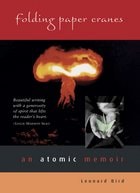
Folding Paper Cranes
An Atomic MemoirLeonard Bird
University of Utah Press, 2005
Among the monuments to tragedy and hope in Hiroshima’s Peace Park stands a statue of Sadako Sasaki holding a crane in her outstretched arms. Sadako was two years old when the atomic bomb was dropped on her city; she was diagnosed with leukemia ten years later. According to popular Japanese belief, folding a thousand paper cranes brings good fortune. Sadako spent the last months of her young life folding hundreds of paper cranes. She folded 644 before she died.
As he journeys from the Geiger counters, radioactive dust, and mushroom clouds of the Nevada desert to the bronze and ivory memorials for the dead in Japan, Bird—himself a survivor of radiation-induced cancer—seeks to make peace with his past and with a future shadowed by nuclear proliferation. His paper cranes are the poetry and prose of this haunting memoir.
Fractured Borders
Reading Women's Cancer LiteratureMary K. DeShazer
University of Michigan Press, 2010
Fractured Borders: Reading Women's Cancer Literature surveys a wide range of contemporary writing about breast, uterine, and ovarian cancer, including works by Marilyn Hacker, Margaret Edson, Carole Maso, Audre Lorde, Eve Sedgwick, Mahasweta Devi, Lucille Clifton, Alicia Ostriker, Jayne Anne Phillips, Terry Tempest Williams, and Jeanette Winterson, among many others. DeShazer's readings bring insights from body theory, performance theory, feminist literary criticism, French feminisms, and disability studies to bear on these works, shining new light on a literary subject that is engaging more and more writers.
"An important and useful book that will appeal to people in a variety of fields and walks of life, including scholars, teachers, and anyone interested in this subject."
--Suzanne Poirier, University of Illinois at Chicago
"A book on a timely and important topic, wisely written beyond scholarly boundaries and crossing many theoretical and disciplinary lines."
--Patricia Moran, University of California, Davis
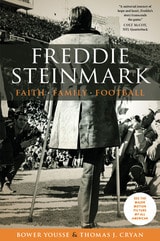
Freddie Steinmark
Faith, Family, FootballBy Bower Yousse and Thomas J. Cryan
University of Texas Press, 2015
Freddie Steinmark tells the story of a legendary University of Texas football player whose courage on the field and in battling cancer still inspires the Longhorn nation.
Freddie Steinmark started at safety for the undefeated University of Texas Longhorns in 1969. In the thrilling “Game of the Century,” a come-from-behind victory against Arkansas that ensured Texas the national championship, Steinmark played with pain in his left leg. Two days later, X-rays revealed a bone tumor so large that it seemed a miracle Steinmark could walk, let alone play football. Within a week of the Arkansas game, his leg was amputated.
A gritty, undersized player, Steinmark had quickly become a fan favorite at Texas. What he endured during the Longhorns’ memorable 1969 season, and what he encountered afterward, captivated not only Texans but the country at large. Americans watched closely as Steinmark confronted life’s ultimate challenge, and his openness during his battle against savage odds helped reframe the national conversation surrounding cancer and the ongoing race for a cure.
Written with unfettered access to the Steinmark family and archives, Freddie Steinmark: Faith, Family, Football is the exploration of a brief but full life, one that began humbly but ended on a grand stage. It is a fitting tribute to a legendary Longhorn whose photograph, emblazoned with the word “Heart,” flashes on the Freddie Steinmark Scoreboard’s Jumbotron prior to each home football game in UT’s Darrell K Royal–Texas Memorial Stadium at Joe Jamail Field.