Results by title
195 books match the query 'Pennsylvania' and 6 start with f
Falling Back
Incarceration and Transitions to Adulthood among Urban YouthFader, Jamie J
Rutgers University Press, 2013
Winner of the 2016 Outstanding Book for the Academy of Criminal Justice Science (ACJS)
2014 Scholarly Contribution Award from the Children and Youth Section of the American Sociological Association
Received an Honorable Mention for the American Sociological Association Race, Gender and Class Section's 2014 Distinguished Book Award
Named a 2013 Choice Outstanding Academic Title
Jamie J. Fader documents the transition to adulthood for a particularly vulnerable population: young inner-city men of color who have, by the age of eighteen, already been imprisoned. How, she asks, do such precariously situated youth become adult men? What are the sources of change in their lives?
Falling Back is based on over three years of ethnographic research with black and Latino males on the cusp of adulthood and incarcerated at a rural reform school designed to address “criminal thinking errors” among juvenile drug offenders. Fader observed these young men as they transitioned back to their urban Philadelphia neighborhoods, resuming their daily lives and struggling to adopt adult masculine roles. This in-depth ethnographic approach allowed her to portray the complexities of human decision-making as these men strove to “fall back,” or avoid reoffending, and become productive adults. Her work makes a unique contribution to sociological understandings of the transitions to adulthood, urban social inequality, prisoner reentry, and desistance from offending.
Family-Friendly Biking
in New Jersey and Eastern PennsylvaniaGoodspeed, Diane
Rutgers University Press, 2005
Through years of research and a lot of trial and error with her own two children, Diane Goodspeed gives us the first biking book for this region geared specifically toward families with young kids. Packed with photos and easy-to-follow maps, Goodspeed shows us where to find nearly twenty-five kid-friendly trails—trails that are not too steep or too long, do not encounter many roads, and provide ample access to food and restroom facilities.
You will find detailed information on popular New Jersey routes, including the Columbia Trail, Delaware & Raritan Canal Trail, Sussex Branch Trail, and Paulinskill Valley Trail, as well as undemanding rides through Duke Island Park, Hartshorne Woods, and Sandy Hook National Recreation Area. In eastern Pennsylvania, kids of all ages can peddle along the Lehigh Canal and the Delaware Canal and explore the many rambling paths of Tyler State Park.
These and many more rides are rated according to a child’s biking skills and each one is accompanied by detailed descriptions of the area. And because kids are always full of questions, Goodspeed includes a short history and interesting "did you know?" facts for each region. Tips on equipment options, bike safety, and the nearest bathrooms, playgrounds, and ice cream shops make this book the definitive source for kid-tested, parent-approved biking fun. It is an essential guide for planning the most enjoyable and rewarding family bike excursions.
Finished Business
My Fifty Years of Headlines, Heroes, and HeartachesRay Didinger
Temple University Press, 2021
Ray Didinger opens his lively memoir Finished Business with the Philadelphia Eagles’ upset win in Super Bowl LII. When the Eagles finally hoist the Lombardi Trophy, Didinger does his best to straddle the emotions of a working reporter and a long-suffering Philly fan. His ability to do that is why he has built up such a loyal following.
Didinger began following the Eagles as a kid, hanging out in his grandfather’s bar in Southwest Philadelphia. He spent his summers at the team's training camp in Hershey. It was there he met his idol, flanker Tommy McDonald. He would later write a play, Tommy and Me, about their friendship and his efforts to see McDonald enshrined in the Pro Football Hall of Fame.
Didinger has been covering the Eagles as a newspaper columnist or TV analyst since 1970. Over the years, he wrote sports for the Philadelphia Bulletin and the Philadelphia Daily News. He later produced Emmy Award–winning documentaries for NFL Films before transitioning to sports talk radio and TV analysis.
In five decades, across multiple media platforms, he has interviewed everyone from Hank Aaron, Wayne Gretzky, Muhammad Ali, Julius Erving, Jack Nicklaus, to Mike Schmidt, as well as writing film scripts for Hollywood stars such as Bruce Willis and Alec Baldwin. He went to the White House with the U.S. Olympic team and even explored the bizarre world of professional wrestling.
His stories, told in his familiar, breezy style, capture his enthusiasm for sports and his affection for the fans who still mourn the pennant that eluded the Phillies in 1964. Didinger has become synonymous with Philadelphia sports, and his memoir is as passionate as an autumn Sunday at Lincoln Financial Field.
From Home Guards to Heroes
The 87th Pennsylvania and Its Civil War CommunityDennis W. Brandt
University of Missouri Press, 2007
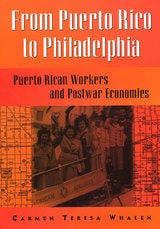
From Puerto Rico To Philadelphia
Puerto Rican Workers and Postwar EconomiesCarmen Whalen
Temple University Press, 2001
Puerto Rican migration to the mainland following World War II took place for a range of reasons -- globalization of the economy, the colonial relationship between the United States and Puerto Rico, state policies, changes in regional and local economies, social networks, and, not least, the decisions made by individual immigrants. In this wide-ranging book, Carmen Whalen weaves them all into a tapestry of Puerto Rican immigration to Philadelphia.
Like African Americans and Mexicans, Puerto Ricans were recruited for low-wage jobs, only to confront racial discrimination as well as economic restructuring. As Whalen shows, they were part of that wave of newcomers who came from areas in the Caribbean, Latin America, and Asia characterized by a heavy U.S. military and economic presence, especially export processing zones looking for a new life in depressed urban environments already populated by earlier labor migrants. But Puerto Rican in-migration was also unique, especially in its regional and gender dimensions. Many migrants came as part of contract labor programs shaped by competing agendas.
By the 1990s, economic conditions, government policies, and racial ideologies had transformed Puerto Rican labor migrants into what has been called "the other underclass." The author analyzes this continuation of "culture and poverty" interpretations and contrasts it with the efforts of Philadelphia's Puerto Ricans to recreate their communities and deal with the impact of economic restructuring and residential segregation in the City of Brotherly Love.
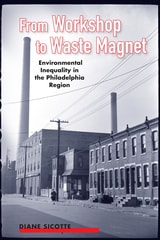
From Workshop to Waste Magnet
Environmental Inequality in the Philadelphia RegionSicotte, Diane
Rutgers University Press, 2016