Results by title
1427 books match the query 'Politics' and 55 start with f
Fabricating the People
Politics and Administration in the Biopolitical StateThomas J. Catlaw
University of Alabama Press, 2012
Fabricating the People boldly proposes post-representational governance that reframes the practice of modern democracy and reinvents the role of public administration.
Since the 1960s, hostility and mistrust toward the U.S. government has risen precipitously. At the same time, the field of public administration has wrestled with its own crisis of legitimacy. What is at the root of current antigovernment sentiment? Conventionally, two explanations for this problem persist. Some see it primarily in moral terms, a deficit of Constitutional or democratic values in government. Others emphasize government’s performance failures and managerial inefficiency.
Thomas J. Catlaw departs from both explanations in this groundbreaking study and demonstrates that the current crisis of government originates in the uncritical manner in which we have accepted the idea of “the People.” He contends that this unifying, foundational concept—and the notion of political representation it entails—have failed. While illuminating some of our most pressing social and political problems, Catlaw shows how the idea of the People, far from serving to unify, relies in fact on a distinctive logic of exclusion. True political power is the power to determine what constitutes the normal, natural life of the electorate. Today, the exclusionary practices that once made up or fabricated the People are increasingly contested. In turn, government and political power now appear more invasive, less legitimate, and our shared reality appears more fragmented and disconnected.
In order to address this crisis and reinvigorate democracy, Catlaw argues, we must accept as bankrupt the premise of the People and the idea of representation itself. Fabricating the People boldly proposes post-representational governance that reframes the practice of modern democracy and reinvents the role of public administration.
Facing the Planetary
Entangled Humanism and the Politics of SwarmingWilliam E. Connolly
Duke University Press, 2017
Faith and Resistance
The Politics of Love and War in LebanonSarah Marusek
Pluto Press, 2018

Faithful Renderings
Jewish-Christian Difference and the Politics of TranslationNaomi Seidman
University of Chicago Press, 2006
Bringing together central issues in translation studies with episodes in Jewish–Christian history, Naomi Seidman considers a range of texts, from the Bible to Elie Wiesel’s Night, delving into such controversies as the accuracy of various Bible translations, the medieval use of converts from Judaism to Christianity as translators, the censorship of anti-Christian references in Jewish texts, and the translation of Holocaust testimony. Faithful Renderings ultimately reveals that translation is not a marginal phenomenon but rather a crucial issue for understanding the relations between Jews and Christians and indeed the development of each religious community.

Fall Guys
False Confessions and the Politics of MurderJim Fisher
Southern Illinois University Press, 1996
Jim Fisher, criminal justice professor and former FBI agent, reveals how he uncovered the framing of two boys in a pair of unrelated murders committed in 1956 and 1958.
In the first of the cases, eleven-year-old Charlie Zubryd confessed that at the age of eight, he had murdered his widowed mother by driving a hatchet into her skull. The crime was committed in the basement of the modest Zubryd home in a rural section of Sewickley Township in western Pennsylvania, an area not far from Pittsburgh. Following intense police questioning, young Zubryd confessed to the crime in March 1959, a full twenty-eight months after the bloody murder of his mother.
Too young to prosecute, Charlie Zubryd was adopted after his confession and a brief stay in a mental ward. A childless couple gave Zubryd a new name and identity. It would be twenty years before Charlie Zubryd—now going by the name Chuck Duffy—would have any contact with his biological family.
When Zubryd/Duffy made an effort to get his real family back, he was rejected because his relatives still believed he had murdered his mother. In fact, until Fisher began to investigate the case in 1989, Chuck Duffy himself was not sure he had not killed his mother during some kind of mental blackout.
The second murder occurred in 1958, two years after the Zubryd case. Thirteen-year-old Jerry Pacek endured forty-one hours of police grilling before he confessed to raping and killing fifty-year-old Lillian Steveck as she walked home one evening from a bus stop in Breckenridge, Pennsylvania. Pacek told the same Allegheny County homicide detective who had framed Charlie Zubryd that he had killed the woman with a variety of blunt objects, none of which were ever found. The thirteen-year-old boy was tried and convicted of the murder the following spring. He was sent to Camp Hill Prison, where he remained incarcerated for ten years.
Fisher’s investigation cleared the names of both the wrongfully accused boys. Because of his investigation, the Zubryd case was reopened, which led to the identification of a vicious killer. In 1991, Fisher’s investigative efforts convinced the governor of Pennsylvania to grant a full pardon to Jerry Pacek, who as a teenager had served ten years in an adult prison for a murder he had not committed.
Jim Fisher and the Zubryd and Pacek stories have been featured on a number of nationally broadcast television programs.

Familial Forms
Politics and Genealogy in Seventeenth-Century English LiteratureErin Murphy
University of Delaware Press, 2011
Familial Forms is the first full-length study to examine how literary writers engaged the politics of genealogy that helped define the “century of revolution.” By demonstrating how conflicts over the family-state analogy intersected with the period’s battles over succession, including: the ascent of James I, the execution of Charles I, disputes over the terms of the Interregnum government, the Restoration of Charles II, the Exclusion Crisis, the deposition of James II, the ascent of William and Mary, and Anne’s failure to produce a surviving heir, this study provides a new map of the seventeenth-century politics of family in England. Beginning with a reconsideration of Jacobean patriarchalism, Familial Forms focuses on the work of John Milton, Lucy Hutchinson, John Dryden, and Mary Astell. From their contrasting political and gendered positions, these authors contemplated and contested the relevance of marriage and kinship to government. Their writing illuminates two crucial elements of England’s conflicts. First, the formal qualities of poems and prose tracts reveal that not only was there a competition among different versions of the family-state analogy, but also a competition over its very status as an analogy. Second, through their negotiations of linear and nonlinear forms, Milton, Hutchinson, Dryden, and Astell demonstrate the centrality of temporality to the period’s political battles.
Through close textual analysis of poetry, political tracts, parliamentary records, and nonliterary genealogies, Familial Forms offers a fresh understanding of the seventeenth-century politics of genealogy. It also provides new answers to long-standing critical questions about the poetic form of canonical works, such as Paradise Lost and Absalom and Achitophel, and illuminates the political significance of newly-canonical works by women writers, including Aemilia Lanyer’s Salve Deus Rex Judaeoreum, Hutchinson’s Order and Disorder, and Astell’s A Serious Proposal to the Ladies.
Published by University of Delaware Press. Distributed worldwide by Rutgers University Press.
Family Activism
Immigrant Struggles and the Politics of NoncitizenshipPallares, Amalia
Rutgers University Press, 2014
Fascism Comes to America
A Century of Obsession in Politics and CultureBruce Kuklick
University of Chicago Press, 2022
From the time Mussolini took power in Italy in 1922, Americans have been obsessed with and brooded over the meaning of fascism and how it might migrate to the United States. Fascism Comes to America examines how we have viewed fascism overseas and its implications for our own country. Bruce Kuklick explores the rhetoric of politicians, who have used the language of fascism to smear opponents, and he looks at the discussions of pundits, the analyses of academics, and the displays of fascism in popular culture, including fiction, radio, TV, theater, and film. Kuklick argues that fascism has little informational meaning in the United States, but instead, it is used to denigrate or insult. For example, every political position has been besmirched as fascist. As a result, the term does not describe a phenomenon so much as it denounces what one does not like. Finally, in displaying fascism for most Americans, entertainment—and most importantly film—has been crucial in conveying to citizens what fascism is about. Fascism Comes to America has been enhanced by many illustrations that exhibit how fascism was absorbed into the US public consciousness.
Fascism Comes to America
A Century of Obsession in Politics and CultureBruce Kuklick
University of Chicago Press, 2022
A deeply relevant look at what fascism means to Americans.
From the time Mussolini took power in Italy in 1922, Americans have been obsessed with and brooded over the meaning of fascism and how it might migrate to the United States. Fascism Comes to America examines how we have viewed fascism overseas and its implications for our own country. Bruce Kuklick explores the rhetoric of politicians, who have used the language of fascism to smear opponents, and he looks at the discussions of pundits, the analyses of academics, and the displays of fascism in popular culture, including fiction, radio, TV, theater, and film. Kuklick argues that fascism has little informational meaning in the United States, but instead, it is used to denigrate or insult. For example, every political position has been besmirched as fascist. As a result, the term does not describe a phenomenon so much as it denounces what one does not like. Finally, in displaying fascism for most Americans, entertainment—and most importantly film—has been crucial in conveying to citizens what fascism is about. Fascism Comes to America has been enhanced by many illustrations that exhibit how fascism was absorbed into the US public consciousness.

Fashion Knowledge
Theories, Methods, Practices and PoliticsEdited by Elke Gaugele and Monica Titton
Intellect Books, 2024
At a point when fashion studies are expanding and the fashion industry is at a crucial point of change, Fashion Knowledge makes a valuable contribution to the field. The book explores current issues in fashion research, with a focus on the relationship between theory and practice. This edited collection assembles academic essays and intellectual activism next to visual essays and artistic interventions, proposing a different concept for fashion research that eschews the traditional logic of academic fashion studies. It features acclaimed designers, artists, curators, and theorists whose work investigates the multi-faceted debates on the rise of practice-based research in fashion. Contributors look at new forms of fashion knowledge that are forming along with shifting practices, shedding light on the entanglement of fashion and politics in both contemporary and historical moments.
Fashioning Lives
Black Queers and the Politics of LiteracyEric Darnell Pritchard
Southern Illinois University Press, 2017
Winner, Lavender Rhetorics Award for Excellence in Queer Scholarship from CCCC, 2018
Winner, Advancement of Knowledge Award from CCCC, 2018
Winner, Outstanding Book Award from the Conference on Community Writing, 2017
Fashioning Lives: Black Queers and the Politics of Literacy analyzes the life stories of sixty Black lesbian, gay, bisexual, transgender, and queer (LGBTQ) people along with archival documents, literature, and film. Author Eric Darnell Pritchard provides a theoretical framework for studying the literacy work of Black LGBTQ people, who do not fit into the traditional categories imposed on their language practices and identities. Examining the myriad ways literacy is used to inflict harm, Pritchard discusses how these harmful events prompt Black LGBTQ people to ensure their own survival by repurposing literacy through literacy performances fueled by accountability to self and communal love towards social and political change, a process the author calls “restorative literacies.” Pritchard highlights restorative literacies in literacy institutions (e.g., libraries, schools), historical records repositories, religious and spiritual spaces, parties, community events, activist organizations, and digital spheres. This trailblazing study draws connections between race and queerness in literacy, composition, and rhetoric and provides the basis for a sustainable dialogue on their intersections in the discipline.
Fear Of A Queer Planet
Queer Politics and Social TheoryMichael Warner
University of Minnesota Press, 1993
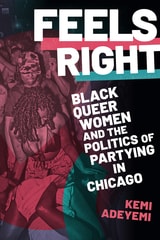
Feels Right
Black Queer Women and the Politics of Partying in ChicagoKemi Adeyemi
Duke University Press, 2022
Duke University Press Scholars of Color First Book Award recipient
Feminism and the Politics of Childhood
Friends or Foes?Edited by Rachel Rosen and Katherine Twamley
University College London, 2018
Feminism
A Brief Introduction to the Ideas, Debates, and Politics of the MovementDeborah Cameron
University of Chicago Press, 2019
In the era of #MeToo, Trump, and online harassment, innovative progressive feminist voices are more essential than ever. With her latest book, Deborah Cameron considers feminism from all sides—as an idea, as a theoretical approach, and as a political movement. Written in the succinct, sharp style that has made Cameron’s feminist linguistics blog so popular, this short book lays out past and present debates on seven key topics: domination, rights, work, femininity, sex, culture, and the future. Feminism emphasizes the diversity of feminist thought, including queer, women-of-color, and trans perspectives. Cameron’s clear and incisive account untangles the often confusing strands of one of history’s most important intellectual and political movements.
Broad in scope but refreshingly concise, this book is perfect for anyone who needs a straightforward primer on the complex history of feminism, a nuanced explanation of key issues and debates, or strategic thinking about the questions facing activists today.
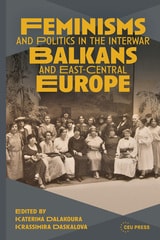
Feminisms and Politics in the Interwar Balkans and East-Central Europe
Katerina Dalakoura
Central European University Press, 2026
Feminist Morality
Transforming Culture, Society, and PoliticsVirginia Held
University of Chicago Press, 1993
Feminist Morality makes a vital contribution to the ongoing debate in feminist theory on the importance of motherhood. For philosophers and other readers outside feminist theory, it offers a feminist moral and social critique in clear and accessible terms.

Fertile Matters
The Politics of Mexican-Origin Women's ReproductionBy Elena R. Gutiérrez
University of Texas Press, 2008
While the stereotype of the persistently pregnant Mexican-origin woman is longstanding, in the past fifteen years her reproduction has been targeted as a major social problem for the United States. Due to fear-fueled news reports and public perceptions about the changing composition of the nation's racial and ethnic makeup—the so-called Latinization of America—the reproduction of Mexican immigrant women has become a central theme in contemporary U. S. politics since the early 1990s.
In this exploration, Elena R. Gutiérrez considers these public stereotypes of Mexican American and Mexican immigrant women as "hyper-fertile baby machines" who "breed like rabbits." She draws on social constructionist perspectives to examine the historical and sociopolitical evolution of these racial ideologies, and the related beliefs that Mexican-origin families are unduly large and that Mexican American and Mexican immigrant women do not use birth control.
Using the coercive sterilization of Mexican-origin women in Los Angeles as a case study, Gutiérrez opens a dialogue on the racial politics of reproduction, and how they have developed for women of Mexican origin in the United States. She illustrates how the ways we talk and think about reproduction are part of a system of racial domination that shapes social policy and affects individual women's lives.

Fiction Beyond Secularism
Justin Neuman
Northwestern University Press, 2014
Modernist thinkers once presumed a progressive secularity, with the novel replacing religious texts as society’s moral epics. Yet religion—beginning with the Iranian revolution of 1979, through the collapse of communism, and culminating in the singular rupture of September 11, 2001—has not retreated quietly out of sight.
In Fiction Beyond Secularism, Justin Neuman argues that contemporary novelists who are most commonly identified as antireligious—among them Orhan Pamuk, Salman Rushdie, Ian McEwan, Margaret Atwood, Nadine Gordimer, Haruki Murakami, and J. M. Coetzee—have defied assumptions and have instead written some of the most trenchant critiques of secular ideologies, as well as the most exciting and rigorous inquiries into the legacies of the religious imagination. As a result, many readers (or nonreaders) on either side of the religious divide neglect the insights of works like The Satanic Verses, Disgrace, and Snow. Fiction Beyond Secularism serves as a timely corrective.

Fictional Environments
Mimesis, Deforestation, and Development in Latin AmericaVictoria Saramago
Northwestern University Press, 2021
Winner of the Brazilian Studies Association’s Roberto Reis Book Award for First Monograph • Honorable Mention for the Latin American Studies Association’s Antonio Candido Book Award • Shortlisted for the Association for the Study of Literature and Environment Book Award
Fictional Environments: Mimesis, Deforestation, and Development in Latin America investigates how fictional works have become sites for the production of knowledge, imagination, and intervention in Latin American environments. It investigates the dynamic relationship between fictional images and real places, as the lasting representations of forests, rural areas, and deserts in novels clash with collective perceptions of changes like deforestation and urbanization.
From the backlands of Brazil to a developing Rio de Janeiro, and from the rainforests of Venezuela and Peru to the Mexican countryside, rapid deforestation took place in Latin America in the second half of the twentieth century. How do fictional works and other cultural objects dramatize, resist, and intervene in these ecological transformations? Through analyses of work by João Guimarães Rosa, Alejo Carpentier, Juan Rulfo, Clarice Lispector, and Mario Vargas Llosa, Victoria Saramago shows how novels have inspired conservationist initiatives and offered counterpoints to developmentalist policies, and how environmental concerns have informed the agendas of novelists as essayists, politicians, and public intellectuals. This book seeks to understand the role of literary representation, or mimesis, in shaping, sustaining, and negotiating environmental imaginaries during the deep, ongoing transformations that have taken place from the 1950s to the present.
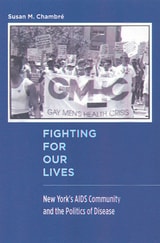
Fighting For Our Lives
New York's AIDS Community and the Politics of DiseaseChambré, Susan M
Rutgers University Press, 2006
In the first decade of the AIDS epidemic, New York City was struck like no other. By the early nineties, it was struggling with more known cases than the next forty most infected cities, including San Francisco, combined.
Fighting for Our Lives is the first comprehensive social history of New York's AIDS community-a diverse array of people that included not only gay men, but also African Americans, Haitians, Latinos, intravenous drug users, substance abuse professionals, elite supporters, and researchers. Looking back over twenty-five years, Susan Chambré focuses on the ways that these disparate groups formed networks of people and organizations that-both together and separately-supported persons with AIDS, reduced transmission, funded research, and in the process, gave a face to an epidemic that for many years, whether because of indifference, homophobia, or inefficiency, received little attention from government or health care professionals.
Beyond the limits of New York City, and even AIDS, this case study also shows how any epidemic provides a context for observing how societies respond to events that expose the inadequacies of their existing social and institutional arrangements. By drawing attention to the major faults of New York's (and America's) response to a major social and health crisis at the end of the twentieth century, the book urges more effective and sensitive actions-both governmental and civil-in the future.
Fighting Over There
U.S. War Making and Contemporary Refugee LiteratureAlaina Kaus
University of Massachusetts Press, 2023
U.S. foreign policy has long been built on a dichotomy of an irreplaceable “here” and an expendable “there.” In his 2003 announcement of the military campaign in Iraq, George W. Bush declared that we would fight in the Middle East so we wouldn’t have to fight “on the streets of our cities.” But what do the millions of people who live over “there” have to say about U.S. interventions and the displacement they provoke?
In this pathbreaking study, Alaina Kaus analyzes literature by and about refugees who fled Southeast Asia, Central America, the Caribbean, North Africa, and the Middle East, in the wake of U.S. military occupation and economic intervention. Narratives by authors such as Lan Cao, Viet Thanh Nguyen, Demetria Martínez, Héctor Tobar, Dave Eggers, Mohsin Hamid, and Riverbend reveal contradictions in the human rights pledges that undergird U.S. foreign policy, which promote freedom while authorizing intervention and displacement, and favor market-based solutions over social justice and racial equality.
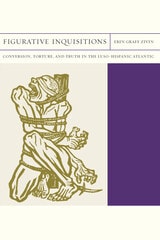
Figurative Inquisitions
Conversion, Torture, and Truth in the Luso-Hispanic AtlanticErin Graff Zivin
Northwestern University Press, 2014
Winner, 2015 LAJSA Best Book in Latin American Jewish Studies
The practices of interrogation, torture, and confession have resurfaced in public debates since the early 2000s following human rights abuses around the globe. Yet discussion of torture has remained restricted to three principal fields: the legal, the pragmatic, and the moral, eclipsing the less immediate but vital question of what torture does.Figurative Inquisitions seeks to correct this lacuna by approaching the question of torture from a literary vantage point.
This book investigates the uncanny presence of the Inquisition and marranismo (crypto-Judaism) in modern literature, theater, and film from Mexico, Brazil, and Portugal. Through a critique of fictional scenes of interrogation, it underscores the vital role of the literary in deconstructing the relation between torture and truth. Figurative Inquisitions traces the contours of a relationship among aesthetics, ethics, and politics in an account of the "Inquisitional logic" that continues to haunt contemporary political forms. In so doing, the book offers a unique humanistic perspective on current torture debates.
Figures of the World
The Naturalist Novel and Transnational FormChristopher Laing Hill
Northwestern University Press, 2020
The book begins by tracing the history of naturalist fiction from the 1860s into the twentieth century and the reasons it spread around the world. Hill explores the development of three naturalist figures—the degenerate body, the self-liberated woman, and the social milieu—through close readings of fiction from France, Japan, and the United States. Rather than genealogies of European influence or the domination of cultural “peripheries” by the center, novels by Émile Zola, Tayama Katai, Frank Norris, and other writers reveal conspicuous departures from metropolitan models as writers revised naturalist methods to address new social conditions. Hill offers a new approach to studying culture on a large scale for readers interested in literature, the arts, and the history of ideas.
Figuring Jerusalem
Politics and Poetics in the Sacred CenterSidra DeKoven Ezrahi
University of Chicago Press, 2022
For two thousand years, Hebrew writers used their exile from the Holy Land as a license for invention. The question at the heart of Figuring Jerusalem is this: how did these writers bring their imagination “home” in the Zionist century? Sidra DeKoven Ezrahi finds that the same diasporic conventions that Hebrew writers practiced in exile were maintained throughout the first half of the twentieth century. And even after 1948, when the state of Israel was founded but East Jerusalem and its holy sites remained under Arab control, Jerusalem continued to figure in the Hebrew imagination as mediated space. It was only in the aftermath of the Six Day War that the temptations and dilemmas of proximity to the sacred would become acute in every area of Hebrew politics and culture.
Figuring Jerusalem ranges from classical texts, biblical and medieval, to the post-1967 writings of S. Y. Agnon and Yehuda Amichai. Ultimately, DeKoven Ezrahi shows that the wisdom Jews acquired through two thousand years of exile, as inscribed in their literary imagination, must be rediscovered if the diverse inhabitants of Jerusalem are to coexist.
Financial Missionaries to the World
The Politics and Culture of Dollar Diplomacy, 1900-1930Emily S. Rosenberg
Duke University Press, 2003
Financial Missionaries to the World establishes the broad scope and significance of "dollar diplomacy"—the use of international lending and advising—to early-twentieth-century U.S. foreign policy. Combining diplomatic, economic, and cultural history, the distinguished historian Emily S. Rosenberg shows how private bank loans were extended to leverage the acceptance of American financial advisers by foreign governments. In an analysis striking in its relevance to contemporary debates over international loans, she reveals how a practice initially justified as a progressive means to extend “civilization” by promoting economic stability and progress became embroiled in controversy. Vocal critics at home and abroad charged that American loans and financial oversight constituted a new imperialism that fostered exploitation of less powerful nations. By the mid-1920s, Rosenberg explains, even early supporters of dollar diplomacy worried that by facilitating excessive borrowing, the practice might induce the very instability and default that it supposedly worked against.
Fixing Illinois
Politics and Policy in the Prairie StateJim Nowlan and J. Thomas Johnson
University of Illinois Press, 2014
- An overhaul of state pension systems that includes more reasonable benefits and raising of the retirement age, among other changes;
- Broadening of the tax base to include services and reductions in rates;
- Raising funds with capital construction bonds to update and integrate the antiquated information systems used by state agencies;
- Uprooting the state's entrenched culture of corruption via public financing of elections, redistricting reform, and revolving door prohibitions for lawmakers
Pointed, honest, and pragmatic, Fixing Illinois is a plan for effective and honest government that seeks an even nobler end: restoring our faith in Illinois's institutions and reviving a sense of citizenship and state pride.
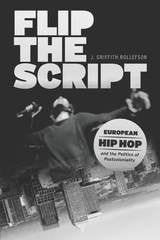
Flip the Script
European Hip Hop and the Politics of PostcolonialityJ. Griffith Rollefson
University of Chicago Press, 2017
Through analysis of recorded music and other media, as well as interviews and fieldwork with hip hop communities, J. Griffith Rollefson shows how this music created by black Americans is deployed by Senegalese Parisians, Turkish Berliners, and South Asian Londoners to both differentiate themselves from and relate themselves to the dominant culture. By listening closely to the ways these postcolonial citizens in Europe express their solidarity with African Americans through music, Rollefson shows, we can literally hear the hybrid realities of a global double consciousness.

Food Allergy Advocacy
Parenting and the Politics of CareDanya Glabau
University of Minnesota Press, 2022
A detailed exploration of parents’ fight for a safe environment for their kids, interrogating how race, class, and gender shape health advocacy
The success of food allergy activism in highlighting the dangers of foodborne allergens shows how illness communities can effectively advocate for the needs of their members. In Food Allergy Advocacy, Danya Glabau follows parents and activists as they fight for allergen-free environments, accurate labeling, the fair application of disability law, and access to life-saving medications for food-allergic children in the United States. At the same time, she shows how this activism also reproduces the culturally dominant politics of personhood and responsibility, based on an idealized version of the American family, centered around white, middle-class, and heteronormative motherhood.
By holding up the threat of food allergens to the white nuclear family to galvanize political and scientific action, Glabau shows, the movement excludes many, including Black women and disabled adults, whose families and health have too often been marginalized from public health and social safety net programs. Further, its strategies are founded on the assumption that market-based solutions will address issues of social exclusion and equal access to healthcare.
Sharing the personal experiences of a wide spectrum of people, including parents, support group leaders, physicians, entrepreneurs, and scientists, Food Allergy Advocacy raises important questions about who controls illness activism. Using critical, intersectional feminism to interrogate how race, class, and gender shape activist priorities and platforms, it shows the way to new, justice-focused models of advocacy.

Food for Change
The Politics and Values of Social MovementsJeff Pratt and Pete Luetchford
Pluto Press, 2013
Concern about our food system is growing, from the costs of industrial farming to the dominant role of supermarkets and recurring scandals about the origins and content of what we eat.
Food for Change documents the way alternative food movements respond to these concerns by trying to create more closed economic circuits within which people know where, how, and by whom their food is produced.
Jeff Pratt, Peter Luetchford and other contributors explore the key political and economic questions of food through the everyday experience and vivid insights of farmers and consumers, using fieldwork from case studies in four European countries (France, Spain, Italy and England). Food for Change is an insightful consideration of connections between food and wider economic relations and draws on a rich vein of anthropological writing on the topic.
Form and Instability
Eastern Europe, Literature, Postimperial DifferenceAnita Starosta
Northwestern University Press, 2015
Located at the intersection of comparative literature, area studies, and literary theory, this interdisciplinary study has a twofold commitment: to Eastern Europe on the one hand and to literature on the other. It aims to intervene in the way we conceive of Eastern Europe by seeking to develop a more equitable way of thinking, one that avoids subordinating it to Eurocentric narratives of progress. At the same time, it marshals literature as both object and method of this rethinking, in order to extend existing conceptions of the usefulness and of the proper organization of literary studies. The three terms in the title of this book mark a passage—via literature—from “Eastern Europe” as an inadequate and obsolescent category to “post-imperial difference” as a more accurate, if provisional, account of the region. By way of original readings of particular texts, and by attending to literature as a critical
Forms of Mobility
Genre, Language, and Media in African Literary CulturesStephanie Bosch Santana
Northwestern University Press, 2025
Presents alternative categories of fiction through which to examine how contemporary writers have envisaged Africa’s changing literary terrains
Stephanie Bosch Santana analyzes southern African writers’ experimentations with literary form in periodical print and digital media since the mid-twentieth century in order to offer an alternative account of contemporary African imaginations of mobility. Based on an understudied archive of texts in English and Chichewa/Nyanja from Malawi, South Africa, Zimbabwe, and Zambia, Forms of Mobility: Genre, Language, and Media in African Literary Cultures examines new, noncanonical categories of fiction, including migrant forms, township tales, weekend stories, and digital diaries. These generically, linguistically, and geographically mobile forms map changing ideas of interconnection and belonging. By reading them “in motion,” as they travel across space, time, genre, and language and between publications and platforms, Bosch Santana limns multiple centers of literary influence and relation across southern African and Black diasporas, revealing forms of literary mobility and space making that are occluded by current models of world literature.
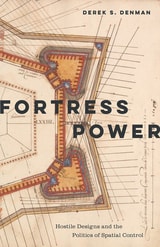
Fortress Power
Hostile Designs and the Politics of Spatial ControlDerek S. Denman
University of Minnesota Press, 2025
A compelling treatise on the relationship between power and enclosure
Fortress Power presents a genealogy of fortification as a material and political technology intent on obstruction, tracing its implementation across battlefields, borders, and urban environments. Drawing on the influential work of philosophers Michel Foucault and Giorgio Agamben, Derek S. Denman places the fortress alongside the archetypes of the prison and the camp, citing them as paradigmatic of how space is transformed into a tool of domination and control.
Focusing on the defensive architecture of bastion fortresses, urban design, and border landscapes, Fortress Power charts the rise of a form of governance grounded in hostility, extending the scope of its subject from a piece of military construction to a much broader political concept. Detailing how power manifests in everything from city centers to international boundaries, the book analyzes the logic of fortification as it moves through various contexts in the advancement of surveillance, exploitation, warfare, and political authority.
Through a unique blend of architecture and design studies, political theory, international relations, geography, and migration studies, Denman outlines the disquieting legacy of the fortress to highlight its role in the formation of modern government and the enactment of violence. In an era marked by the increasing prevalence of authoritarian power and conflicting geopolitical boundaries, he presents an insightful investigation of the weaponization of the built environment.
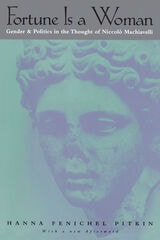
Fortune Is a Woman
Gender and Politics in the Thought of Niccolo MachiavelliHanna Fenichel Pitkin
University of Chicago Press, 1999
Hanna Pitkin's provocative and enduring study of Machiavelli was the first to systematically place gender at the center of its exploration of his political thought. In this edition, Pitkin adds a new afterword, in which she discusses the book's critical reception and situates the book's arguments in the context of recent interpretations of Machiavelli's thought.
"A close and often brilliant exegesis of Machiavelli's writings."—The American Political Science Review
Foucault's Discipline
The Politics of SubjectivityJohn S. Ransom
Duke University Press, 1997
Foucault’s Discipline demonstrates how Foucault’s valorization of descriptive critique over prescriptive plans of action can be applied to the decisively altered political landscape of the end of this millennium. By reconstructing the philosopher’s arguments concerning the significance of disciplinary institutions, biopower, subjectivity, and forms of resistance in modern society, Ransom shows how Foucault has provided a different way of looking at and responding to contemporary models of government—in short, a new depiction of the political world.
Foucault, Politics, and Violence
Johnanna Oksala
Northwestern University Press, 2012
Fragmenting Globalization
The Politics of Preferential Trade Liberalization in China and the United StatesKa Zeng and Xiaojun Li
University of Michigan Press, 2021
Fragmenting Globalization uses multiple methods, including time series, cross-sectional analysis of the pattern of Preferential Trade Alliance formation by existing World Trade Organization members, a firm-level survey, and case studies of the pattern of corporate support for regional trade liberalization in both China and the United States. Zeng and Li show that the growing fragmentation of global production, trade, and investment is altering trade policy away from the traditional divide between export-oriented and import-competing industries.
Framing Identities
Autobiography and the Politics of PedagogyWendy S. Hesford
University of Minnesota Press, 1999
A trenchant examination of the political dynamics of autobiography in education.
How do historically marginalized groups expose the partiality and presumptions of educational institutions through autobiographical acts? How are the stories we tell used to justify resistance to change or institutional complacency? These are the questions Wendy S. Hesford asks as she considers the uses of autobiography in educational settings. This book demonstrates how autobiographical acts-oral, written, performative, and visual-play out in vexed and contradictory ways and how in the academy they can become sites of cultural struggle over multicultural education, sexual harassment, institutional racism, hate speech, student activism, and commemorative practices.
Within the context of Oberlin, a small liberal arts college in Ohio, and beginning with a speak-out organized by Asian American students in 1995, this book looks at the uses of autobiographical practices in empowering groups traditionally marginalized in academic settings. Investigating the process of self-representation and the social, spatial, and discursive frames within which academic bodies and identities are constituted, Framing Identities explores the use of autobiographical acts in terms of power, influence, risks involved, and effectiveness. Hesford does not endorse autobiography as an unequivocal source of empowerment, however. Instead, she illustrates how autobiographical practices in the academy can mobilize competing and often irreconcilable interests. Hesford argues that by integrating self-reflection into cultural, rhetorical, and material analyses-and encouraging students to do the same-teachers not only will largely justify attention to the personal in the classroom, they will help their communities move beyond a naive identity politics. Framing Identities provides a model for teacher-researchers across the disciplines (education, English, composition, cultural studies, women’s studies, to name a few) to investigate the contradictory uses and consequences of autobiography at their own institutions, and to carve out new pedagogical spaces from which they and their students can emerge as social, political, and intellectual subjects.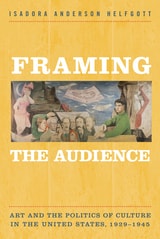
Framing the Audience
Art and the Politics of Culture in the United States, 1929-1945Isadora Helfgott
Temple University Press, 2015
Framing the Audience explores the cultural politics of the Great Depression and World War II through the prism of art appreciation. Isadora Helfgott interrogates the ideological and political motivations for breaking down barriers between fine art and popular culture. She charts the impact that changes in art appreciation had on the broader political, social, cultural, and artistic landscape.
Framing the Audience argues that efforts to expand the social basis of art became intertwined with—and helped shape—broader debates about national identity and the future of American political economy. Helfgott chronicles artists’ efforts toinfluence the conditions of artistic production and display. She highlights the influence of the Federal Art Project, the impact of the Museum of Modern Art as an institutional home for modernism in America and as an organizer of traveling exhibitions, and the efforts by LIFE and Fortune magazines to integrate art education into their visual record of modern life. In doing so, Helfgott makes critical observations about the changing relationship between art and the American public.

Francis Warrington Dawson and the Politics of Restoration
South Carolina, 1874-1889E. Culpepper Clark
University of Alabama Press, 1980
A revealing biography of a powerful Southern editor at the center of South Carolina’s post‑Reconstruction political transformation.
In the decades following the Civil War, South Carolina—like much of the South—struggled to redefine its political identity amid the collapse of Reconstruction and the rise of conservative “Redeemer” governments. In Francis Warrington Dawson and the Politics of Restoration, historian E. Culpepper Clark offers a deeply researched and incisive study of this transformation through the life and work of Francis Warrington Dawson, one of the state’s most influential newspaper editors.
Dawson was far more than a chronicler of events. As a powerful voice in South Carolina’s political press, he helped shape public opinion, broker alliances among conservative factions, and articulate the ideological foundations of post‑Reconstruction governance. Clark situates Dawson at the center of the struggles among Redeemers, Straight‑Out Democrats, agrarian reformers, and emerging political leaders such as Ben Tillman, revealing a political landscape marked by rivalry, class conflict, and competing visions of the New South.
Drawing on extensive manuscript collections, newspapers, and political correspondence, Clark explores the close relationship between journalism and power in the late nineteenth century and demonstrates how newspapers functioned as active political actors rather than neutral observers. The result is both a compelling political biography and a broader analysis of how restoration politics operated at the state level.
Francis Warrington Dawson and the Politics of Restoration is an essential work for readers interested in Southern history, Reconstruction and its aftermath, the history of American journalism, and the forces that shaped the political culture of the modern South.
Fraternal Critique
The Politics of Muslim Community in FranceKirsten Wesselhoeft
University of Chicago Press, 2025
The conversation about Islam in France is framed by the presumption that Muslim communities are a threat to secular solidarity or fraternité. In the face of state repression, French Muslims have not closed ranks around a narrow range of voices; instead, Kirsten Wesselhoeft finds that young Muslim activists have continued to purposefully spark debate about the values that anchor community life. Wesselhoeft argues that such disagreements, far from dividing communities, actually constitute a form of belonging. Some activists call this ethic “fraternal critique,” and Wesselhoeft finds in it profound insights about the place for critique in civic life. The French state has reacted to Muslim solidarity with repression, but Wesselhoeft argues that unity need not come at the expense of dissent. Instead, fraternal critique can teach us how to build communities that are worth fighting over and fighting for.

Friedrich Nietzsche and the Politics of Transfiguration (expanded ed.)
Tracy B. Strong
University of Illinois Press, 2000

Frigid Embrace
Politics, Economics, and Environment in AlaskaStephen Haycox
Oregon State University Press, 2002
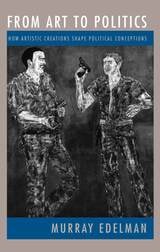
From Art to Politics
How Artistic Creations Shape Political ConceptionsMurray Edelman
University of Chicago Press, 1995
In this book, Edelman continues his quest to understand the influence of perception on the political process by turning to the role of art. He argues that political ideas, language, and actions cannot help but be based upon the images and narratives we take from literature, paintings, film, television, and other genres. Edelman believes art provides us with models, scenarios, narratives, and images we draw upon in order to make sense of political events, and he explores the different ways art can shape political perceptions and actions to both promote and inhibit diversity and democracy.
"Elegantly written. . . . He brilliantly contends that art helps create the images from which opinion-molders and citizens construct the social realities of politics."—Choice
"It is perhaps the freshness with which he puts his case that is what makes From Art to Politics, as well as his other works, so challenging and invigorating."—Philip Abbott, Review of Politics

From Class to Identity
The politics of education reforms in former YugoslaviaJana Bacevic
Central European University Press, 2014
From Identity To Politics
Lesbian & Gay Movements In The U.S.Craig Rimmerman
Temple University Press, 2001
Enriched by eight years of interviews in Washington, D.C. and New York City, and by the author's experience as a Capitol Hill staffer, From Identity to Politics will provoke discussion in classrooms and caucus rooms across the United States.

From Migrants to Refugees
The Politics of Aid along the Tanzania-Rwanda BorderJill Rosenthal
Duke University Press, 2023
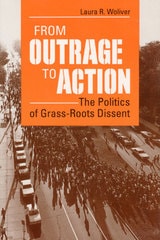
From Outrage to Action
The Politics of Grass-Roots DissentLaura R. Woliver
University of Illinois Press, 1993
Through in-depth interviews with activists, Laura Woliver examines these community actions, studying the groups involved and linking her conclusions to larger questions of political power and the impact of social movements. Her findings will make fascinating reading for those interested in the rise and fall of grass-roots interest groups, the nature of dissent, and the reasons why people volunteer countless hours, sometimes in the face of community opposition and isolation, to dedicate themselves to a cause. The ad hoc interest groups studied are the Committee to Recall Judge Archie Simonson (Madison), the Coalition for Justice for Ernest Lacy (Milwaukee), Concerned Citizens for Children (Grant County, Wisconsin), and Citizens Taking Action (Madison). Woliver relates the community responses in these cases to those in the Jeffrey Dahmer mass murder case and the beating by Los Angeles police of Rodney King.

From Politics to the Pews
How Partisanship and the Political Environment Shape Religious IdentityMichele F. Margolis
University of Chicago Press, 2018
Michele F. Margolis offers a bold challenge to the conventional wisdom, arguing that the relationship between religion and politics is far from a one-way street that starts in the church and ends at the ballot box. Margolis contends that political identity has a profound effect on social identity, including religion. Whether a person chooses to identify as religious and the extent of their involvement in a religious community are, in part, a response to political surroundings. In today’s climate of political polarization, partisan actors also help reinforce the relationship between religion and politics, as Democratic and Republican elites stake out divergent positions on moral issues and use religious faith to varying degrees when reaching out to voters.

From Utopia to Apocalypse
Science Fiction and the Politics of CatastrophePeter Y. Paik
University of Minnesota Press, 2010