Results by title
191 books match the query 'Politics and literature' and 5 start with f
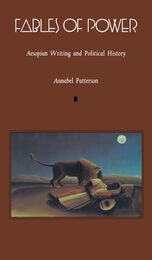
Fables of Power
Aesopian Writing and Political HistoryAnnabel Patterson
Duke University Press, 1991
In this imaginative and illuminating work, Annabel Patterson traces the origins and meanings of the Aesopian fable, as well as its function in Renaissance culture and subsequently. She shows how the fable worked as a medium of political analysis and communication, especially from or on behalf of the politically powerless.
Patterson begins with an analysis of the legendary Life of Aesop, its cultural history and philosophical implications, a topic that involves such widely separated figures as La Fontaine, Hegel, and Vygotsky. The myth’s origin is recovered here in the saving myth of Aesop the Ethiopian, black, ugly, who began as a slave but become both free and influential, a source of political wisdom. She then traces the early modern history of the fable from Caxton, Lydgate, and Henryson through the eighteenth century, focusing on such figures as Spenser, Sidney, Lyly, Shakespeare, and Milton, as well as the lesser-known John Ogilby, Sir Roger L’Estrange, and Samuel Croxall.
Patterson discusses the famous fable of The Belly and the Members, which, because it articulated in symbolic terms some of the most intransigent problems in political philosophy and practice, was still going strong as a symbolic text in the mid-nineteenth century, where it was focused on industrial relations by Karl Marx and by George Eliot against electoral reform.
[more]
Fictions of Land and Flesh
Blackness, Indigeneity, SpeculationMark Rifkin
Duke University Press, 2019
In Fictions of Land and Flesh Mark Rifkin explores the impasses that arise in seeking to connect Black and Indigenous movements, turning to speculative fiction to understand those difficulties and envision productive ways of addressing them. Against efforts to subsume varied forms of resistance into a single framework in the name of solidarity, Rifkin argues that Black and Indigenous political struggles are oriented in distinct ways, following their own lines of development and contestation. Rifkin suggests how movement between the two can be approached as something of a speculative leap in which the terms and dynamics of one are disoriented in the encounter with the other. Futurist fiction provides a compelling site for exploring such disjunctions. Through analyses of works by Octavia Butler, Walter Mosley, Nalo Hopkinson, Melissa Tantaquidgeon Zobel, and others, the book illustrates how ideas about fungibility, fugitivity, carcerality, marronage, sovereignty, placemaking, and governance shape the ways Black and Indigenous intellectuals narrate the past, present, and future. In turning to speculative fiction, Rifkin illustrates how speculation as a process provides conceptual and ethical resources for recognizing difference while engaging across it.
[more]
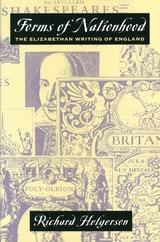
Forms of Nationhood
The Elizabethan Writing of EnglandRichard Helgerson
University of Chicago Press, 1992
What have poems and maps, law books and plays, ecclesiastical polemics and narratives of overseas exploration to do with one another? By most accounts, very little. They belong to different genres and have been appropriated by scholars in different disciplines. But, as Richard Helgerson shows in this ambitious and wide-ranging study, all were part of an extraordinary sixteenth- and seventeenth-century enterprise: the project of making England.
[more]
From Androboros to the First Amendment
A History of America's First PlayPeter A. Davis
University of Iowa Press, 2015
The story of America’s earliest extant play begins with a petty crime—a crime that would have passed largely unnoticed had it not been for one fact: it prompted a beleaguered royal governor of one of Britain’s colonies to lash out at his enemies by writing a biting satire. Androboros, A Bographical [sic] Farce in Three Acts (1715), is universally acknowledged as the first play both written and printed in America. Its significance stems not simply from its publication but from its eventual impact. The play inadvertently laid the foundation for one of the defining rights of the nation that would eventually emerge some seventy-five years later—the First Amendment of the Constitution of the United States, guaranteeing a free press and freedom of expression.
Androboros was not just the first of its kind, it was also ahead of its time in many ways, preceding the harsh political satires and farces of the later eighteenth century by some fifty years. Such plays served a small but essential role in promoting political thought among the colonists. Written by anonymous authors and passed from hand to hand, these short, crude, and often bawdy plays and dialogues were rarely acted due to their inflammatory lampoonery. Nevertheless, they provided an opportunity for disgruntled colonists to vent their grievances and promote their ideas to fellow citizens. The farces of the late eighteenth century drove home the meaning and message of the American Revolution.
Equally significant is that Androboros may have influenced a few of the key political discourses published in the 1730s, and these works in turn may well have shaped the future of the American political landscape for the next several decades and even into the modern era. But as a closet drama intended only to be read by close friends and political supporters, this play has languished as a minor footnote in American intellectual history. Scholarly research published to date has been, for the most part, inadequate and occasionally inaccurate. This study remedies that oversight, providing a full analysis as well as an annotated typescript and facsimiles of the original printing.
[more]

From Utopia to Apocalypse
Science Fiction and the Politics of CatastrophePeter Y. Paik
University of Minnesota Press, 2010
"I read Peter Y. Paik’s lucid, graceful, ruthless book in one single astonished sitting. I scarred it all over with arrows and exclamation points, so I can read it again as soon as possible." —Bruce Sterling
Revolutionary narratives in recent science fiction graphic novels and films compel audiences to reflect on the politics and societal ills of the day. Through character and story, science fiction brings theory to life, giving shape to the motivations behind the action as well as to the consequences they produce.
In From Utopia to Apocalypse, Peter Y. Paik shows how science fiction generates intriguing and profound insights into politics. He reveals that the fantasy of putting annihilating omnipotence to beneficial effect underlies the revolutionary projects that have defined the collective upheavals of the modern age. Paik traces how this political theology is expressed, and indeed literalized, in popular superhero fiction, examining works including Alan Moore and Dave Gibbons’s graphic novel Watchmen, the science fiction cinema of Jang Joon-Hwan, the manga of Hayao Miyazaki, Alan Moore’s V for Vendetta, and the Matrix trilogy. Superhero fantasies are usually seen as compensations for individual feelings of weakness, victimization, and vulnerability. But Paik presents these fantasies as social constructions concerned with questions of political will and the disintegration of democracy rather than with the psychology of the personal.
What is urgently at stake, Paik argues, is a critique of the limitations and deadlocks of the political imagination. The utopias dreamed of by totalitarianism, which must be imposed through torture, oppression, and mass imprisonment, nevertheless persist in liberal political systems. With this reality looming throughout, Paik demonstrates the uneasy juxtaposition of saintliness and cynically manipulative realpolitik, of torture and the assertion of human dignity, of cruelty and benevolence.
[more]