Results by title
138 books match the query 'Postcolonialism' and 5 start with f
For Emplacement
Political Ontology in Two ActsMario Blaser
Duke University Press, 2025
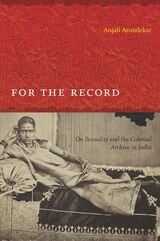
For the Record
On Sexuality and the Colonial Archive in IndiaAnjali Arondekar
Duke University Press, 2009
The logic and the interpretive resources of For the Record arise out of two entangled and minoritized historiographies: one in South Asian studies and the other in queer/sexuality studies. Focusing on late colonial India, Arondekar examines the spectacularization of sexuality in anthropology, law, literature, and pornography from 1843 until 1920. By turning to materials and/or locations that are familiar to most scholars of queer and subaltern studies, Arondekar considers sexuality at the center of the colonial archive rather than at its margins. Each chapter addresses a form of archival loss, troped either in a language of disappearance or paucity, simulacrum or detritus: from Richard Burton’s missing report on male brothels in Karáchi (1845) to a failed sodomy prosecution in Northern India, Queen Empress v. Khairati (1884), and from the ubiquitous India-rubber dildos found in colonial pornography of the mid-to-late nineteenth century to the archival detritus of Kipling’s stories about the Indian Mutiny of 1857.

France and Algeria
A History of Decolonization and TransformationPhillip Naylor
University of Texas Press, 2024
An examination of the complicated history between France and Algeria since the latter’s independence.
While most related studies concentrate on the colonial era and Algeria's War of Independence, France and Algeria details the nations' postcolonial relationship. Phillip Naylor provides a philosophical approach, contending that France reformulated, rather than repudiated, “essential” strategic values during decolonization. It thus continued to pursue grandeur and independence, especially with regard to the Third World and Algeria, an essentialism that expedited France’s postcolonial transformation. But as a new nation, Algeria needed to pursue the “existential” project of self-definition. It became involved in state-building while also promulgating socialism, and it recognized how French oil concessions in the Sahara impeded its independence, leading to the industry's postcolonial decolonization. Finally, the postcolonial relationship has featured a human dimension involving immigrants, pieds-noirs (colonial settlers), and harkis (Algerian soldiers loyal to France), all of them central to bilateral relations.
In this revised and updated edition of his seminal work, first published over twenty years ago, Naylor expands his coverage of the decolonization era, drawing on new information while continuing to study the ever-evolving relationship between the two countries. These new additions expose the continually shifting relations of power, perception, and identity between the two states.

Freak Performances
Dissidence in Latin American TheaterAnalola Santana
University of Michigan Press, 2018
From the Margins
Historical Anthropology and Its FuturesBrian Keith Axel, ed.
Duke University Press, 2002
In original articles encompassing a wide range of geographic and temporal locations, eminent scholars contest some of the primary preconceptions of their fields. The contributors tackle such topics as the paradoxical nature of American Civil War monuments, the figure of the “New Christian” in early seventeenth-century Peru, the implications of statistics for ethnography, and contemporary South Africa's “occult economies.” That anthropology and history have their provenance in—and have been complicit with—colonial formations is perhaps commonplace knowledge. But what is rarely examined is the specific manner in which colonial processes imbue and threaten the celebratory ideals of postcolonial reason or the enlightenment of today’s liberal practices in the social sciences and humanities.
By elaborating this critique, From the Margins offers diverse and powerful models that explore the intersections of historically specific local practices with processes of a world historical order. As such, the collection will not only prove valuable reading for anthropologists and historians, but also for scholars in colonial, postcolonial, and globalization studies.
Contributors. Talal Asad, Brian Keith Axel, Bernard S. Cohn, Jean Comaroff, John L. Comaroff, Nicholas B. Dirks, Irene Silverblatt, Paul A. Silverstein, Teri Silvio, Ann Laura Stoler, Michel-Rolph Trouillot